
The word values has several meanings, so the best synonym depends heavily on context. It can describe personal beliefs and principles, the worth or price of something, a numerical quantity, or the importance assigned to something. Because of these different meanings, replacing values with another word is not always as simple as choosing the closest word in a thesaurus.
This guide explains 37+ synonyms for values and, more importantly, shows when each alternative works. You will find formal, neutral, casual, academic, business, financial, mathematical, and everyday options, along with examples, grammar tips, email examples, sentence transformations, and practical comparisons.
Quick Answer
Depending on the meaning, synonyms for values include principles, beliefs, standards, ideals, ethics, morals, priorities, convictions, worth, price, cost, merit, importance, significance, quantities, figures, measurements, ratings, scores, levels, amounts, and variables. These words are not all interchangeable; the correct choice depends on whether values refers to beliefs, worth.
Alternatives for “Values”
“values” means beliefs or principles

- Principles
- Beliefs
- Standards
- Ideals
- Ethics
- Morals
- Convictions
- Priorities
- Guiding principles
- Moral principles
- Code of conduct
- Philosophy
- Virtues
- Commitments
- Norms
importance or “values” means worth
- Worth
- Merit
- Importance
- Significance
- Usefulness
- Benefit
- Utility
- Advantage
- Price
- Cost
- Valuation
- Appraisal
- Estimate
When “values” means numerical or measurable information

- Quantities
- Amounts
- Figures
- Measurements
- Scores
- Ratings
- Levels
- Results
- Readings
- Variables
- Data points
- Statistics
- Numerical results
The important point is that principles can replace values when discussing beliefs, while figures or measurements may work when discussing numbers. Neither group is a universal replacement for the other.
Formal Alternatives for “Values”
1. Principles
Meaning:
Basic rules or beliefs that guide behavior and decisions.
Explanation:
Principles is one of the closest alternatives when values refers to ethical or personal beliefs. It usually suggests standards that guide action.
Example:
“Our company operates according to strong ethical principles.”
Best Use:
Business writing, academic writing, policies, leadership discussions, and professional communication.
Worst Use:
Avoid it when values means a numerical amount or monetary worth.
Tone:
Formal, professional, and authoritative.
2. Standards
Meaning:
Expected levels of quality, behavior, or performance.
Explanation:
Standards overlaps with values when discussing expected behavior, but it often implies an external or agreed benchmark rather than a personal belief.
Example:
“The organization maintains high standards of professional conduct.”
Best Use:
Corporate policies, education, quality control, and professional writing.
Worst Use:
It is less suitable when describing deeply held personal beliefs.
Tone:
Formal and practical.
3. Ideals
Meaning:
Principles or goals that someone considers desirable or worthy.
Explanation:
Ideals emphasizes aspirations. A person’s values may shape their ideals, but the two words are not always identical.
Example:
“Equality and fairness are central ideals of the organization.”
Best Use:
Academic writing, philosophy, culture, politics, and personal development.
Worst Use:
Avoid it for numerical values or financial amounts.
Tone:
Formal and aspirational.
4. Convictions
Meaning:
Strongly held beliefs.
Explanation:
Convictions is stronger than values. It suggests beliefs that a person holds firmly and may be unwilling to compromise.
Example:
“She spoke openly about her convictions regarding environmental protection.”
Best Use:
Personal beliefs, ethical discussions, social issues, and persuasive writing.
Worst Use:
Do not use it simply because someone has a preference.
Tone:
Strong and serious.
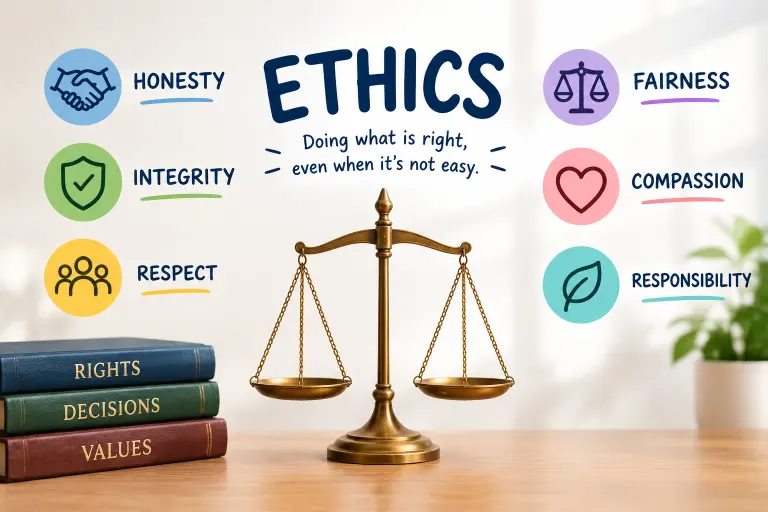
5. Ethics
Meaning:
Principles concerning what is right and wrong.
Explanation:
Ethics is narrower than values. Values may include honesty, creativity, or ambition, while ethics specifically concerns moral conduct.
Example:
“The company emphasizes ethics and transparency.”
Best Use:
Business, medicine, law, education, research, and professional conduct.
Worst Use:
Not appropriate when talking about numerical or financial values.
Tone:
Formal and professional.
6. Morals
Meaning:
Beliefs about right and wrong behavior.
Explanation:
Morals is close to values when discussing personal ideas about right and wrong. However, it has a specifically moral focus.
Example:
“Parents often teach children important moral principles.”
Best Use:
Personal behavior, education, philosophy, and ethical discussions.
Worst Use:
Avoid it for broad corporate priorities that are not specifically moral.
Tone:
Serious and personal.
7. Norms
Meaning:
Accepted behaviors or expectations within a group or society.
Explanation:
Norms refers to socially accepted patterns rather than individual beliefs. It is therefore a contextual alternative, not a perfect synonym.
Example:
“Workplace norms differ across cultures.”
Best Use:
Sociology, anthropology, workplace studies, and academic writing.
Worst Use:
Avoid it when discussing someone’s personal principles.
Tone:
Academic and analytical.
8. Virtues
Meaning:
Positive moral qualities such as honesty, courage, or generosity.
Explanation:
Virtues are qualities considered morally good. They represent one specific category of values.
Example:
“Patience and honesty are widely regarded as virtues.”
Best Use:
Philosophy, ethics, education, and personal development.
Worst Use:
It should not replace values in financial or mathematical contexts.
Tone:
Formal and positive.
9. Philosophy
Meaning:
A system of beliefs or ideas that guides thought and behavior.
Explanation:
Philosophy can describe an organization’s or person’s broader approach to life or work. It is broader than values.
Example:
“Our business philosophy emphasizes customer trust.”
Best Use:
Business websites, leadership statements, personal essays, and organizational descriptions.
Worst Use:
Avoid it if you mean a specific list of principles.
Tone:
Professional and conceptual.
10. Code of Conduct
Meaning:
A formal set of rules describing expected behavior.
Explanation:
This is a narrower, more formal expression. A code of conduct may be based on organizational values but is not itself exactly the same thing.
Example:
“All employees must follow the company’s code of conduct.”
Best Use:
Corporate communication, workplaces, schools, and institutions.
Worst Use:
Too formal for casual conversations about personal beliefs.
Tone:
Highly formal and institutional.
Semi-Formal and Neutral Alternatives
11. Beliefs
Meaning:
Ideas that a person accepts as true or important.
Explanation:
Beliefs is one of the most natural alternatives for personal values. It can be broader than values because beliefs can concern facts, religion, politics, or opinions.
Example:
“Her beliefs influence the way she approaches difficult decisions.”
Best Use:
Personal writing, interviews, school assignments, and conversations.
Worst Use:
Avoid it when referring specifically to professional standards.
Tone:
Neutral.
12. Priorities
Meaning:
Things considered most important.
Explanation:
Priorities describes what someone chooses to focus on. They may reflect values but can change according to circumstances.
Example:
“Our current priorities are customer service and product quality.”
Best Use:
Business, project management, personal planning, and emails.
Worst Use:
Not ideal when discussing deep moral beliefs.
Tone:
Neutral and practical.
13. Commitments
Meaning:
Promises, responsibilities, or strong dedication to something.
Explanation:
Commitments can express values in action, but they are not direct synonyms. A value is a belief; a commitment is an obligation or dedication.
Example:
“Our commitment to sustainability guides our purchasing decisions.”
Best Use:
Corporate communication, websites, reports, and professional emails.
Worst Use:
Avoid replacing every use of values with this word.
Tone:
Professional.
14. Beliefs and Principles
Meaning:
Core ideas that influence decisions and behavior.
Explanation:
This combined phrase works well when you want to make the meaning of values clearer.
Example:
“The school’s beliefs and principles shape its approach to education.”
Best Use:
Websites, school policies, organizational descriptions, and formal writing.
Worst Use:
Too wordy for simple sentences.
Tone:
Neutral to formal.
15. Priorities
Meaning:
The things that matter most at a particular time.
Explanation:
This is especially useful when values refers to what a person or organization considers important.
Example:
“Employee well-being remains one of our top priorities.”
Best Use:
Workplace communication and planning.
Worst Use:
It does not necessarily imply morality or permanent beliefs.
Tone:
Practical and professional.
16. Worth
Meaning:
The amount of value, usefulness, or importance something has.
Explanation:
Worth is appropriate when value means importance or monetary value.
Example:
“The painting’s worth has increased significantly.”
Best Use:
Finance, property, art, personal evaluation, and everyday speech.
Worst Use:
Do not use it for moral principles.
Tone:
Neutral.
17. Importance
Meaning:
The degree to which something matters.
Explanation:
This is a strong contextual alternative when values means significance rather than price.
Example:
“The importance of clear communication cannot be ignored.”
Best Use:
Academic, business, and general writing.
Worst Use:
It cannot replace values when discussing numbers.
Tone:
Neutral to formal.
18. Significance
Meaning:
The importance or meaning of something.
Explanation:
Significance is slightly more formal than importance.
Example:
“The report explains the significance of the new findings.”
Best Use:
Academic and professional writing.
Worst Use:
May sound unnecessarily formal in casual conversation.
Tone:
Formal and analytical.
19. Benefit
Meaning:
An advantage or positive result.
Explanation:
A benefit can be a reason something has value, but it is not a direct synonym for value in every context.
Example:
“One major benefit of the program is its flexibility.”
Best Use:
Business, marketing, customer service, and product writing.
Worst Use:
Avoid using it when discussing ethical values.
Tone:
Positive and practical.
20. Utility
Meaning:
Usefulness or practical value.
Explanation:
Utility emphasizes how useful something is rather than how expensive or meaningful it is.
Example:
“The utility of the software depends on how often employees use it.”
Best Use:
Academic, economics, technology, and product discussions.
Worst Use:
Too technical for casual writing in many situations.
Tone:
Formal and analytical.
Numerical and Data-Related Alternatives
When values refers to numbers or measurements, completely different synonyms are needed.
21. Quantities
Meaning:
Amounts of something.
Example:
“Enter the quantities for each item.”
Best Use:
Science, mathematics, inventory, and business.
Tone:
Neutral.
22. Amounts
Meaning:
Numerical quantities, especially amounts of money or substances.
Example:
“The table lists the amounts paid by each customer.”
Best Use:
Finance, shopping, accounting, and everyday writing.
Tone:
Neutral.
23. Figures
Meaning:
Numbers or numerical information.
Example:
“The latest sales figures exceeded expectations.”
Best Use:
Business, finance, journalism, and reports.
Tone:
Professional.
24. Measurements
Meaning:
Numbers obtained by measuring something.
Example:
“Record the measurements in centimeters.”
Best Use:
Science, engineering, construction, and research.
Tone:
Technical and precise.
25. Scores
Meaning:
Numbers representing performance or results.
Example:
“Students received their test scores on Friday.”
Best Use:
Education, sports, evaluations, and testing.
Tone:
Neutral.
26. Ratings
Meaning:
Numbers or categories used to evaluate quality or performance.
Example:
“The hotel received excellent customer ratings.”
Best Use:
Reviews, entertainment, products, services, and customer feedback.
Tone:
Neutral.
27. Levels
Meaning:
Measured degrees or stages of something.
Example:
“The device records noise levels throughout the day.”
Best Use:
Science, health, business, and technical writing.
Tone:
Neutral to technical.
28. Readings
Meaning:
Numbers shown by an instrument or measurement system.
Example:
“The technician recorded the temperature readings.”
Best Use:
Science, medicine, engineering, and equipment testing.
Tone:
Technical.
29. Results
Meaning:
The outcomes produced by a test, calculation, or activity.
Example:
“The researchers analyzed the test results.”
Best Use:
Academic, scientific, business, and professional writing.
Worst Use:
Not suitable when values means personal principles.
Tone:
Neutral and professional.
30. Data Points
Meaning:
Individual pieces of information within a dataset.
Example:
“Each data point represents one customer’s response.”
Best Use:
Data analysis, research, statistics, and technology.
Tone:
Technical.
31. Variables
Meaning:
Quantities that can change within a mathematical or scientific model.
Example:
“The equation contains three variables.”
Important distinction:
A variable can have a value, but a variable itself is not always a synonym for value.
Best Use:
Mathematics, programming, science, and statistics.
Tone:
Technical.
32. Statistics
Meaning:
Numerical information that summarizes data.
Example:
“The report includes statistics on customer satisfaction.”
Important distinction:
Not every numerical value is a statistic.
Tone:
Technical and analytical.
Informal and Casual Alternatives
There are fewer true casual synonyms for values because the correct alternative depends on what values means.
Worth
Example: “It’s worth a lot more than I expected.”
Natural in everyday conversation. Avoid using it for personal principles.
What Matters
Example: “Family is what matters most to her.”
Useful when discussing priorities or personal values. It sounds conversational.
What’s Important
Example: “Let’s focus on what’s important.”
Natural and friendly, but broader than values.
Beliefs
Example: “Those are his beliefs, and he stands by them.”
Good for personal principles, though broader than values.
Priorities
Example: “My priorities have changed this year.”
Useful when discussing practical concerns rather than moral principles.
True Synonyms vs. Contextual Alternatives
The word values is unusually difficult because it has several meanings.
| Type | What It Means | Can It Replace “Values”? |
|---|---|---|
| True synonym | A word with essentially the same meaning in a specific context | Sometimes |
| Near synonym | A closely related word with a slightly different meaning | Often, depending on context |
| Contextual alternative | A word that works only in a particular sentence | Yes, in that context |
| Broader expression | A word covering a wider concept | Sometimes |
| Narrower expression | A word covering only one part of the meaning | Only in specific contexts |
For example, principles can closely replace values in “personal values,” while figures can replace values in “sales values” if the context refers to numerical data. But principles and figures are obviously not synonyms of each other.
Industry-Specific Usage
Business Writing
In business writing, values usually refers to an organization’s beliefs or standards.
Useful alternatives include:
- Principles
- Priorities
- Standards
- Commitments
- Ethics
- Philosophy
Example:
“Our core values include honesty and accountability.”
Possible alternatives:
- “Our core principles include honesty and accountability.”
- “Our ethical standards include honesty and accountability.”
The first is close in meaning. The second focuses more specifically on ethics.
Corporate Communication
Corporate reports and websites often use values, principles, commitments, and standards.
Example:
“Our values guide how we work with customers.”
More formal:
“Our principles guide our approach to customer relationships.”
For sustainability messaging, commitments may be better:
“Our environmental commitments guide our operations.”
That sentence emphasizes action rather than belief.
Academic Writing
Academic writing often benefits from precise terms such as:
- Principles
- Beliefs
- Norms
- Ethics
- Standards
- Priorities
- Ideals
Example:
“Cultural values influence attitudes toward education.”
A more academic version could be:
“Cultural norms influence attitudes toward education.”
However, norms changes the meaning by emphasizing socially accepted behavior rather than personal beliefs.
Customer Service
Customer-facing communication usually benefits from simple words such as importance, benefit, worth, or priorities.
Instead of:
“We understand the values of your feedback.”
Use:
“We understand the importance of your feedback.”
This is clearer and more natural.
Legal Writing
Legal writing requires particular care. Values, principles, rights, duties, standards, and interests can have different meanings in legal contexts.
For example:
“The policy reflects the organization’s values.”
This does not necessarily mean:
“The policy establishes a legal duty.”
Legal terminology should therefore be chosen for precision rather than simply to avoid repetition.
Email Communication
For professional emails, choose the word based on the intended meaning:
- Principles for guiding beliefs
- Priorities for current goals
- Importance for significance
- Worth for monetary or practical value
- Figures for numerical information
- Benefits for advantages
Email Examples
1. Client Communication — “Importance”
Subject: The Importance of Your Feedback
Hi Sarah,
Thank you for taking the time to share your feedback on the proposal. We understand the importance of your comments and will review each point carefully before the next revision.
I’ll send you an updated version by Thursday.
Best,
Daniel
2. Internal Workplace Email — “Priorities”
Subject: Updated Project Priorities
Hi Team,
I wanted to share our priorities for the next two weeks. Our main focus will be completing the testing phase, resolving the remaining issues, and preparing the final documentation.
Please let me know if you see any conflicts with these priorities.
Thanks,
Maya
3. Academic Communication — “Principles”
Subject: Research Discussion
Dear Professor Lee,
I have revised the introduction to explain the ethical principles behind the study more clearly. you believe this makes the research question easier to understand.
It would appreciate your feedback when you have time.
Best regards,
Alex
4. Vendor Communication — “Standards”
Subject: Quality Standards for the Next Shipment
Hello Mark,
Before the next shipment is prepared, could you please confirm that the products will meet the agreed quality standards?
We would also appreciate the updated inspection report.
Thank you,
Nina
5. Customer Service — “Worth”
Subject: Your Product Inquiry
Hello James,
Thank you for contacting us. We understand that you’re considering whether the product is worth the price.
I’ve included the main features and warranty information below so you can compare the options.
Best,
Customer Support
6. Business Update — “Figures”
Subject: Monthly Sales Figures
Hi everyone,
The latest sales figures are now available. Overall revenue increased this month, while several product categories remained stable.
Please review the attached summary before Friday’s meeting.
Best,
Chris
Short Dialogue Examples
Workplace
Person A: What are our main values as a team?
Person B: I’d say trust, accountability, and clear communication.
Classroom
Person A: Is “principles” a synonym for “values”?
Person B: Often, yes, especially when you’re talking about beliefs that guide behavior.
Customer Service
Person A: What’s another word for “value” here?
Person B: If you mean importance, “significance” or “importance” would work better.
Casual Conversation
Person A: What matters most to you?
Person B: Honestly, family and having time to enjoy life.
Professional Discussion
Person A: Should we call these our values or priorities?
Person B: Priorities works better because we’re talking about what we’re focusing on this quarter.
How to Replace “Values” in a Sentence
Example 1
Original:
“Our company values guide our decisions.”
Alternative:
“Our company principles guide our decisions.”
Why it works:
Principles closely matches the idea of beliefs that guide behavior.
Example 2
Original:
“The values of the measurements were recorded.”
Alternative:
“The measurements were recorded.”
Why it works:
Removing values makes the sentence clearer because the measurements themselves are numerical results.
Example 3
Original:
“The values of the company include honesty and respect.”
Alternative:
“The company’s core principles include honesty and respect.”
Why it works:
Principles sounds natural and precise in an organizational context.
Example 4
Original:
“The values of the products vary by region.”
Alternative:
“The prices of the products vary by region.”
Why it works:
If values means monetary amounts, prices is much more specific.
Example 5
Original:
“The values of the results were unexpected.”
Alternative:
“The numerical results were unexpected.”
Why it works:
The alternative clarifies that the discussion concerns numbers rather than beliefs or importance.
Example 6
Original:
“Customer values are important to our strategy.”
Alternative:
“Customer priorities are important to our strategy.”
Why it works:
If you mean what customers care about or prioritize, priorities can be clearer.
Example 7
Original:
“The values of the organization shape its culture.”
Alternative:
“The organization’s principles shape its culture.”
Why it works:
Principles clearly communicates guiding beliefs.
Example 8
Original:
“This item has good value.”
Alternative:
“This item is worth the price.”
Why it works:
The alternative sounds natural when discussing whether something is a good purchase.
Comparison Table
| Phrase | Tone | Meaning / Scope | Best Use | Example |
|---|---|---|---|---|
| Principles | Formal | Guiding beliefs | Business, ethics | “Our principles guide decisions.” |
| Beliefs | Neutral | Ideas accepted as true or important | Personal writing | “Her beliefs shape her choices.” |
| Standards | Formal | Expected level of behavior or quality | Policies | “We maintain high standards.” |
| Ideals | Formal | Aspirational beliefs | Essays, philosophy | “Equality is a core ideal.” |
| Ethics | Formal | Moral principles | Professional conduct | “Ethics guide our work.” |
| Priorities | Neutral | Things considered most important | Planning | “Our priorities have changed.” |
| Worth | Neutral | Value or usefulness | Purchases | “It is worth the price.” |
| Importance | Neutral | Degree of significance | General writing | “We understand its importance.” |
| Significance | Formal | Importance or meaning | Academic writing | “Its significance is clear.” |
| Figures | Professional | Numerical information | Business | “Sales figures increased.” |
| Measurements | Technical | Recorded dimensions or quantities | Science | “The measurements were accurate.” |
| Ratings | Neutral | Evaluations or scores | Reviews | “Customer ratings improved.” |
| Results | Neutral | Outcomes | Research | “The results were positive.” |
| Data points | Technical | Individual data items | Analytics | “The dataset contains 500 data points.” |
| Variables | Technical | Changeable quantities | Math/science | “The variables were controlled.” |
Which Alternative Should You Choose?
For formal writing
Choose principles, standards, ethics, ideals, or significance, depending on the meaning.
For business communication
Use principles, priorities, standards, commitments, or benefits.
For academic writing
Prefer precise terms such as principles, norms, beliefs, significance, measurements, or results.
For legal writing
Use the exact legal concept needed. Do not casually substitute values with principles, rights, duties, or standards if the legal meaning changes.
For professional email
Use plain, specific words. Importance, priorities, principles, figures, and benefits are often clearer than repeatedly using values.
For everyday conversation
Use beliefs, what matters, priorities, worth, or importance.
For casual messages
Simple phrases such as what matters, what’s important, and worth usually sound more natural.
Grammar & Usage Guide
1. “Value” vs. “Values”
Value can be singular:
“The value of the property increased.”
Values is commonly plural when discussing beliefs:
“Her values include honesty and kindness.”
Do not automatically use the plural form just because you are discussing more than one idea.
2. “Values” Can Be a Verb
Values can also mean appreciates or considers important.
“She values her friendships.”
Possible alternatives include:
- Appreciates
- Respects
- Cherishes
- Treasures
- Esteems
These are different from the noun values meaning principles.
3. “Value” and “Worth” Are Not Always Identical
“The value of the house is $300,000.”
“The house is worth $300,000.”
These are close in many financial contexts, but value can sound more technical, while worth is often more conversational.
4. Natural Prepositions
Common combinations include:
- values in society
- values of a company
- values toward something — less common and often needs rewriting
- value of something
- value for money
- place value on something
Examples:
“The company places a high value on customer service.”
“The value of the property increased.”
5. “Core Values” Is a Common Phrase
Core values refers to fundamental beliefs that guide an individual or organization.
“Integrity is one of our core values.”
Replacing it with simply beliefs may weaken the organizational meaning.
6. Numerical “Values”
In technical writing, values commonly follows a noun:
“The measured values were recorded.”
“The temperature values ranged from 10°C to 20°C.”
In many cases, repeating values can be avoided by naming the measurement:
“The temperatures ranged from 10°C to 20°C.”
That is often cleaner.
Common Mistakes to Avoid
1. Treating Every Alternative as a True Synonym
Principles, prices, figures, and importance all relate to different meanings of values. They cannot replace one another freely.
2. Confusing Values With Priorities
Values are often deeper beliefs, while priorities describe what receives attention at a particular time.
3. Using “Ethics” Too Broadly
Ethics specifically concerns right and wrong. Not every personal value is an ethical rule.
4. Using “Worth” for Personal Principles
You can say:
“The painting has great worth.”
But not naturally:
“My worth are honesty and kindness.”
Use values or principles instead.
5. Using “Figures” for Beliefs
“Company figures” normally means numerical information, not organizational beliefs.
6. Overusing “Values”
In technical writing, repeated phrases such as “the values of the measurements” can often be simplified.
7. Choosing a Word That Is Too Formal
“Significance” may sound unnecessary in a casual sentence where “importance” would be clearer.
8. Ignoring Context
Always ask what values means in the sentence before choosing a replacement.
When Not to Use “Values”
There are several situations where replacing values can improve clarity.
When you mean a specific price
Use price, cost, or worth.
“The price of the product increased.”
When you mean numerical information
Use figures, measurements, readings, or data points.
When you mean what someone considers important
Use priorities or what matters when appropriate.
When you mean moral beliefs
Use principles, ethics, or moral beliefs when that narrower meaning is intended.
When the sentence is vague
Instead of:
“The values were important.”
Say:
“The findings were important.”
or:
“The principles were important to the organization.”
When a specific noun is available
Replacing “values” with the exact concept often makes writing stronger.
Instead of:
“The values of the measurements changed.”
Write:
“The measurements changed.”
When “values” is actually the best choice
Keep the original word when you are genuinely referring to a set of beliefs, numerical data, or another established concept. Do not replace a precise word simply to avoid repetition.
Advanced Writer Tips
Tone Control
For a formal tone, use:
“Our ethical principles guide our decisions.”
a neutral tone:
“Our beliefs guide our decisions.”
a conversational tone:
“What matters to us guides the way we work.”
The message is similar, but the tone changes.
Professional Email Etiquette
Avoid forcing sophisticated synonyms into business emails. Clear language usually works better.
Instead of:
“We recognize the significance of your concerns.”
You can write:
“We understand the importance of your concerns.”
The second version is often warmer and easier to read.
Politeness
Word choice can soften communication.
“Your priorities are important to us.”
sounds more customer-focused than:
“We have reviewed your values.”
Context Alignment
Before replacing values, identify its meaning:
Precision
The most impressive synonym is not always the best one. The best word is the one that communicates the exact intended meaning.
Readability
If a synonym makes the sentence longer or harder to understand, keep values.
Good writing is not about avoiding a word at all costs. It is about choosing the clearest word.
Related Questions
What is another way to say “values”?
Depending on the context, you can say principles, beliefs, standards, ideals, priorities, worth, importance, figures, measurements, or ratings.
What is a professional alternative to “values”?
For organizational beliefs, principles, standards, or guiding principles work well. For numerical information, use a more precise term such as figures or measurements.
What is a formal alternative to “values”?
For beliefs, principles, ideals, or ethical standards can sound more formal. For importance, significance may work.
What can I use instead of “values” in a sentence?
First determine the meaning. If you mean beliefs, try principles. thats mean importance, try significance. it mean money, try worth or price. If you mean numbers, try figures or measurements.
Is “values” a formal word?
Yes. Values is a standard word suitable for formal, professional, academic, and everyday communication. You do not need to replace it simply because you are writing formally.
Can “principles” replace “values”?
Often, but not always. Principles usually refers to rules or beliefs that guide behavior, while values can include broader priorities and qualities.
What is the difference between “values” and “priorities”?
Values are usually deeper beliefs about what matters, while priorities are the things someone chooses to focus on at a particular time.
FAQs
1. What are the closest synonyms for “values”?
The closest alternatives depend on the sense. For personal or organizational beliefs, principles, beliefs, standards, ideals, and ethics are useful. For monetary value, worth and price may fit better.
2. Is “principles” always a synonym for “values”?
No. Principles is a close synonym only when values refer to guiding beliefs or rules. It cannot replace values when the word refers to numerical amounts, prices, or measurements.
3. What is the best synonym for “values” in business writing?
Principles, priorities, standards, and commitments are strong options. Choose based on meaning: principles describe beliefs, priorities describe current focus, and commitments emphasize actions or promises.
4. What is the best alternative when “values” means numbers?
Use a specific term such as figures, measurements, readings, quantities, scores, ratings, or data points. The best choice depends on what the numbers represent.
5. Can “worth” replace “value”?
Often, especially when discussing monetary or practical value. For example, “The item is worth $100” is natural. However, worth does not replace values when discussing moral principles.
6. What is the difference between values and beliefs?
Beliefs are ideas a person accepts as true or meaningful, while values are principles or qualities a person considers important. The two overlap, but beliefs have a broader meaning.
7. How do I avoid repeating “values” in an article?
Do not replace it mechanically. Identify the intended meaning first, then use precise alternatives such as principles, priorities, importance, worth, figures, measurements, or benefits where appropriate.
Key Takeaways
- Values has several meanings, so there is no single synonym that works everywhere.
- Use principles, beliefs, standards, or ideals for personal and organizational beliefs.
- Use worth, price, importance, or significance when discussing value or importance.
- Use figures, measurements, readings, scores, or data points for numerical meanings.
- Choose the most precise word for the audience, context, and intended meaning rather than replacing values automatically.
Conclusion;
The best synonym for values depends entirely on what you mean. When the word describes beliefs, principles, beliefs, standards, ideals, and ethics are useful alternatives.
When it refers to importance, significance, merit, importance, and benefit may be more precise. For money or worth, consider price, cost, worth, valuation, or appraisal.
For numerical information, terms such as figures, measurements, readings, scores, and data points are usually clearer.
The key is not simply to find a different word. It is to preserve the original meaning while matching the tone of your writing. In a business report, principles or standards may sound appropriate.
In an academic paper, norms or significance may be more precise. so everyday conversation, what matters, priorities, or worth can sound more natural.
Good synonym choice makes writing clearer, not merely more varied. When values is already the most accurate word, there is no reason to replace it.
