
If you are looking for 33+ synonyms for contrast, the best word depends on what you mean by contrast. The word can describe a difference between two things, the act of comparing them, or the way two things appear noticeably different.
In writing, you may need alternatives such as difference, distinction, comparison, opposition, disparity, or variation for the synonyms for contrast .
Choosing the right alternative matters because these words are not perfectly interchangeable. Difference is broad and neutral, while distinction often suggests an important or meaningful difference. Disparity can imply an uneven or unfair gap, while opposition suggests stronger conflict.
This guide explains more than 33 useful alternatives, including formal, neutral, academic, professional, and casual choices, with examples showing exactly when each one works.
Quick Answer
Some of the most useful synonyms for contrast are difference, distinction, comparison, variation, divergence, disparity, opposition, dissimilarity, discrepancy, separation, differentiation, juxtaposition, inconsistency, imbalance, gap, and polarity. The best choice depends on whether you mean a simple difference, a strong opposition, a comparison, or a noticeable visual or conceptual difference.
Alternatives to “Contrast”
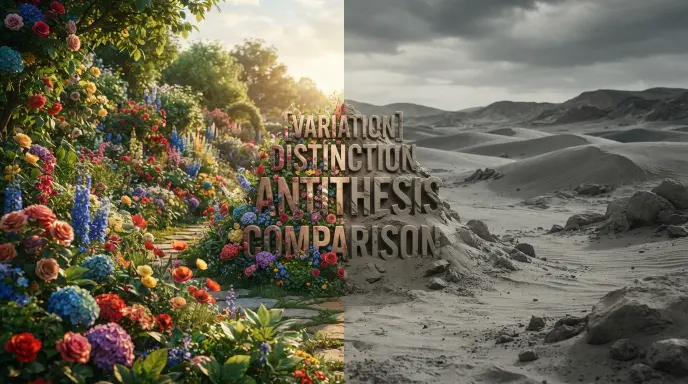
Closest and Most Useful Alternatives
- Difference
- Distinction
- Comparison
- Dissimilarity
- Variation
- Divergence
- Disparity
- Opposition
- Discrepancy
- Differentiation
More Formal or Academic Choices
- Divergence
- Disparity
- Distinction
- Juxtaposition
- Polarity
- Dichotomy
- Differentiation
- Discrepancy
- Incongruity
- Discontinuity
Neutral Contextual Alternatives
- Gap
- Separation
- Imbalance
- Difference in degree
- Change
- Shift
- Variation
- Distinctness
- Unevenness
- Disagreement
Stronger or More Specific Alternatives
- Opposition
- Conflict
- Antithesis
- Polarity
- Dichotomy
- Disparity
- Incongruity
- Inconsistency
- Discrepancy
- Disconnection
Casual Alternatives
- Difference
- Gap
- Change
- Mismatch
- Difference of opinion
The important point is that not all 45 alternatives mean exactly the same thing. Some describe simple differences, some emphasize comparison, and others suggest conflict, inequality, or visual separation.
Formal Alternatives to “Contrast”
Formal alternatives for synonyms for contrast are especially useful in academic papers, reports, professional writing, and analytical essays.
1. Difference
Meaning: A way in which two or more things are not the same.
Explanation: Difference is the broadest and safest alternative to contrast. It does not necessarily suggest a dramatic or obvious distinction for synonyms for contrast .
Example:
“The study identifies several differences between the two groups.”
Best Use: Academic, professional, and everyday writing.
Worst Use: Avoid it when you specifically mean an intentional side-by-side comparison or dramatic opposition for synonyms for contrast .
Tone: Neutral and flexible.
2. Distinction
Meaning: A clear or meaningful difference between things.
Explanation: Distinction is more precise than difference. It often suggests that the difference matters or helps separate one category from another for synonyms for contrast .
Example:
“The report makes an important distinction between short-term and long-term costs.”
Best Use: Academic writing, professional reports, definitions, and analytical writing.
Worst Use: It can sound unnecessarily formal when discussing a very ordinary difference for synonyms for contrast .
Tone: Formal and precise.
3. Disparity
Meaning: A significant difference, especially an unequal one.
Explanation: Disparity is not a general replacement for every use of contrast. It often refers to a gap between people, groups, amounts, conditions, or outcomes for synonyms for contrast .
Example:
“The report highlights a disparity in access to educational resources.”
Best Use: Social research, economics, business analysis, and policy writing.
Worst Use: Do not use it for a harmless visual difference, such as two colors contrasting for synonyms for contrast .
Tone: Formal and analytical.
4. Divergence
Meaning: A movement or development away from similarity or agreement.
Explanation: Divergence emphasizes how things become different or follow separate directions.
Example:
“The researchers observed a divergence in the two markets after 2024.”
Best Use: Academic, scientific, financial, and analytical writing.
Worst Use: It may sound too technical for a simple difference for synonyms for contrast .
Tone: Formal and analytical.
5. Discrepancy
Meaning: A difference between things that are expected to agree.
Explanation: Discrepancy usually implies that something does not match correctly. It can therefore carry a sense of error or inconsistency for synonyms for contrast .
Example:
“The auditor discovered a discrepancy between the invoice and the payment record.”
Best Use: Finance, accounting, research, administration, and professional reports.
Worst Use: Avoid it when there is simply a deliberate difference for synonyms for contrast .
Tone: Formal and problem-focused.
6. Dissimilarity
Meaning: A lack of similarity.
Explanation: This is a relatively direct synonym when discussing how two things differ in characteristics, appearance, or behavior in synonyms for contrast .
Example:
“The researchers measured the dissimilarity between the two samples.”
Best Use: Academic and scientific writing.
Worst Use: It can sound stiff in casual conversation in synonyms for contrast .
Tone: Formal and technical.
7. Differentiation
Meaning: The process of making or recognizing something as different.
Explanation: Differentiation often focuses on how things are separated into distinct categories rather than simply observing a difference in synonyms for contrast .
Example:
“Brand differentiation helps the company stand out from its competitors.”
Best Use: Business, marketing, education, and academic writing.
Worst Use: Do not use it when you simply mean that two objects look different.
Tone: Professional and analytical.
8. Juxtaposition

Meaning: The placement of two things close together so their differences become noticeable.
Explanation: Juxtaposition is especially useful when the contrast is created by deliberately presenting two things side by side in synonyms for contrast .
Example:
“The photographer uses the juxtaposition of old buildings and modern architecture.”
Best Use: Literature, art, photography, design, journalism, and cultural analysis.
Worst Use: It is not a general substitute for contrast in every sentence.
Tone: Formal and descriptive.
9. Polarity
Meaning: A state in which two things occupy strongly opposite positions.
Explanation: Polarity describes an extreme form of difference or opposition, often between two ends of a spectrum.
Example:
“The debate revealed a strong polarity between the two political positions.”
Best Use: Academic, political, scientific, and analytical writing.
Worst Use: Too strong for a minor difference.
Tone: Formal and analytical.
10. Dichotomy
Meaning: A division into two clearly opposing categories.
Explanation: Dichotomy is narrower than contrast. It specifically emphasizes a division between two distinct sides.
Example:
“The article challenges the traditional dichotomy between work and leisure.”
Best Use: Academic writing, philosophy, social science, and critical analysis.
Worst Use: Avoid it when there are three or more relevant categories or when the differences are not genuinely oppositional.
Tone: Formal and academic.
11. Antithesis
Meaning: A direct or strong opposite.
Explanation: Antithesis is a particularly strong form of contrast. In rhetoric and literature, it can describe two opposing ideas deliberately presented together.
Example:
“The speech creates an antithesis between freedom and control.”
Best Use: Literature, rhetoric, essays, speeches, and critical analysis.
Worst Use: Too dramatic for an ordinary difference.
Tone: Highly formal and rhetorical.
12. Incongruity
Meaning: A lack of harmony, agreement, or expected consistency.
Explanation: Incongruity describes something that seems out of place or does not fit with something else.
Example:
“The bright modern furniture creates an incongruity with the historic interior.”
Best Use: Design, literature, art criticism, psychology, and analytical writing.
Worst Use: Avoid it when you simply need a basic synonym for difference.
Tone: Formal and analytical.
Semi-Formal and Neutral Alternatives
13. Variation
Meaning: A difference or change within a group or pattern.
Explanation: Variation is useful when things are similar overall but differ in certain details.
Example:
“There is considerable variation in customer preferences.”
Best Use: Research, business, education, science, and everyday writing.
Worst Use: It may be too weak if you mean complete opposition.
Tone: Neutral.
14. Opposition
Meaning: A state of being strongly different or directly against something.
Explanation: Opposition is much stronger than ordinary contrast. It often suggests competing ideas, forces, or positions.
Example:
“The proposal faced strong opposition from local residents.”
Best Use: Politics, debates, arguments, social issues, and competitive situations.
Worst Use: Avoid it for simple visual differences.
Tone: Strong and sometimes confrontational.
15. Gap
Meaning: A space or difference between two things.
Explanation: Gap is a practical, easy-to-understand alternative, especially for differences in ability, income, knowledge, performance, or distance.
Example:
“There is a significant gap between the two teams’ performances.”
Best Use: Business, education, everyday speech, and reports.
Worst Use: It may sound too informal for highly technical analysis.
Tone: Neutral and accessible.
16. Separation
Meaning: The state of being apart or kept apart.
Explanation: Separation focuses more on distance or division than on the qualities that differ.
Example:
“The design uses a clear separation between the public and private areas.”
Best Use: Design, architecture, organization, and general writing.
Worst Use: It does not always communicate a meaningful difference in characteristics.
Tone: Neutral to formal.
17. Imbalance
Meaning: A lack of equality or balance.
Explanation: Imbalance works when one side has noticeably more, less, or greater influence than another.
Example:
“The study found an imbalance between supply and demand.”
Best Use: Economics, business, health, systems, and analysis.
Worst Use: Avoid it for neutral differences that do not involve balance.
Tone: Neutral and analytical.
18. Mismatch
Meaning: A situation where two things do not fit, correspond, or work well together.
Explanation: Mismatch is useful for practical situations where things are expected to match but do not.
Example:
“There was a mismatch between the customer’s order and the delivered product.”
Best Use: Customer service, shopping, technology, and everyday speech.
Worst Use: It can sound too casual in a formal academic paper.
Tone: Neutral to casual.
19. Disagreement
Meaning: A difference in opinions or views.
Explanation: This is a narrower alternative to contrast. It should be used when people or groups hold different opinions.
Example:
“The two researchers had a disagreement about the interpretation of the data.”
Best Use: Meetings, discussions, workplace writing, and everyday conversation.
Worst Use: Do not use it for differences in color, size, shape, or performance.
Tone: Neutral.
20. Distinctness
Meaning: The quality of being clearly different or recognizable.
Explanation: Distinctness focuses on how clearly something stands apart from another thing.
Example:
“The distinctness of the two design styles is immediately noticeable.”
Best Use: Design, academic writing, description, and analysis.
Worst Use: It can sound unnatural in casual conversation.
Tone: Formal and descriptive.
More Neutral Contextual Alternatives
21. Change
Meaning: A difference from an earlier state.
Explanation: Change works when the contrast involves before-and-after conditions rather than two things existing at the same time.
Example:
“The change in tone is noticeable in the second paragraph.”
Best Use: Reports, writing, everyday speech.
Worst Use: It does not necessarily imply comparison between two separate things.
Tone: Neutral.
22. Shift
Meaning: A movement from one position, condition, or approach to another.
Example:
“The company experienced a shift in customer preferences.”
Best Use: Business, journalism, analysis.
Worst Use: Not suitable for a simple visual contrast.
Tone: Neutral and professional.
23. Difference in Degree
Meaning: A difference in how much or how strongly something occurs.
Example:
“The two products show a difference in degree rather than a fundamental difference.”
Best Use: Academic and analytical writing.
Worst Use: Too wordy for casual conversation.
Tone: Formal and precise.
24. Unevenness
Meaning: A lack of equality or uniformity.
Example:
“The unevenness of the distribution created problems for the project.”
Best Use: Data analysis, design, physical description, and technical writing.
Worst Use: It does not fit every type of conceptual contrast.
Tone: Neutral.
25. Inconsistency
Meaning: A lack of agreement or consistency between things.
Example:
“The editor noticed an inconsistency between the two sections.”
Best Use: Writing, research, policies, data, and quality control.
Worst Use: Do not use it if the difference is intentional.
Tone: Professional and analytical.
26. Disconnection
Meaning: A lack of connection or relationship.
Example:
“The report reveals a disconnection between policy goals and actual results.”
Best Use: Business, social analysis, communication, and organizational writing.
Worst Use: Too strong if the only difference is minor.
Tone: Neutral to formal.
Informal and Casual Alternatives
The word contrast itself is not particularly formal, so casual English often uses simpler expressions rather than slang.
27. Difference
Example: “What’s the difference between these two?”
Natural when: Talking with friends, classmates, or coworkers.
Avoid when: You need to emphasize a very strong opposition or technical distinction.
Tone: Everyday and neutral.
28. Gap
Example: “There’s a big gap between the two teams.”
Natural when: Talking about performance, money, skills, or results.
Avoid when: Discussing a purely visual difference.
Tone: Casual and accessible.
29. Mismatch
Example: “Those colors are a funny mismatch.”
Natural when: Things do not fit or match as expected.
Avoid when: You mean a carefully designed artistic comparison.
Tone: Casual.
30. Opposite
Example: “They’re almost complete opposites.”
Natural when: Two things are strongly different.
Avoid when: The difference is minor.
Tone: Casual and direct.
31. Not the Same
Example: “These two versions are not the same.”
Natural when: You want extremely simple language.
Avoid when: Writing formal academic or professional analysis.
Tone: Very simple and conversational.
32. Worlds Apart
Meaning: Extremely different.
Example: “The two approaches are worlds apart.”
Natural when: Emphasizing a dramatic difference in conversation or creative writing.
Avoid when: Precision matters more than emphasis.
Tone: Informal and expressive.
33. Night and Day
Meaning: Extremely different from each other.
Example: “The new version is night and day compared with the old one.”
Natural when: Casual conversation and persuasive writing.
Avoid when: Academic or technical writing requires exact wording.
Tone: Informal and vivid.
True Synonyms vs. Contextual Alternatives
The biggest mistake in finding synonyms is assuming every word can replace contrast in every sentence.
| Type | What It Means | Can It Replace “Contrast”? |
|---|---|---|
| True/near synonym: difference | A way two things are not the same | Usually |
| Near synonym: distinction | A meaningful or recognizable difference | Often |
| Near synonym: dissimilarity | Lack of similarity | Often |
| Contextual: comparison | Examining two or more things together | Sometimes |
| Contextual: disparity | A significant or unequal difference | Only in suitable contexts |
| Contextual: opposition | Strong difference or being against something | Only for strong differences |
| Broader: variation | A change or difference within a range | Often, depending on context |
| Narrower: dichotomy | A division into two opposing categories | Only when there are two sides |
| Narrower: juxtaposition | Placing things side by side to emphasize difference | Only in presentation/comparison contexts |
| Narrower: antithesis | Strong rhetorical opposition | Only for deliberate, strong opposition |
An important distinction: “contrast” vs. “comparison”
These two words are closely related, but they are not identical.
A comparison can identify both similarities and differences. A contrast specifically highlights differences.
Comparison:
“The essay compares urban and rural schools.”
Contrast:
“The essay contrasts the resources available in urban and rural schools.”
Industry-Specific Usage
Business Writing
In business writing, mainly for synonyms for contrast use difference, distinction, gap, variation, disparity, or divergence according to the meaning.
Example:
“The report identifies a significant gap between customer expectations and service performance.”
Here, gap is clearer than contrast because it describes a measurable difference.
For competitive positioning:
“The company uses product differentiation to stand apart from competitors.”
Differentiation is more precise than contrast in marketing.
Corporate Communication
Corporate reports often need precise alternatives.
Instead of:
“There is a contrast between our goals and our results.”
You could write:
“There is a discrepancy between our stated goals and the reported results.”
If the difference is expected rather than an error:
“There is a difference between projected and actual results.”
The second sentence is safer because discrepancy can imply that something is wrong.
Academic Writing
Academic writers commonly use:
- difference
- distinction
- divergence
- disparity
- dissimilarity
- comparison
- juxtaposition
- dichotomy
- opposition
Example:
“The study highlights a distinction between correlation and causation.”
For literature:
“The juxtaposition of wealth and poverty strengthens the novel’s central theme.”
For quantitative research:
“The results reveal a significant disparity between the two groups.”
Choose the word according to the exact relationship being described.
Customer Service
Customer service usually benefits from simple, non-confrontational language.
Instead of:
“There is a contrast between your order and the item we sent.”
Use:
“There is a difference between the item you ordered and the item you received.”
If an error is confirmed:
“We noticed a mismatch between your order and the item delivered.”
These choices are clearer and more customer-friendly.
Legal Writing
Legal writing requires particular care. Words such as distinction, discrepancy, inconsistency, disparity, and difference can have different implications depending on the document and jurisdiction.
For example, discrepancy may suggest that two records do not agree, while distinction may identify a meaningful legal or factual difference. Casual expressions such as worlds apart should generally be avoided in formal legal documents.
Email Communication
Professional emails usually benefit from direct alternatives such as difference, distinction, discrepancy, variation, and gap.
For example:
“I noticed a discrepancy between the figures in the spreadsheet and the figures in the report.”
This is more precise than simply saying:
“I noticed a contrast between the figures.”
Email Examples
1. Client Communication — “Difference”
Subject: Difference in Project Requirements
Hi Maria,
I noticed a difference between the requirements in the original brief and the latest version you sent.
Could you confirm which version we should use for the next stage of the project?
Thanks,
Daniel
Why it works: Difference is neutral and avoids suggesting that anyone made an error.
2. Internal Workplace Email — “Discrepancy”
Subject: Discrepancy in Monthly Figures
Hi Team,
I noticed a discrepancy between the sales figures in the dashboard and those in the monthly report.
Could we review the source data before the report is finalized?
Thanks,
Aisha
Why it works: Discrepancy appropriately signals that two records do not agree.
3. Academic Email — “Distinction”
Subject: Question About the Essay
Dear Professor Lee,
I am reviewing my essay and would like to clarify the distinction between the two theories discussed in class.
Would you recommend focusing on their practical differences as well as their theoretical differences?
Best,
James
Why it works: Distinction suits careful academic analysis.
4. Customer Service Email — “Mismatch”
Subject: Incorrect Item in My Order
Hello,
I received my order today, but there appears to be a mismatch between the item I ordered and the item delivered.
Could you please let me know how I can arrange an exchange?
Thank you,
Taylor
Why it works: Mismatch is clear and practical without sounding accusatory.
5. Vendor Communication — “Variation”
Subject: Variation in Product Specifications
Hello,
We noticed some variation between the specifications listed in the latest shipment and those provided in the original documentation.
Please confirm whether this change was intentional.
Best,
Morgan
Why it works: Variation is useful when differences may be normal or intentional.
Short Dialogue Examples
Workplace
Person A: I noticed a difference between these two reports.
Person B: Good catch. Let’s check which figures are current.
Classroom
Person A: What’s the difference between a comparison and a contrast?
Person B: A comparison can discuss similarities and differences, while a contrast focuses mainly on differences.
Customer Service
Person A: There’s a mismatch between my order and what arrived.
Person B: I’m sorry about that. I’ll check the order details and help arrange a replacement.
Casual Conversation
Person A: These two jackets look completely different.
Person B: Yeah, they’re almost worlds apart.
Professional Discussion
Person A: Is “disparity” the right word here?
Person B: Yes, if you’re describing a significant inequality rather than an ordinary difference.
How to Replace “Contrast” in a Sentence
Example 1
Original:
“There is a contrast between the two designs.”
Alternative:
“There is a distinction between the two designs.”
Why it works: Distinction sounds slightly more analytical and emphasizes the identifiable difference.
Example 2
Original:
“The report contrasts the two markets.”
Alternative:
“The report compares the two markets.”
Why it works: Compares is broader. It can include similarities as well as differences, so the meaning becomes slightly less specific.
Example 3
Original:
“The colors contrast sharply.”
Alternative:
“The colors differ sharply.”
Why it works: This preserves the basic meaning, although contrast is more natural for visual design.
Example 4
Original:
“The study shows a contrast between the groups.”
Alternative:
“The study shows a disparity between the groups.”
Why it works: Disparity is stronger and suggests a significant difference, especially in measurable outcomes.
Example 5
Original:
“The author contrasts freedom with control.”
Alternative:
“The author sets freedom against control.”
Why it works: Sets … against … clearly communicates deliberate opposition.
Example 6
Original:
“The old building creates a contrast with the modern tower.”
Alternative:
“The old building creates a striking juxtaposition with the modern tower.”
Why it works: Juxtaposition emphasizes the deliberate placement of two different things together.
Example 7
Original:
“There is a contrast in their opinions.”
Alternative:
“There is a disagreement in their opinions.”
Why it works: Disagreement is more specific when the difference concerns people’s views.
Example 8
Original:
“The two approaches are in contrast.”
Alternative:
“The two approaches are fundamentally different.”
Why it works: This is clearer for general readers and emphasizes the degree of difference.
Comparison Table
| Phrase | Tone | Meaning / Scope | Best Use | Example |
|---|---|---|---|---|
| Difference | Neutral | Things are not the same | General writing | “There is a difference between the plans.” |
| Distinction | Formal | Meaningful difference | Academic/business | “The distinction is important.” |
| Comparison | Neutral | Examines similarities/differences | Essays/reports | “The comparison reveals several trends.” |
| Disparity | Formal | Significant or unequal gap | Research/policy | “A disparity exists between groups.” |
| Divergence | Formal | Movement away from similarity | Analysis | “Their views began to diverge.” |
| Discrepancy | Formal | Mismatch between expected facts | Reports/audits | “A discrepancy was identified.” |
| Opposition | Strong | Directly conflicting positions | Debate/politics | “The proposal faced opposition.” |
| Juxtaposition | Formal | Side-by-side placement | Art/literature/design | “The juxtaposition is striking.” |
| Dichotomy | Academic | Two opposing categories | Critical writing | “The essay challenges the dichotomy.” |
| Mismatch | Casual/neutral | Things do not fit | Customer service | “There is a mismatch.” |
| Gap | Neutral | Measurable difference | Business/education | “There is a skills gap.” |
| Variation | Neutral | Difference within a range | Research/general | “There is variation in results.” |
Which Alternative Should You Choose?
For Formal Writing
Choose distinction, disparity, divergence, discrepancy, differentiation, or dissimilarity, depending on the meaning.
For Business Communication
Use difference, gap, discrepancy, variation, or differentiation.
For Academic Writing
Prefer distinction, divergence, disparity, dissimilarity, juxtaposition, dichotomy, or difference.
For Legal Writing
Use precise terms such as distinction, difference, discrepancy, or inconsistency only when they accurately describe the legal or factual relationship.
For Professional Email
Difference is the safest general choice. Use discrepancy when records do not agree and distinction when explaining categories or concepts.
For Everyday Conversation
Use difference, gap, mismatch, opposite, or not the same.
For Casual Messages
Expressions such as worlds apart or night and day work well when you want an expressive, informal tone.
Grammar & Usage Guide
“Contrast” as a Noun
The noun can refer to a difference:
“There is a strong contrast between the two styles.”
It can also describe the quality created by differences:
“The contrast between light and dark is striking.”
Common patterns
- contrast between A and B
- contrast with
- in contrast
- by contrast
Examples:
“There is a contrast between the two approaches.”
“The bright walls contrast with the dark furniture.”
“The first design is simple. By contrast, the second is highly decorative.”
“Contrast” as a Verb
The verb can mean to compare things by emphasizing their differences.
“The article contrasts traditional teaching methods with digital approaches.”
A common structure is:
contrast A with B
Example:
“The study contrasts rural communities with urban communities.”
“In Contrast To” vs. “In Contrast With”
Both forms are used in English.
“In contrast to the previous model, the new version is lighter.”
“In contrast with the older design, the new one uses fewer materials.”
In contrast to is especially common in formal writing.
“By Contrast”
Use by contrast to introduce a different or opposing point.
“The first option is inexpensive. By contrast, the second requires a larger investment.”
“In Contrast”
Use in contrast when signaling a difference between ideas or situations.
“The northern region experienced growth. In contrast, the southern region remained stable.”
“Contrast” vs. “Compare”
This is one of the most important usage distinctions.
Compare = examine similarities and/or differences.
Contrast = emphasize differences.
“The assignment asks students to compare the two novels.”
This does not necessarily mean they should discuss only differences.
“The assignment asks students to contrast the two novels.”
This specifically directs attention to differences.
Common Mistakes to Avoid
1. Treating every synonym as interchangeable
Disparity, difference, and opposition do not have identical meanings.
Better: Choose the word that matches the relationship you are describing.
2. Using “discrepancy” for an intentional difference
A discrepancy often suggests that two records or facts do not agree.
Better: Use difference or variation when the difference is expected.
3. Using “opposition” for a visual difference
Two colors can contrast without being in opposition.
Better: Say “The colors contrast strongly.”
4. Confusing comparison with contrast
A comparison can include similarities. A contrast focuses on differences.
Better: Use contrast when differences are the main point.
5. Using “dichotomy” too casually
A dichotomy involves two distinct or opposing categories.
Better: Do not use it simply because two things are different.
6. Using “disparity” for small differences
Disparity often implies a substantial or unequal gap.
Better: Use difference for ordinary variation.
7. Using “juxtaposition” when there is no side-by-side presentation
Juxtaposition often involves placing two things together so their relationship becomes noticeable.
Better: Use difference or contrast if physical or conceptual placement is not relevant.
8. Making casual writing unnecessarily formal
Saying “There is a notable dissimilarity between our lunch preferences” sounds unnatural in everyday conversation.
Better: “We have different tastes in food.”
When Not to Use the Original Word “Contrast”
Although contrast is a useful word, another option may be clearer in some situations.
Use “difference” when:
You simply mean that two things are not the same.
Use “discrepancy” when:
Two records, numbers, or statements fail to agree.
Use “disparity” when:
You mean a significant or unequal gap.
Use “opposition” when:
Two ideas, groups, or positions directly conflict.
Use “juxtaposition” when:
Two things are deliberately placed or presented together.
Use “dichotomy” when:
You are describing a division into two opposing categories.
Keep “contrast” when:
You want a clear, flexible word for highlighting differences, especially in essays, design, photography, literature, and general analysis.
Advanced Writer Tips
Tone Control
For a neutral tone, use difference.
More analytical tone, choose distinction, divergence, or variation. A stronger tone, use disparity, opposition, or polarity when justified.
For creative writing, juxtaposition, antithesis, and night and day can create stronger imagery.
Professional Email Etiquette
Professional emails benefit from precise but simple wording.
Instead of:
“There is a significant contrast between these documents.”
Try:
“There is a difference between these documents.”
If the documents were expected to match:
“There is a discrepancy between these documents.”
The second version gives the reader more useful information.
Politeness
Word choice can soften or strengthen a message.
Compare:
“There is an error.”
with:
“There appears to be a discrepancy.”
The second phrasing can sound less blunt while still identifying a problem.
Context Alignment
Ask yourself what kind of difference you mean:
- Simple difference → difference
- Meaningful category difference → distinction
- Unequal gap → disparity
- Data mismatch → discrepancy
- Directional difference → divergence
- Direct conflict → opposition
- Side-by-side artistic difference → juxtaposition
Precision
Do not choose a sophisticated word merely because it sounds impressive. The most effective synonym is the one that tells readers exactly what kind of difference exists.
Readability
For general audiences, prefer:
“The two products are different.”
over:
“The products demonstrate substantial dissimilarity.”
The second sentence is grammatically correct but unnecessarily heavy in many contexts.
Related Questions
What is another way to say “contrast”?
The simplest alternatives are difference, distinction, comparison, variation, and dissimilarity. If you mean a strong conflict, opposition may be better. If you mean an unequal gap, choose disparity.
What is a professional alternative to “contrast”?
Difference, distinction, discrepancy, variation, and differentiation are strong professional choices. The correct word depends on whether you are describing categories, data, performance, or visual design.
What is a formal alternative to “contrast”?
Useful formal options include distinction, divergence, dissimilarity, disparity, juxtaposition, dichotomy, and antithesis. Some are more specialized than others.
Can “comparison” replace “contrast”?
Sometimes, but not always. Comparison can include similarities and differences, whereas contrast specifically emphasizes differences.
Is “contrast” a formal word?
No. Contrast is a standard, widely used English word that works in everyday, professional, academic, artistic, and technical contexts. Its formality depends more on the sentence than on the word itself.
Can “opposition” replace “contrast”?
Only when the difference is strong enough to suggest competing or opposing positions. You can contrast two colors, but you would not normally describe those colors as being in “opposition.”
What is the difference between “contrast” and “distinction”?
A contrast highlights differences between things, often through direct comparison. A distinction identifies a specific difference that separates one thing from another, often because the distinction matters.
FAQs
1. What is the best synonym for “contrast”?
Difference is the safest general synonym. However, distinction may be better for meaningful categories, disparity for unequal gaps, and opposition for conflicting positions.
2. What is a strong synonym for contrast?
Opposition, polarity, antithesis, or dichotomy can express strong forms of contrast. They should only be used when the difference is genuinely strong or oppositional.
3. What is a simple word for contrast?
The simplest choice is difference. For example, “There is a difference between the two plans” is clearer for most general readers than a more technical alternative.
4. What is the difference between contrast and comparison?
A comparison examines two or more things for similarities and differences. A contrast focuses specifically on differences.
5. What synonym works best in academic writing?
Distinction, difference, divergence, disparity, dissimilarity, and juxtaposition can all work, but each has a specific meaning. Academic writing should favor precision over complexity.
6. What synonym works best in business writing?
Difference, gap, discrepancy, variation, and differentiation are especially useful. Choose based on whether you are discussing performance, records, products, or market positioning.
7. How can I avoid repeating “contrast” in an essay?
First determine what you mean each time. Use difference for general cases, distinction for meaningful differences, disparity for unequal gaps, divergence for separate trends, and juxtaposition for deliberate side-by-side presentation.
Key Takeaways
- Difference is the safest general alternative to contrast.
- Distinction works best when the difference is meaningful or categorical.
- Disparity suggests a significant or unequal gap, not just any difference.
- Comparison is broader than contrast because it can include similarities as well as differences.
- Choose words such as opposition, dichotomy, or antithesis only when the relationship is genuinely strong or opposing.
Conclusion;
There is no single replacement for contrast that works in every sentence. The best synonym depends on what kind of difference you want to communicate.
For everyday and general writing, difference is usually the clearest choice. In professional or academic contexts, distinction, variation, discrepancy, divergence, and differentiation can provide greater precision.
For stronger relationships, disparity highlights inequality, opposition signals conflict, and dichotomy describes a division between two opposing categories.
In creative and visual writing, juxtaposition can be especially effective because it emphasizes the deliberate presentation of different elements together.
The key is not to choose the most sophisticated word. Choose the word that accurately matches your meaning, audience, and tone.
Clear vocabulary makes writing easier to understand—and a precise synonym can turn an ordinary sentence into a much sharper.
