
The word Synonyms for Basic is common, useful, and easy to understand, but it can become repetitive or vague. Depending on the sentence, basic can mean fundamental, simple, essential, elementary, introductory, standard, ordinary, or limited in complexity. That is why writers often search for alternatives when they want a more precise or polished word.
The right replacement depends heavily on context. For example, basic knowledge may become fundamental knowledge, while basic course could become introductory course. A Synonyms for Basic design might mean simple, plain, or minimalist, while basic needs usually means essential needs. This guide explains more than 38 useful alternatives and shows exactly when each one works.
Quick Answer
Useful synonyms for basic include fundamental, essential, elementary, simple, foundational, introductory, rudimentary, primary, core, standard, ordinary, plain, uncomplicated, conventional, preliminary, underlying, minimal, modest, generic, basic-level, and straightforward. The best choice depends on whether basic means necessary, simple, introductory, ordinary, or lacking complexity.
Alternatives to “Basic”
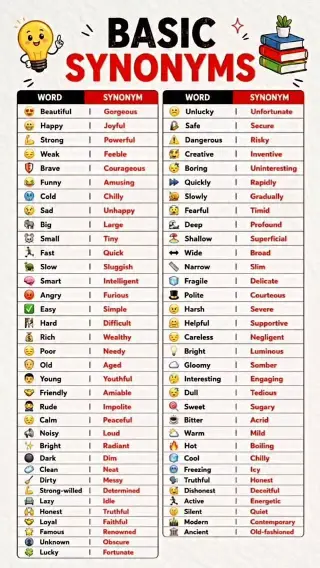
Closest and widely useful alternatives
- Fundamental
- Essential
- Elementary
- Foundational
- Simple
- Rudimentary
- Primary
- Core
- Introductory
- Straightforward
- Uncomplicated
- Underlying
Formal or professional alternatives
- Preliminary
- Principal
- Integral
- Fundamental-level
- Foundational
- Conventional
- Standard
- Essential
- Indispensable
- Constituent
Neutral alternatives
- Ordinary
- Plain
- Common
- General
- Standard
- Typical
- Conventional
- Minimal
- Modest
- Limited
Context-specific alternatives
- Entry-level
- Beginner
- Introductory
- Primary-level
- Core
- Baseline
- Default
- Generic
- Bare-bones
- Simplified
- Unrefined
- Primitive
Important: These are not interchangeable in every sentence. Some describe importance, some describe difficulty, some describe simplicity, and others describe quality or sophistication.
Formal Alternatives
1. Fundamental
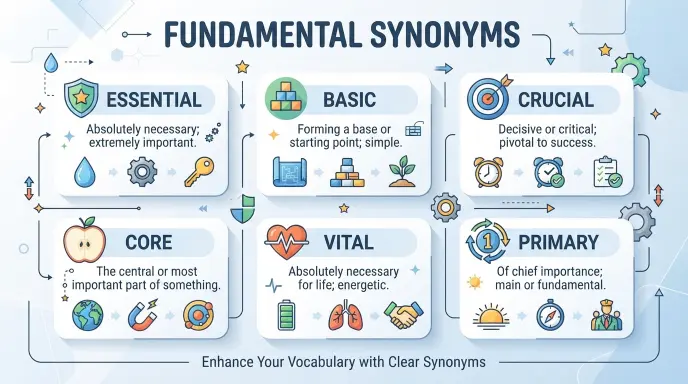
Meaning: Something essential or central to a subject.
Explanation: Fundamental is one of the strongest general alternatives to Synonyms for Basic when you mean something that forms the foundation of knowledge, principles, or understanding.
Example:
Students must understand the fundamental principles of economics.
Best Use: Academic writing, business reports, technical explanations, and professional communication.
Worst Use: Avoid it when you simply mean visually simple or inexpensive.
Tone: Formal, precise, authoritative.
2. Essential
Meaning: Absolutely necessary or important.
Explanation: Essential focuses on necessity rather than simplicity. It works well when basic means something a person must have or understand.
Example:
Clean water is essential for human health.
Best Use: Professional writing, instructions, policies, health information, and everyday communication.
Worst Use: It does not replace basic when you mean “simple.”
Tone: Neutral to formal.
3. Foundational
Meaning: Providing the foundation for something more advanced.
Explanation: This is especially useful for education, skills, systems, and theories.
Example:
The course teaches foundational programming skills.
Best Use: Academic writing, training materials, education, and professional development.
Worst Use: It sounds awkward for objects such as “a foundational shirt.”
Tone: Formal and educational.
4. Elementary
Meaning: Relating to the first or simplest stage of learning.
Explanation: Elementary often describes beginner-level knowledge or a very simple concept.
Example:
The textbook introduces elementary mathematical concepts.
Best Use: Education, academic writing, and explanations of beginner-level subjects.
Worst Use: Calling a professional’s work “elementary” may sound insulting because it can imply that the work is too simple.
Tone: Formal or neutral, depending on context.
5. Rudimentary
Meaning: Very simple and not fully developed.
Explanation: Rudimentary is useful when something exists at an early or incomplete stage.
Example:
The team developed a rudimentary prototype.
Best Use: Technical writing, research, development, and descriptions of early systems.
Worst Use: Avoid it when you want to praise something as complete or highly effective.
Tone: Formal, sometimes slightly negative.
6. Primary
Meaning: First in importance, position, or order.
Explanation: Primary can replace basic when the intended meaning is “main,” “first,” or “most important.”
Example:
The primary goal is to improve customer satisfaction.
Best Use: Business, academic, professional, and technical writing.
Worst Use: It does not mean “simple” in every context.
Tone: Formal and professional.
7. Preliminary
Meaning: Happening before the main or final stage.
Explanation: This is a contextual alternative, not a direct synonym. It works when basic means an early or initial stage.
Example:
The researchers conducted a preliminary analysis.
Best Use: Research, reports, planning, meetings, and investigations.
Worst Use: Don’t use it for something that is merely simple.
Tone: Formal.
8. Principal
Meaning: Most important or main.
Explanation: Principal can replace basic only when the word means “main” rather than “simple.”
Example:
The principal objective of the project is efficiency.
Best Use: Formal reports, academic writing, and professional documents.
Worst Use: It is not appropriate for “basic instructions” if you mean beginner instructions.
Tone: Formal.
9. Integral
Meaning: Necessary to make a whole complete.
Explanation: Integral is stronger than basic and emphasizes that something is an essential part of a system.
Example:
Communication is an integral part of effective teamwork.
Best Use: Business, academic, technical, and professional writing.
Worst Use: Avoid it when discussing something merely simple.
Tone: Formal and polished.
10. Indispensable
Meaning: Absolutely necessary; impossible to do without.
Explanation: This is a stronger alternative to essential, not a general synonym for basic.
Example:
Reliable data is indispensable to the research process.
Best Use: Formal writing when emphasizing necessity.
Worst Use: It sounds excessive for minor or ordinary things.
Tone: Strong and formal.
11. Underlying
Meaning: Existing beneath the surface and supporting something.
Explanation: Underlying works when basic refers to a deeper principle or cause.
Example:
The report examines the underlying causes of the problem.
Best Use: Research, analysis, academic writing, and professional reports.
Worst Use: It does not mean “easy.”
Tone: Analytical and formal.
12. Constituent
Meaning: Forming part of a larger whole.
Explanation: This is a specialized alternative and is useful when discussing components.
Example:
Trust is a constituent element of a strong professional relationship.
Best Use: Academic, legal, technical, and analytical writing.
Worst Use: It can sound unnecessarily technical in casual writing.
Tone: Formal and technical.
Semi-Formal & Neutral Alternatives

13. Simple
Meaning: Easy to understand, use, or do.
Explanation: Probably the most common replacement when basic means uncomplicated.
Example:
The website has a simple navigation system.
Best Use: Websites, instructions, emails, product descriptions, and everyday writing.
Worst Use: Avoid it if you mean “essential.”
Tone: Neutral.
14. Straightforward
Meaning: Easy to understand or deal with.
Explanation: This suggests clarity and lack of unnecessary complexity.
Example:
The application process is straightforward.
Best Use: Business writing, customer service, websites, and emails.
Worst Use: It may not work for physical objects where you mean visually plain.
Tone: Friendly and professional.
15. Uncomplicated
Meaning: Not difficult or complex.
Explanation: This is a close alternative when describing a process, task, or idea.
Example:
We need an uncomplicated solution.
Best Use: Business communication, instructions, and everyday writing.
Worst Use: It can sound awkward before some nouns.
Tone: Neutral.
16. Introductory
Meaning: Designed for people who are new to a subject.
Explanation: Use this instead of basic for courses, lessons, guides, and training.
Example:
I enrolled in an introductory photography class.
Best Use: Education, websites, courses, manuals, and training.
Worst Use: Don’t use it for something that is simply inexpensive or plain.
Tone: Neutral and educational.
17. Standard
Meaning: Normal, commonly accepted, or regularly used.
Explanation: Standard can replace basic when describing a normal version rather than an advanced or premium one.
Example:
The standard package includes email support.
Best Use: Business, products, services, websites, and customer communication.
Worst Use: It does not necessarily mean simple.
Tone: Neutral and professional.
18. Ordinary
Meaning: Normal or not unusual.
Explanation: Ordinary is useful when basic means common or unexceptional.
Example:
It was an ordinary day at the office.
Best Use: Everyday writing and descriptive prose.
Worst Use: It may sound negative if you are trying to praise something.
Tone: Neutral.
19. Plain
Meaning: Simple, undecorated, or without special features.
Explanation: Plain is particularly useful for appearance, design, clothing, and language.
Example:
She chose a plain white shirt.
Best Use: Fashion, design, food, writing, and everyday conversation.
Worst Use: Don’t use it for “basic skills” when you mean foundational.
Tone: Neutral.
20. Common
Meaning: Frequently found, used, or experienced.
Explanation: Common focuses on frequency rather than simplicity.
Example:
This is a common mistake among new writers.
Best Use: Education, websites, articles, and everyday explanations.
Worst Use: It can change the meaning if basic means necessary.
Tone: Neutral.
21. General
Meaning: Broad rather than specific or detailed.
Explanation: General information is often used where someone might otherwise say basic information.
Example:
The website provides general information about the program.
Best Use: Websites, introductions, reports, and public communication.
Worst Use: Don’t use it when you specifically mean beginner-level.
Tone: Neutral and professional.
22. Typical
Meaning: Representative of what is normal or expected.
Explanation: Typical can work when basic means ordinary or standard.
Example:
This is a typical example of the problem.
Best Use: Explanations, reports, education, and everyday writing.
Worst Use: It does not mean simple or fundamental.
Tone: Neutral.
23. Conventional
Meaning: Traditional, usual, or widely accepted.
Explanation: This is useful when basic describes a normal or established method.
Example:
The company uses conventional methods for quality control.
Best Use: Academic, professional, technical, and business writing.
Worst Use: It can imply tradition rather than simplicity.
Tone: Formal-neutral.
24. Minimal
Meaning: The smallest amount necessary or very limited.
Explanation: Minimal is narrower than basic. It emphasizes quantity, features, or extent.
Example:
The design uses minimal decoration.
Best Use: Design, technology, business, and everyday descriptions.
Worst Use: Don’t use it if you mean “fundamental.”
Tone: Neutral and modern.
25. Modest
Meaning: Limited in size, quality, amount, or ambition.
Explanation: Modest can replace basic when describing something simple but not necessarily poor.
Example:
They live in a modest apartment.
Best Use: Housing, budgets, achievements, and descriptive writing.
Worst Use: It is not a synonym for fundamental.
Tone: Neutral and polite.
26. Limited
Meaning: Restricted in amount, range, or capability.
Explanation: This works when basic means having few features or capabilities.
Example:
The free version offers limited functionality.
Best Use: Software, services, products, and business writing.
Worst Use: It can sound negative and should not replace basic when you mean foundational.
Tone: Neutral to negative.
27. Generic
Meaning: General rather than customized or specialized.
Explanation: Generic can describe a basic product or solution, but it often suggests a lack of customization.
Example:
The template provides a generic starting point.
Best Use: Software, marketing, products, and business.
Worst Use: It may imply low individuality or quality.
Tone: Neutral.
28. Baseline
Meaning: A starting level used for comparison.
Explanation: Baseline is not a direct synonym for basic. It is useful when discussing a starting measurement or standard.
Example:
We established a baseline before beginning the experiment.
Best Use: Research, analytics, business, and technical writing.
Worst Use: Avoid it as a replacement for “simple.”
Tone: Technical and professional.
Informal and Casual Alternatives
29. Beginner
Meaning: Suitable for someone new to a subject.
Example:
This is a beginner-friendly guitar lesson.
When natural: Classes, hobbies, tutorials, and casual explanations.
Avoid when: Writing highly formal academic material where introductory or elementary may be more suitable.
Tone: Friendly and accessible.
30. Bare-bones
Meaning: Containing only the most necessary features.
Example:
We started with a bare-bones version of the website.
When natural: Technology, projects, casual business conversations.
Avoid when: Writing formal reports or polished academic work.
Tone: Informal.
31. No-frills
Meaning: Simple and without extra features or luxuries.
Example:
We booked a no-frills hotel for the weekend.
When natural: Travel, products, services, and casual conversation.
Avoid when: The subject is a serious academic or legal document.
Tone: Casual and practical.
32. Easy
Meaning: Not difficult.
Example:
The instructions are easy to follow.
When natural: Everyday conversation, tutorials, and friendly communication.
Avoid when: You mean “essential” rather than “simple.”
Tone: Very casual and clear.
33. Straight-up
Meaning: Direct, plain, or uncomplicated in informal speech.
Example:
Give me the straight-up version of the story.
When natural: Casual conversation and messages.
Avoid when: Writing professional reports, academic papers, or formal emails.
Tone: Very informal.
34. Plain and simple
Meaning: Completely straightforward and without complications.
Example:
The plan is plain and simple: finish the work by Friday.
When natural: Conversation, blogs, and informal writing.
Avoid when: You need technical precision.
Tone: Conversational.
35. No-nonsense
Meaning: Practical, direct, and without unnecessary extras.
Example:
She prefers a no-nonsense approach to management.
When natural: Business conversations, reviews, and casual professional writing.
Avoid when: The subject requires a softer or more diplomatic tone.
Tone: Informal but confident.
36. Bare
Meaning: Without extra features, decoration, or support.
Example:
The room had bare walls and simple furniture.
When natural: Descriptive writing and casual conversation.
Avoid when: You mean “fundamental” or “necessary.”
Tone: Neutral to informal.
True Synonyms vs. Contextual Alternatives
Not every word in a “synonyms for basic” list can replace basic in every sentence. The table below shows why.
| Type | What It Means | Can It Replace “Basic”? |
|---|---|---|
| True/very close synonym | Similar meaning in a specific sense | Often |
| Near synonym | Similar but with a different emphasis | Sometimes |
| Contextual alternative | Works only in certain situations | Only in context |
| Broader expression | Covers a wider idea | Sometimes |
| Narrower expression | Describes a more specific meaning | Only when appropriate |
For example, fundamental can replace basic in “basic principles,” but plain cannot. Likewise, simple works in “basic design,” while essential would change the meaning.
The safest approach is to identify what basic means in your sentence before selecting a replacement.
Industry-Specific Usage
Business Writing
Business writing often benefits from replacing vague uses of basic with more precise terms.
Instead of:
We need a basic plan.
Consider:
We need a standard plan.
If you mean a starting plan:
We need a foundational plan.
If you mean a low-feature plan:
We need a limited plan.
Precision matters because business readers need to know whether “basic” refers to price, features, complexity, or importance.
Corporate Communication
In reports, policies, and internal announcements, useful choices include:
- Essential for requirements
- Standard for normal procedures
- Foundational for core principles
- Preliminary for early information
- General for broad information
- Core for central functions
Example:
Employees must complete the essential training before accessing the system.
This is clearer than:
Employees must complete the basic training.
Academic Writing
Academic writing usually benefits from words such as fundamental, foundational, elementary, preliminary, primary, underlying, and core.
Example:
The study examines the underlying causes of the behavior.
Instead of:
The study examines the basic causes.
For an introductory course:
This chapter introduces fundamental concepts in chemistry.
Use basic when it is genuinely the clearest option, but avoid repeating it when a more precise academic term exists.
Customer Service
Customer-facing language should usually stay simple and friendly.
Good choices include:
- Simple
- Straightforward
- Standard
- General
- Essential
- Introductory
Example:
Here is a straightforward guide to resetting your password.
This is often better than:
Here is a basic guide to resetting your password.
Straightforward tells the customer that the process should be easy to follow.
Legal Writing
Legal writing requires extra care because words that appear similar can have different meanings.
For example, fundamental, essential, primary, and preliminary are not automatically interchangeable. A legal document should use the term that accurately describes the legal concept rather than simply choosing a more sophisticated synonym.
If basic appears in a legal explanation, replacing it with a stronger word could unintentionally change the meaning. Legal drafting should therefore favor precision over variety.
Email Communication
Professional emails commonly benefit from:
- Simple
- Straightforward
- Essential
- General
- Standard
- Preliminary
For example:
“I’ve attached a straightforward summary of the proposal.”
sounds more natural than:
“I’ve attached a basic summary of the proposal.”
Email Examples
1. Client Communication — “Straightforward”
Subject: A Straightforward Overview of the New Process
Hi Daniel,
I’ve attached a straightforward overview of the new ordering process. It covers the main steps without going into technical details.
Please let me know if you would like a more detailed version.
Best,
Maria
2. Project Update — “Preliminary”
Subject: Preliminary Project Findings
Hi Team,
I’ve attached our preliminary findings from this week’s testing. These results are not final, but they give us a useful starting point for the next stage.
I’ll share the complete report once the remaining tests are finished.
Best,
James
3. Academic Email — “Foundational”
Subject: Foundational Reading for the Assignment
Hello Professor Lee,
I’ve completed the foundational readings for the assignment and have started reviewing the additional research you recommended.
I’ll submit my first draft by Thursday.
Best,
Nadia
4. Customer Service — “Simple”
Subject: Simple Steps to Update Your Account
Hi Robert,
Here are the simple steps for updating your account information:
- Sign in.
- Open your profile.
- Select “Account Settings.”
- Update your information and save the changes.
Please contact us if you need any help.
Best,
Customer Support
5. Internal Workplace Email — “Essential”
Subject: Essential Information for Friday’s Meeting
Hi Everyone,
Please review the essential information in the attached document before Friday’s meeting. We’ll use it as a reference during the discussion.
Thanks,
Alex
Short Dialogue Examples
Workplace
Person A: Can you explain the basic process?
Person B: Sure. I’ll give you a straightforward overview first, then we can discuss the details.
Classroom
Person A: Is this an advanced course?
Person B: No, it’s introductory. It’s designed for students who are new to the subject.
Customer Service
Person A: I need help using the website.
Person B: No problem. I can show you a simple way to complete the process.
Casual Conversation
Person A: What kind of room did you book?
Person B: Nothing fancy. Just a no-frills room near the station.
Professional Discussion
Person A: What should we focus on first?
Person B: The fundamental issues. Once those are resolved, we can move to the smaller details.
How to Replace “Basic” in a Sentence
Example 1
Original:
She has basic knowledge of accounting.
Alternative:
She has foundational knowledge of accounting.
Why it works:
Foundational sounds more precise and emphasizes knowledge that supports further learning.
Example 2
Original:
We need a basic explanation.
Alternative:
We need a simple explanation.
Why it works:
Simple clearly communicates that the explanation should be easy to understand.
Example 3
Original:
This is a basic course.
Alternative:
This is an introductory course.
Why it works:
Introductory specifically tells readers that the course is intended for beginners.
Example 4
Original:
These are the basic requirements.
Alternative:
These are the essential requirements.
Why it works:
Essential emphasizes necessity.
Example 5
Original:
We used a basic design.
Alternative:
We used a minimal design.
Why it works:
Minimal emphasizes limited decoration or features.
Example 6
Original:
The software has basic features.
Alternative:
The software has limited features.
Why it works:
Limited emphasizes the restricted range of functions.
Example 7
Original:
The report gives basic information about the topic.
Alternative:
The report gives general information about the topic.
Why it works:
General is useful when the report provides a broad overview rather than detailed analysis.
Example 8
Original:
We need a basic version of the product.
Alternative:
We need a standard version of the product.
Why it works:
Standard works when you mean the normal version rather than a premium or customized option.
Example 9
Original:
He has basic computer skills.
Alternative:
He has elementary computer skills.
Why it works:
Elementary emphasizes beginner-level ability, although it can sound more formal.
Example 10
Original:
The machine uses basic technology.
Alternative:
The machine uses conventional technology.
Why it works:
Conventional suggests established or commonly used technology rather than necessarily simple technology.
Comparison Table
| Phrase | Tone | Meaning / Scope | Best Use | Example |
|---|---|---|---|---|
| Basic | Neutral | Simple, fundamental, or limited | General writing | Basic skills |
| Fundamental | Formal | Essential foundation | Academic/business | Fundamental principles |
| Essential | Neutral/formal | Necessary | Requirements | Essential information |
| Simple | Neutral | Easy or uncomplicated | General communication | Simple instructions |
| Foundational | Formal | Supporting later learning | Education | Foundational skills |
| Introductory | Neutral/formal | For beginners | Courses/guides | Introductory lesson |
| Elementary | Formal | Early/simple level | Education | Elementary concepts |
| Rudimentary | Formal | Early and underdeveloped | Technical writing | Rudimentary system |
| Standard | Neutral | Normal or usual version | Products/business | Standard package |
| Plain | Neutral | Undecorated/simple | Design/style | Plain language |
| Minimal | Neutral | Limited in amount/features | Design | Minimal interface |
| General | Neutral | Broad, not detailed | Websites/reports | General information |
| Straightforward | Neutral | Easy and clear | Instructions/emails | Straightforward process |
| Conventional | Formal | Established or usual | Technical/business | Conventional method |
| Limited | Neutral | Restricted in scope | Products/software | Limited access |
| No-frills | Casual | Without extras | Travel/services | No-frills hotel |
Which Alternative Should You Choose?
For formal writing
Choose fundamental, foundational, essential, integral, or underlying, depending on meaning.
For business communication
Use standard, straightforward, essential, general, or core.
For academic writing
Prefer fundamental, foundational, elementary, introductory, preliminary, or underlying.
For legal writing
Choose the most precise term, not simply the most formal one. Basic may sometimes be safer than an inaccurate substitute.
For professional email
Use simple, straightforward, essential, standard, or general.
For everyday conversation
Simple, basic, easy, plain, and straightforward are natural.
For casual messages
Try easy, no-frills, bare-bones, plain and simple, or straight-up, depending on the situation.
Grammar & Usage Guide
“Basic” is usually an adjective
The most common structure is:
basic + noun
Examples:
- basic knowledge
- basic skills
- basic information
- basic requirements
- basic equipment
- basic principles
You generally do not need a hyphen in these ordinary constructions.
“Basic” can describe different qualities
Compare:
basic skills = beginner-level skills
basic needs = essential needs
basic design = simple design
basic package = standard or limited package
The noun determines the intended meaning.
“Basic” can have different tones
The word is normally neutral, but it can sometimes sound dismissive:
“The course is basic.”
Depending on context, this might mean introductory—or it might suggest that the course lacks depth.
A more precise version would be:
“The course is introductory.”
“Basic” vs. “basically”
Basic is an adjective:
This is a basic explanation.
Basically is an adverb:
Basically, we need more time.
Do not replace one with the other.
Common collocations
Natural combinations include:
- basic knowledge
- basic skills
- basic needs
- basic information
- basic principles
- basic requirements
- basic understanding
- basic education
- basic training
- basic equipment
- basic structure
- basic features
Choosing a synonym often means changing the noun combination too. For example, foundational knowledge is natural, while foundational shopping bag is not.
Common Mistakes to Avoid
1. Treating every alternative as an exact synonym
Simple, essential, and standard can all replace basic in some contexts, but they mean different things.
2. Using “fundamental” when you mean “easy”
❌ The software has a fundamental interface.
✅ The software has a simple interface.
3. Using “elementary” to praise professional work
Calling a professional’s analysis elementary may imply that it lacks sophistication.
4. Using “minimal” for essential information
Minimal means limited in amount or features. It does not mean necessary.
5. Using casual phrases in formal writing
Expressions such as no-frills and straight-up usually belong in conversational writing.
6. Overusing sophisticated synonyms
Replacing every instance of basic with fundamental can make writing sound unnatural.
7. Ignoring the noun that follows
The best alternative depends on the phrase:
basic needs → essential needs
basic course → introductory course
basic design → minimal/simple design
basic information → general information
8. Creating a false change in meaning
Do not replace basic with essential unless necessity is actually part of the intended meaning.
When Not to Use the Original Word
You may want to replace basic when:
1. The meaning is too vague
Instead of:
We provide basic training.
Say:
We provide introductory training for new employees.
2. You mean “necessary”
Use essential instead.
3. You mean “easy”
Use simple or straightforward.
4. You mean “beginner-level”
Use introductory or elementary.
5. You mean “normal version”
Use standard.
6. You mean “few features”
Use limited, minimal, or bare-bones, depending on tone.
When “basic” is actually better
Keep basic when it is the clearest word for a broad audience:
This guide covers basic computer skills.
The phrase is short, familiar, and easy to understand.
Advanced Writer Tips
Tone Control
For a more formal tone:
basic principles → fundamental principles
a neutral tone:
basic instructions → simple instructions
For a friendly tone:
basic guide → easy guide
Choose precision before sophistication.
Professional Email Etiquette
Avoid replacing basic merely to sound intelligent. A sentence such as:
“Here is a straightforward overview.”
usually sounds more natural than:
“Here is a fundamental overview.”
The first describes clarity; the second can sound unnatural.
Politeness
Some alternatives can subtly change how a message feels.
Compare:
“These are basic requirements.”
with:
“These are the essential requirements.”
The second sounds more serious and emphasizes necessity.
Context Alignment
Ask yourself what basic means before replacing it:
- Necessary? → essential
- Foundational? → fundamental
- Beginner-level? → introductory
- Easy? → simple
- Normal? → standard
- Broad? → general
- Few features? → limited
- Undecorated? → plain
- Early-stage? → rudimentary
Precision
The best synonym is not necessarily the fanciest one. It is the one that preserves the original meaning most accurately.
Readability
Short words often work best:
“We provide simple instructions.”
is usually clearer than:
“We provide uncomplicated procedural guidance.”
Good writing is precise without being unnecessarily complicated.
Related Questions
What is another way to say “basic”?
Depending on the context, you can say simple, fundamental, essential, elementary, foundational, introductory, standard, general, straightforward, or rudimentary.
What is a professional alternative to “basic”?
Fundamental, essential, foundational, standard, and straightforward are useful professional choices, but the best option depends on the sentence.
What is a formal alternative?
For formal writing, fundamental, foundational, elementary, preliminary, underlying, integral, or essential may work.
What can I use instead of “basic information”?
Try general information when you mean a broad overview or essential information when you mean information people need to know.
Is “basic” formal?
Basic is neither strongly formal nor informal. It is a common neutral English word. Its tone depends on context.
Can “simple” replace “basic”?
Often, but not always. Simple describes lack of complexity, while basic can also mean fundamental, necessary, standard, or beginner-level.
What is the difference between “basic” and “fundamental”?
Basic is broader and more flexible. Fundamental specifically emphasizes something that forms a foundation or is central to understanding a subject.
FAQs
1. What are the best synonyms for “basic”?
The best choices are simple, fundamental, essential, foundational, introductory, elementary, standard, and straightforward. Choose based on the intended meaning rather than simply selecting the closest-looking word.
2. What is the best synonym for “basic” in academic writing?
Fundamental and foundational are often strong choices. Introductory is better when referring to a beginner-level course or resource, while elementary works for early-stage concepts.
3. What is the best alternative for “basic information”?
Use general information for a broad overview and essential information when the information is necessary. Introductory information can work when introducing a subject to beginners.
4. Is “fundamental” stronger than “basic”?
Usually, yes. Fundamental emphasizes importance and foundation. Basic can simply mean simple, ordinary, or beginner-level, so the two are not always interchangeable.
5. Is “rudimentary” a positive synonym for “basic”?
Not necessarily. Rudimentary often suggests that something is underdeveloped, incomplete, or at an early stage. It can therefore carry a mildly negative meaning.
6. What is the best casual synonym for “basic”?
For casual conversation, simple, easy, no-frills, bare-bones, and plain and simple can work, depending on what you mean.
7. How can I avoid repeating “basic” in an article?
First identify the meaning in each sentence. Replace it with fundamental for principles, essential for requirements, introductory for beginner material, simple for ease, and standard for normal versions.
Key Takeaways
- Basic has several meanings, so there is no single perfect replacement for every sentence.
- Use fundamental or foundational when you mean something that forms a base.
- Use essential when you mean something necessary and simple when you mean uncomplicated.
- Choose introductory or elementary for beginner-level learning and standard for a normal version.
- The strongest synonym is the one that preserves your exact meaning, audience, and tone.
Conclusion;
Finding the right synonym for basic is less about replacing one word with another and more about choosing the exact meaning you want to express. Basic can describe something fundamental, simple, necessary, introductory, standard, ordinary, or limited, so context should always guide your choice.
For formal and academic writing, fundamental, foundational, essential, underlying, and preliminary can add precision. For professional communication, straightforward, standard, general, and essential are often clearer. In everyday writing, simple, easy, plain, and basic itself may be the most natural choices.
Avoid changing words simply to make your writing sound more sophisticated. A precise, familiar word is usually better than an impressive but inaccurate one. Before replacing basic, ask what the word means in that particular sentence. Then choose the alternative that preserves the meaning while improving clarity, tone, and readability.
