
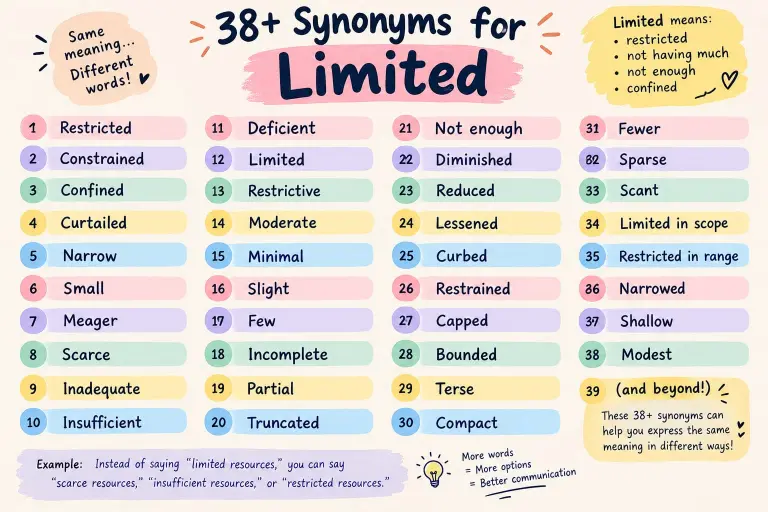
Finding the right alternative to 38+Synonyms for Limited can make your writing clearer, more precise, and more natural. The word can describe something restricted in amount, size, time, availability, scope, or access. For example, a limited budget is not the same as a limited-edition product, and limited knowledge is different from limited access. Each situation calls for a slightly different word.
People often search for synonyms for 38+Synonyms for Limited when writing essays, reports, emails, business documents, websites, applications, or everyday messages. The best replacement depends on the exact meaning you want to express and the tone of your sentence. This guide explains more than 38 + Synonyms for Limited useful alternatives, shows how they differ, and provides practical examples so you can choose the right word without changing your intended meaning.
Quick Answer
Useful synonyms for limited include restricted, finite, confined, constrained, narrow, small, scarce, insufficient, modest, minimal, bounded, controlled, capped, reduced, short, low, exclusive, selective, localized, and conditional. The best choice depends on whether you mean a small quantity, restricted access, limited time, reduced scope, or a specific condition.
Quick List — 40+ Useful Alternatives to Limited
Closest alternatives 38+Synonyms for Limited

- Restricted
- Constrained
- Confined
- Finite
- Bounded
- Narrow
- Capped
- Controlled
- Reduced
- Circumscribed
Closest alternatives
- Scarce
- Sparse
- Small
- Low
- Minimal
- Insufficient
- Inadequate
- Meager
- Modest
- Short
Scope of 38+Synonyms for Limited
- Narrow
- Restricted
- Specific
- Focused
- Defined
- Localized
- Confined
- Bounded
- Selective
- Partial
Access or permission
- Restricted
- Controlled
- Exclusive
- Selective
- Conditional
- Regulated
- Reserved
- Authorized
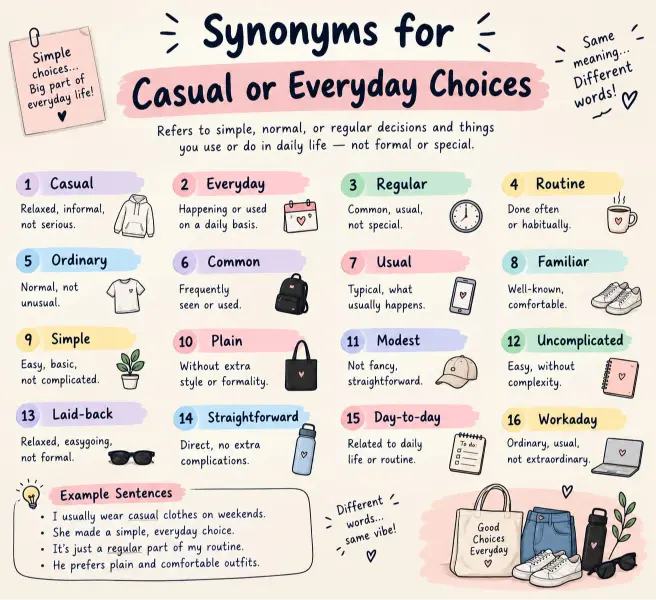
Synonyms for Casual or everyday choices
- Small
- Short
- Low
- Tight
- Few
- Not much
- Hard to find
- In short supply
Formal Alternatives to 38+Synonyms for Limited
1. Restricted
Meaning: Something is controlled or prevented from being freely available.
Explanation: This is one of the closest alternatives to limited when talking about access, use, movement, or permission. It emphasizes a restriction rather than simply a small quantity.
Example: Access to the research database is restricted to registered users.
Best Use: Policies, reports, security notices, business writing, and official communication.
Worst Use: Avoid it when you simply mean that something is small in quantity.
Tone: Formal and precise.
2. Constrained
Meaning: Restricted by a condition, rule, resource, or circumstance.
Explanation: Constrained suggests that something cannot expand or operate freely because of a specific limitation.
Example: The project was constrained by a limited budget and tight deadline.
Best Use: Business reports, academic writing, planning, and technical documents.
Worst Use: It can sound unnecessarily formal in casual conversation.
Tone: Formal and analytical.
3. Confined
Meaning: Kept within a particular space, range, or boundary.
Explanation: Confined is especially useful when something is restricted to a specific area or scope.
Example: The study was confined to participants between the ages of 18 and 30.
Best Use: Academic research, formal reports, medical writing, and technical contexts.
Worst Use: It may sound too strong if there is no real boundary.
Tone: Formal and specific.
4. Finite
Meaning: Having a definite end or quantity.
Explanation: Finite is ideal when something exists in a fixed amount and cannot continue indefinitely.
Example: The company has finite resources for the project.
Best Use: Academic, scientific, financial, and technical writing.
Worst Use: Avoid it when you simply mean something is currently unavailable.
Tone: Formal and technical.
5. Bounded
Meaning: Having clear limits or boundaries.
Explanation: This word emphasizes a defined range rather than general scarcity.
Example: The research examined a bounded set of variables.
Best Use: Mathematics, science, research, statistics, and formal analysis.
Worst Use: It can sound overly technical in ordinary emails.
Tone: Formal and technical.
6. Circumscribed
Meaning: Strictly restricted within certain limits.
Explanation: Circumscribed is a sophisticated alternative to limited. It often describes scope, authority, or activity that has clearly defined boundaries.
Example: The committee has circumscribed authority over financial decisions.
Best Use: Academic, legal, political, and formal professional writing.
Worst Use: Avoid it when a simpler word such as restricted would be clearer.
Tone: Highly formal.
7. Constrained in Scope
Meaning: Restricted to a specific range or area.
Explanation: This phrase is useful when describing a project, study, policy, or discussion that does not cover everything.
Example: The report is constrained in scope and focuses only on regional sales.
Best Use: Reports, academic papers, project documentation.
Worst Use: Too formal for a simple conversation.
Tone: Formal and professional.
8. Regulated
Meaning: Controlled by rules or official requirements.
Explanation: Regulated does not simply mean small. It means that access, activity, or use is governed by rules.
Example: The industry operates under heavily regulated conditions.
Best Use: Legal, financial, business, government, and compliance writing.
Worst Use: Do not use it merely to mean limited in quantity.
Tone: Formal and official.
9. Conditional
Meaning: Available or applicable only when certain conditions are met.
Explanation: This is useful when the limitation depends on requirements or circumstances.
Example: Funding is conditional on meeting the eligibility requirements.
Best Use: Contracts, policies, applications, grants, and formal communication.
Worst Use: It does not replace limited when quantity alone is the issue.
Tone: Formal and precise.
10. Selective
Meaning: Available to or involving only chosen people, items, or situations.
Explanation: Selective focuses on deliberate choice rather than shortage.
Example: The program uses a selective admission process.
Best Use: Education, recruitment, marketing, business, and access policies.
Worst Use: Avoid it if access is restricted because of a lack of resources rather than deliberate selection.
Tone: Neutral to formal.
11. Capped
Meaning: Set at a maximum level.
Explanation: Capped is especially useful for prices, spending, numbers, salaries, memberships, and quantities.
Example: Annual enrollment is capped at 500 students.
Best Use: Business, finance, education, policy, and pricing.
Worst Use: It sounds unnatural for abstract ideas such as limited creativity.
Tone: Professional and direct.
12. Circumscribed by
Meaning: Restricted by a particular rule, condition, or boundary.
Example: The team’s authority is circumscribed by company policy.
Best Use: Formal reports and legal or organizational writing.
Worst Use: Casual conversation.
Tone: Highly formal.
Semi-Formal and Neutral Alternatives
13. Small
Meaning: Not large in amount, size, or number.
Explanation: Small is broad and easy to understand. It works well when the main idea is simply that the quantity or scale is not large.
Example: We have a small number of seats available.
Best Use: Everyday writing, websites, emails, and general communication.
Worst Use: Avoid it when you need to emphasize legal or formal restrictions.
Tone: Neutral.
14. Scarce
Meaning: Available in very small quantities.
Explanation: Scarce suggests that there is not enough of something and that obtaining it may be difficult.
Example: Clean drinking water is scarce in some regions.
Best Use: Academic, environmental, business, and general writing.
Worst Use: Don’t use it if the item is deliberately restricted but actually abundant.
Tone: Neutral to formal.
15. Sparse
Meaning: Thinly distributed or occurring in small numbers.
Example: The region has sparse public transportation.
Best Use: Describing populations, information, vegetation, data, or distribution.
Worst Use: It is not a general replacement for every use of limited.
Tone: Neutral.
16. Minimal
Meaning: Very small or only as much as necessary.
Example: The changes had a minimal effect on the final result.
Best Use: Reports, websites, academic writing, and professional communication.
Worst Use: Don’t use it when you mean that something is unavailable.
Tone: Neutral and professional.
17. Modest
Meaning: Relatively small, moderate, or not excessive.
Example: The company achieved a modest increase in sales.
Best Use: Business writing, reports, and polite descriptions.
Worst Use: It may sound too positive if the amount is genuinely inadequate.
Tone: Polite and understated.
18. Reduced
Meaning: Made smaller or lower than before.
Example: The company is operating with reduced staff this month.
Best Use: Business, health, finance, operations, and everyday writing.
Worst Use: It does not necessarily mean the amount was always small.
Tone: Neutral.
19. Minimalist
Meaning: Using very little or keeping something simple.
Example: The website uses a minimalist design.
Best Use: Design, architecture, lifestyle, branding, and creative writing.
Worst Use: Not suitable when limited means restricted access.
Tone: Neutral and descriptive.
20. Narrow
Meaning: Small in range, scope, width, or variety.
Example: The course has a narrow focus on digital marketing.
Best Use: Academic writing, research, business, and general descriptions.
Worst Use: Avoid it when describing a physical quantity unless width is actually involved.
Tone: Neutral.
21. Partial
Meaning: Incomplete or covering only part of something.
Example: The customer received a partial refund.
Best Use: Business, customer service, reports, and everyday writing.
Worst Use: Don’t use it when something is complete but simply small.
Tone: Neutral and professional.
22. Specific
Meaning: Focused on a particular area rather than broad.
Example: The training provides specific guidance for new employees.
Best Use: Academic writing, websites, instructions, and professional communication.
Worst Use: Specific does not always mean restricted.
Tone: Neutral.
23. Focused
Meaning: Concentrated on a particular subject or purpose.
Example: The report provides a focused analysis of customer behavior.
Best Use: Business, academic, marketing, and website writing.
Worst Use: Avoid it if you need to emphasize a lack of resources.
Tone: Positive and professional.
24. Localized
Meaning: Restricted to a particular place or area.
Example: The outbreak remained localized to one region.
Best Use: Geography, medicine, business, technology, and news writing.
Worst Use: It does not mean limited in quantity.
Tone: Neutral to formal.
Informal and Casual Alternatives
25. Few
Meaning: A small number.
Example: Only a few tickets are left.
When it sounds natural: Everyday conversation, social media, texts, and simple writing.
When to avoid it: Formal reports may need a more precise number.
Tone: Casual and clear.
26. Not many
Meaning: A small number of people or things.
Example: Not many seats are left.
When it sounds natural: Conversations and friendly messages.
When to avoid it: Academic or legal writing.
Tone: Casual.
27. Not much
Meaning: A small amount.
Example: There isn’t much time left.
When it sounds natural: Everyday speech.
When to avoid it: Formal writing where a specific quantity matters.
Tone: Casual.
28. In short supply
Meaning: Difficult to obtain because there is not enough available.
Example: Affordable housing is in short supply.
When it sounds natural: News, conversation, business, and general writing.
When to avoid it: Don’t use it for deliberate restrictions.
Tone: Neutral and conversational.
29. Tight
Meaning: Small or restricted, especially regarding money, time, or resources.
Example: We’re on a tight budget this month.
When it sounds natural: Business conversation and everyday speech.
When to avoid it: Formal academic writing.
Tone: Informal.
30. Low
Meaning: Small in amount, level, or degree.
Example: We have low stock right now.
When it sounds natural: Business, shopping, conversation, and practical communication.
When to avoid it: Low does not necessarily mean restricted by a rule.
Tone: Neutral.
31. Short
Meaning: Not enough of something, especially time, money, or supplies.
Example: We’re short on staff today.
When it sounds natural: Everyday and workplace conversations.
When to avoid it: Formal documents may require insufficient or inadequate.
Tone: Casual to neutral.
32. Hard to come by
Meaning: Difficult to find or obtain.
Example: Good parking spaces are hard to come by downtown.
When it sounds natural: Blogs, conversations, reviews, and informal writing.
When to avoid it: Contracts and highly formal reports.
Tone: Conversational.
33. Few and far between
Meaning: Rare and widely separated.
Example: Affordable homes in that neighborhood are few and far between.
When it sounds natural: Articles, conversations, blogs, and storytelling.
When to avoid it: Technical writing where exact data is required.
Tone: Conversational and expressive.
True Synonyms vs. Contextual Alternatives
Not every word above can replace limited in every sentence. The key difference is why something is limited.
| Type | What It Means | Can It Replace Limited? |
|---|---|---|
| True synonym | Directly expresses restriction or a definite boundary | Often |
| Near synonym | Similar meaning but adds a shade of meaning | Sometimes |
| Contextual alternative | Works only in a particular situation | Depends on context |
| Broader expression | Describes a related idea more generally | Sometimes |
| Narrower expression | Describes one specific kind of limitation | Only in relevant contexts |
For example, restricted access and limited access are close matches. But scarce access sounds different because scarce suggests that access is difficult to obtain rather than officially restricted.
Likewise, finite resources means resources have a definite amount, while reduced resources means the amount has become smaller than before. These differences matter in precise writing.
Industry-Specific Usage
Business Writing
Business documents often benefit from precise alternatives such as constrained, reduced, finite, capped, scarce, narrow, and restricted.
- Limited budget → constrained budget
- Limited resources → finite resources
- Limited sales period → restricted sales period
- Limited number of users → capped number of users
Choose the word that explains the actual business condition rather than simply replacing limited for variety.
Corporate Communication
For policies and internal announcements, restricted, controlled, capped, and conditional are particularly useful.
Example:
Access to the new system is restricted to authorized employees.
This is clearer than:
Access to the new system is limited to authorized employees.
Both work, but restricted puts more emphasis on control.
Academic Writing
Academic writing often benefits from finite, constrained, narrow, localized, partial, scarce, and specific.
Example:
The study has a narrow geographic focus.
This is better than:
The study has a limited geographic focus.
Both are correct, but narrow clearly describes the scope.
Customer Service
Customer-facing writing should usually be polite and simple.
Good choices include:
- limited availability
- small quantity
- few remaining
- currently unavailable
- restricted access
- reduced selection
Example:
Only a few appointments remain available this week.
This sounds more natural than an overly formal phrase such as circumscribed availability.
Legal Writing
Legal language requires special care. Restricted, conditional, authorized, regulated, and bounded may describe specific legal limitations, but they are not automatically interchangeable.
For example, conditional access means access depends on stated conditions, while restricted access suggests that rules prevent general access. The exact wording in a legal document should reflect the intended legal condition.
Email Communication
Professional emails usually work best with clear alternatives:
- limited → restricted
- limited availability → few openings
- limited resources → available resources are constrained
- limited time → short timeframe
- limited options → fewer options
Simple language is often more professional than unnecessarily complex vocabulary.
Email Examples
Client Communication
Subject: Limited Availability for Next Week
Hi Jordan,
We currently have only a few appointment openings next week. If you’d like to move forward, I can reserve one of the available times for you.
Please let me know which option works best.
Best,
Alex
Project Update
Subject: Project Resource Update
Hi Team,
The project is moving forward, but our available resources are constrained this week. We may need to adjust the schedule slightly to keep the work on track.
I’ll share an updated timeline tomorrow.
Best,
Maria
Customer Service
Subject: Your Product Availability
Hello Sam,
Thank you for your interest in the product. Stock is currently in short supply, but we expect another shipment soon.
We’ll let you know as soon as the item becomes available.
Best,
Customer Support
Academic Communication
Subject: Scope of the Research Project
Professor Lee,
I wanted to confirm that my research will have a narrow focus on online learning among undergraduate students. This will allow me to examine the topic in greater detail.
Thank you,
Daniel
Internal Workplace Email
Subject: Meeting Time
Hi everyone,
We have a short timeframe 38+ Synonyms for Limited to complete the current review, so I’d like to keep tomorrow’s meeting focused on the three main issues.
Please send any additional points before the meeting.
Thanks,
Nina
Short Dialogue Examples
Workplace
Person A: We have limited time before the presentation.
Person B: Then let’s keep the discussion focused on the main points.
Classroom
Person A: Why does the study have a narrow focus?
Person B: The researcher wanted to explore one group in more detail.
Customer Service
Person A: Are there any seats left?
Person B: Yes, but only a few remain.
Casual Conversation
Person A: Is parking easy to find here?
Person B: Not really. Good spots are hard to come by.
Professional Discussion
Person A: Can we increase the number of participants?
Person B: Not yet. The current enrollment is capped.
How to Replace “Limited” in a Sentence
Example 1
Original: The company has limited resources.
Alternative: The company has finite resources.
Why it works: Finite emphasizes that the total resources have a definite boundary.
Example 2
Original: Access is limited to employees.
Alternative: Access is restricted to employees.
Why it works: Restricted clearly communicates controlled access.
Example 3
Original: We have limited time.
Alternative: We have a short timeframe.
Why it works: The alternative sounds natural and clearly focuses on time.
Example 4
Original: The store has limited stock.
Alternative: The product is in short supply.
Why it works: This emphasizes scarcity rather than an official restriction.
Example 5
Original: The course has limited content.
Alternative: The course has a narrow scope.
Why it works: Narrow scope explains that the course covers a focused area.
Example 6
Original: Only limited options are available.
Alternative: Only a few options are available.
Why it works: The alternative is simpler and more natural for everyday communication.
Example 7
Original: The offer is limited to new customers.
Alternative: The offer is exclusive to new customers.
Why it works: Exclusive emphasizes eligibility, not quantity.
Example 8
Original: Funding is limited by the annual budget.
Alternative: Funding is constrained by the annual budget.
Why it works: Constrained clearly shows that the budget creates the restriction.
Comparison Table
| Phrase | Tone | Meaning / Scope | Best Use | Example |
|---|---|---|---|---|
| Limited | Neutral | General restriction | Most contexts | Limited access |
| Restricted | Formal | Controlled access or use | Policies | Restricted area |
| Finite | Formal | Definite quantity | Academic/business | Finite resources |
| Constrained | Formal | Restricted by conditions | Business | Constrained budget |
| Scarce | Neutral | Hard to obtain | Resources | Scarce supplies |
| Narrow | Neutral | Small range or scope | Research | Narrow focus |
| Reduced | Neutral | Lower than before | Reports | Reduced staffing |
| Minimal | Neutral | Very small | Analysis | Minimal impact |
| Capped | Professional | Maximum fixed level | Finance/business | Capped enrollment |
| Selective | Neutral | Available to chosen cases | Admissions | Selective access |
| Partial | Neutral | Incomplete | Refunds/data | Partial payment |
| Few | Casual | Small number | Everyday use | Few seats remain |
| Short | Casual | Not enough | Time/resources | Short on time |
| In short supply | Conversational | Difficult to obtain | Products/resources | In short supply |
| Hard to come by | Casual | Difficult to find | Conversation | Hard to come by |
Which Alternative Should You Choose?
For Formal Writing
Choose restricted, constrained, finite, bounded, or circumscribed when the sentence needs precision and a professional tone.
For Business Communication
Use constrained, reduced, capped, restricted, or scarce depending on the situation.
For Academic Writing
Prefer finite, narrow, constrained, localized, partial, or specific.
For Legal Writing
Use restricted, conditional, regulated, authorized, or another term that describes the exact legal condition. Do not replace legal terminology casually.
For Professional Email
Keep it simple. Limited availability, few openings, short timeframe, or restricted access are usually clear choices.
For Everyday Conversation
Use few, small, short, low, not much, or in short supply.
For Casual Messages
Simple phrases usually sound best:
Only a few spots left.
is more natural than:
Availability is circumscribed.
Grammar & Usage Guide
“Limited” as an Adjective
Limited commonly comes before a noun.
- limited access
- limited time
- limited resources
- limited options
- limited availability
Example:
We have limited parking.
“Limited to” for Restrictions
Use limited to when describing who or what is included.
The offer is limited to members.
You can often use restricted to in similar contexts:
The offer is restricted to members.
“Limited by” for a Cause of Restriction
Use limited by when something creates the restriction.
The project is limited by its budget.
A close alternative is:
The project is constrained by its budget.
“Limited in” for a Specific Area
Use limited in when describing a restricted quality or capacity.
The device is limited in storage capacity.
“A limited number of”
This is a common structure.
A limited number of seats are available.
You can also say:
Only a few seats are available.
The second version is shorter and more conversational.
“Limited” vs. “Limiting”
These forms are different.
- Limited describes something that has a restriction.
- Limiting describes something that creates a restriction.
Example:
We have limited resources.
The budget is limiting our options.
Common Mistakes to Avoid
- Treating every alternative as an exact synonym
Scarce means hard to obtain, while restricted means controlled. They are not always interchangeable. - Using “circumscribed” in casual writing
It is grammatically correct but often unnecessarily formal. - Using “scarce” for controlled access
If access is officially blocked, restricted is usually better. - Using “few” with uncountable nouns
Say few options, but little time or not much time. - Confusing “reduced” with “limited”
Reduced suggests something became smaller. Limited does not necessarily imply a previous larger amount. - Using “exclusive” when quantity is the issue
Exclusive usually describes access or eligibility, not scarcity. - Using “low” for rules or permissions
Say restricted access, not low access, when a rule controls access. - Making professional writing unnecessarily complicated
A few openings remain is often better than availability is circumscribed. - Ignoring context
The correct word for limited resources may be finite, while the correct word for limited access may be restricted.
When Not to Use the Original Word “Limited”
There are situations where another word is more precise.
When access is officially controlled
Use restricted.
Restricted access is required.
When quantity is difficult to obtain
Use scarce or in short supply.
Skilled workers are in short supply.
When something has a fixed maximum
Use capped.
Enrollment is capped at 200 students.
When something is smaller than before
Use reduced.
The company has reduced staffing.
When the scope is narrow
Use narrow or focused.
The research has a narrow focus.
When the number is simply small
Use few.
Only a few seats remain.
When “limited” is actually the better choice
Keep limited when you want a broad, neutral word that does not add an unnecessary shade of meaning.
The report provides limited information.
This sentence is useful when you do not need to say whether the information is scarce, restricted, incomplete, or narrowly focused.
Advanced Writer Tips
Professional Email Etiquette
Clear language usually sounds more professional than complicated vocabulary. Instead of saying resources are circumscribed, say:
We have limited resources available this week.
Politeness
Word choice can change how a limitation feels.
Compare:
You have restricted access.
with:
Access is currently available to authorized users.
The second version can sound less harsh while communicating the same basic condition.
Context Alignment
Think about why something is limited:
- Rule → restricted
- Fixed amount → finite
- Maximum → capped
- Shortage → scarce
- Small number → few
- Narrow range → narrow
- Smaller than before → reduced
- Condition-based → conditional
Precision
Don’t replace limited just because you want variety. Replace it when another word gives the reader more useful information.
Readability
Simple words often win.
Only a few seats remain.
is easier to understand than:
Seating availability is significantly circumscribed.
Related Questions
What is another word for limited?
Common alternatives include restricted, finite, constrained, narrow, scarce, reduced, minimal, bounded, capped, selective, and few. The right choice depends on whether you mean restricted access, a small amount, a fixed maximum, a shortage, or a narrow scope.
What is a professional alternative to limited?
Restricted, constrained, finite, reduced, and capped are strong professional alternatives. For example, limited resources can become constrained resources when external conditions prevent the organization from using more resources.
What is a formal synonym for limited?
Restricted, constrained, finite, bounded, and circumscribed are formal options. However, they have different meanings, so the most sophisticated word is not always the best choice.
Can “scarce” replace “limited”?
Sometimes. Scarce means difficult to obtain because there is not enough available. It works well for resources, supplies, or opportunities but usually does not describe an official restriction.
Is “limited” formal?
Limited is neutral rather than strongly formal. It works comfortably in academic papers, business documents, professional emails, websites, and everyday conversation.
What is the difference between limited and restricted?
38+Synonyms for Limited is broader and can mean small, finite, or restricted. Restricted specifically emphasizes control, rules, or lack of permission. For example, limited availability means there is not much available, while restricted access means access is controlled.
FAQs
What are the best synonyms for limited?
The best synonym depends on context. Use restricted for controlled access, finite for a definite quantity, scarce for difficult-to-find resources, narrow for scope, capped for a maximum, and few for a small number.
What is the strongest formal alternative to limited?
Circumscribed is one of the most formal alternatives, but it is not always the best. Restricted and constrained are usually more natural in professional writing, while finite works particularly well for resources and quantities.
What is a good synonym for limited availability?
Good options include restricted availability, scarce availability, reduced availability, few openings, and in short supply. Choose based on the reason for the shortage. For a simple customer message, few openings remain is usually clearest.
What can I use instead of limited in academic writing?
Try constrained, finite, narrow, localized, partial, specific, or restricted, depending on the sentence. Academic writing benefits from precision, so choose the word that describes the exact type of limitation.
What is the opposite of limited?
Common opposites include unlimited, unrestricted, abundant, extensive, broad, plentiful, ample, and boundless. The correct opposite depends on whether the original meaning concerns quantity, access, scope, or availability.
Is “few” a synonym for limited?
Few can work as a contextual alternative when limited means a small number of countable things. For example, limited seats can become few seats. It cannot replace limited in every context.
Is “finite” the same as limited?
Not exactly. Finite means something has a definite boundary or endpoint. 38+Synonyms for Limited is broader and can also describe restrictions, shortages, narrow scope, or controlled access.
Key Takeaways
- Restricted is best when rules or controls limit access or use.
- Finite describes a definite amount with a clear boundary.
- Scarce suggests that something is difficult to obtain or in short supply.
- Narrow, reduced, capped, and few describe different kinds of limitation.
- Choose the alternative based on meaning, audience, tone, and context—not simply for vocabulary variety.
Conclusion;
The best synonym for 38+ Synonyms for Limited depends on exactly what kind of limitation you mean. If access is controlled, restricted is usually the clearest choice. If resources have a definite amount, finite works well. For shortages, consider scarce or in short supply. For a narrow range, use narrow or focused, while capped is useful for a fixed maximum. In everyday writing, simpler choices such as few, small, short, or not much often sound more natural.
Good 38+ Synonyms for Limited word choice is not about finding the fanciest replacement. It is about preserving the original meaning while making the sentence clearer and more suitable for its audience. Before replacing limited, ask what the limitation actually describes: quantity, access, scope, time, availability, or conditions. Then 38+Synonyms for Limited choose the word that communicates that exact idea.
