
Finding the right synonyms for caused can make your writing clearer, more precise, and less repetitive.
The word 33+Synonyms for Caused is common in essays, reports, emails, academic writing, business documents, and everyday English, but it does not always express the exact relationship between two events.
Sometimes you need a stronger word such as triggered or provoked. In other situations, led to, resulted in, or contributed to may be more accurate.
This guide explains more than 33 alternatives to Synonyms for Caused, including formal, neutral, academic, professional, and conversational choices.
You will learn what each word means, how its meaning differs from caused, where it works best.
Quick Answer
Useful synonyms for 33+Synonyms for Caused include led to, resulted in, brought about, triggered, produced, created, generated, prompted, induced, provoked, contributed to, gave rise to, sparked, and precipitated. The best choice depends on whether you mean direct causation, partial influence, a sudden reaction, or a resulting event.
Quick List: Useful Alternatives to Caused
Closest and neutral alternatives

Closest and neutral alternatives
- led to
- resulted in
- brought about
- produced
- created
- generated
- prompted
- triggered
- caused
- induced
- contributed to
- gave rise to
- brought on
- resulted from
- influenced
- affected
- sparked
- provoked
- produced
- occasioned
More formal alternatives
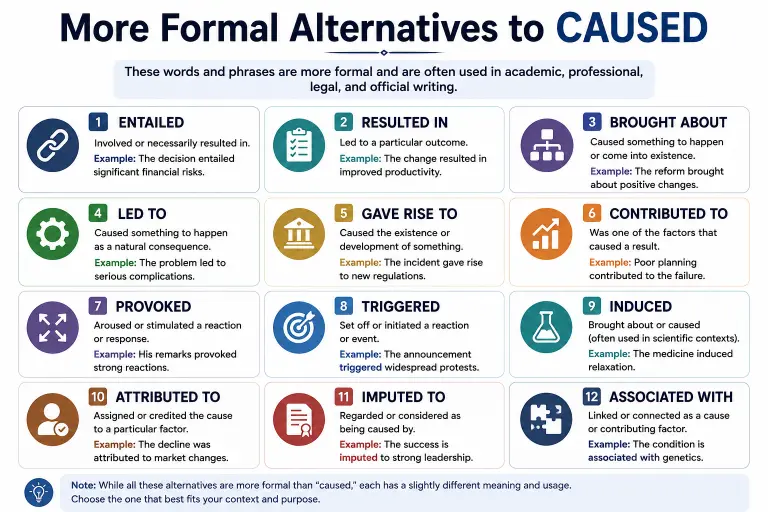
- precipitated
- engendered
- instigated
- occasioned
- effected
- induced
- prompted
- generated
- brought about
- gave rise to
Context-specific alternatives
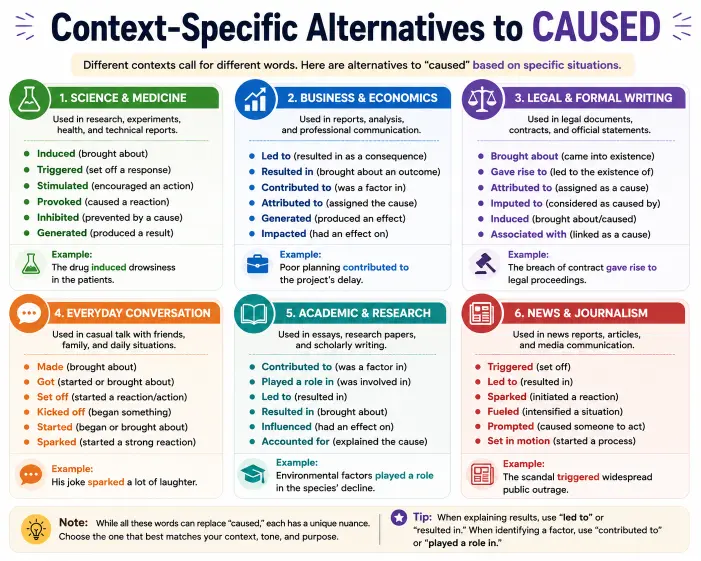
- triggered — for something that starts a reaction
- provoked — for a strong reaction
- prompted — for an action or response
- contributed to — for partial causation
- led to — for a consequence or outcome
- resulted in — for a clear outcome
- produced — for an effect or result
- generated — for an outcome, response, or output
- sparked — for an idea, movement, reaction, or sudden activity
- precipitated — for a serious or rapid event
Formal Synonyms
Formal alternatives are especially useful in academic papers, 33+Synonyms for Caused professional reports, business writing, and official communication. However, formal does not automatically mean better. Choose the word that accurately describes the relationship between the action and the result.
1. Led to
Meaning: Caused something to happen or resulted in a particular outcome.
Explanation: Led to is one of the safest replacements for 33+Synonyms for Caused It usually describes a relationship between an earlier event and a later result without sounding overly technical.
Example:
The new policy led to a significant reduction in processing time.
Best Use: Academic writing, business reports, essays, and general professional writing.
Worst Use: Avoid it when you need to show that something directly and immediately produced an effect.
Tone: Neutral and professional.
2. Resulted in
Meaning: Produced a particular outcome.
Explanation: Resulted in focuses strongly on the outcome. It is especially useful when describing what happened after an event or decision.
Example:
The software error resulted in several delayed transactions.
Best Use: Reports, research writing, technical documents, and formal explanations.
Worst Use: It can sound awkward when the relationship is indirect or speculative.
Tone: Formal and objective.
3. Brought about
Meaning: Made something happen.
Explanation: This phrase is close to caused, but it often suggests 33+Synonyms for Caused for Caused that an action, change, or development produced a new situation.
Example:
The agreement brought about major changes in the organization.
Best Use: Formal writing, history, social science, and business communication.
Worst Use: Avoid it when a shorter phrase such as caused or led to would be clearer.
Tone: Formal and polished.
4. Produced
Meaning: Created or generated a particular result.
Explanation: Produced works well when an action, process, or condition creates a measurable result or effect.
Example:
The experiment produced unexpected results.
Best Use: Scientific, academic, technical, and business writing.
Worst Use: Do not use it when the subject did not actually generate the outcome.
Tone: Neutral to formal.
5. Generated
Meaning: Created, developed, or produced something.
Explanation: Generated is common when discussing data, interest, revenue, energy, reactions, ideas, or responses.
Example:
The campaign generated considerable interest among customers.
Best Use: Marketing, business, technology, research, and professional writing.
Worst Use: It may sound unnatural for simple physical events where caused or led to is clearer.
Tone: Professional and modern.
6. Prompted
Meaning: Encouraged or caused someone to take an action or caused a response.
Explanation: Prompted is more specific than 33+Synonyms for Caused caused. It often involves a person, group, decision, question, or event responding to something.
Example:
The complaint prompted the company to review its policy.
Best Use: Business emails, reports, journalism, and professional writing.
Worst Use: Avoid it when the result happened automatically and involved no response.
Tone: Neutral and formal.
7. Induced
Meaning: Caused something to happen, often through influence or deliberate action.
Explanation: Induced is more technical than caused. It is common in medicine, science, economics, and formal writing.
Example:
The medication induced a temporary change in blood pressure.
Best Use: Scientific, medical, technical, and academic contexts.
Worst Use: It may sound unnecessarily technical in casual conversation.
Tone: Formal and technical.
8. Precipitated
Meaning: Caused an event to happen suddenly or sooner than expected.
Explanation: This word suggests that something directly helped bring about a significant, often serious event.
Example:
The announcement precipitated a sharp decline in investor confidence.
Best Use: Academic, financial, historical, and formal analytical writing.
Worst Use: Avoid it for ordinary, minor outcomes.
Tone: Highly formal.
9. Engendered
Meaning: 33+Synonyms for Caused or created a feeling, condition, or situation.
Explanation: Engendered is usually used with abstract outcomes such as trust, debate, resentment, support, or concern.
Example:
The decision engendered considerable public debate.
Best Use: Academic writing, journalism, essays, and formal analysis.
Worst Use: It is not a natural choice for everyday physical events.
Tone: Formal.
10. Instigated
Meaning: Started or encouraged an action or event.
Explanation: Instigated usually suggests that someone deliberately started something, particularly an action, dispute, protest, or conflict.
Example:
The group instigated a discussion about workplace safety.
Best Use: Historical, political, social, and formal contexts.
Worst Use: Avoid it when there is no intentional action.
Tone: Formal and sometimes negative.
11. Occasioned
Meaning: Caused or provided the reason for something.
Explanation: Occasioned is a formal and relatively uncommon alternative. It often appears in legal, historical, or literary writing.
Example:
The incident occasioned a review of the company’s safety procedures.
Best Use: Formal documents, historical writing, and legal-style prose.
Worst Use: Avoid it in casual conversation because it can sound old-fashioned.
Tone: Very formal.
12. Effected
Meaning: Brought about or made something happen.
Explanation: Effected means successfully brought about a change. It is different from affected, which means influenced something without necessarily changing it.
Example:
The reforms effected significant improvements in public services.
Best Use: Formal and academic writing.
Worst Use: Do not confuse effected with affected.
Tone: Formal.
Semi-Formal and Neutral Alternatives
These choices are often easier to read than highly formal vocabulary.
13. Triggered
Meaning: Started a reaction or event.
Explanation: Triggered is stronger and more specific than caused when something acts as the immediate starting point.
Example:
The sudden price increase triggered a wave of complaints.
Best Use: News, business, technology, everyday writing, and analytical content.
Worst Use: Avoid it when the cause was gradual rather than sudden.
Tone: Neutral and direct.
14. Sparked
Meaning: Started something, especially an idea, reaction, discussion, or movement.
Example:
The article sparked a lively debate among students.
Best Use: Journalism, blogs, social media, essays, and general writing.
Worst Use: It is less suitable for precise technical causation.
Tone: Conversational and energetic.
15. Provoked
Meaning: Caused a reaction, especially a strong emotional or behavioral response.
Example:
The comment provoked an angry response.
Best Use: Describing emotions, arguments, reactions, and controversy.
Worst Use: Avoid it when the result was neutral or purely mechanical.
Tone: Neutral to strong.
16. Contributed to
Meaning: Helped cause something but was not necessarily the only cause.
Example:
Poor planning contributed to the project’s delay.
Best Use: Academic writing, research, reports, and careful analysis.
Worst Use: Do not use it when you know something was the sole or direct cause.
Tone: Precise and cautious.
17. Gave rise to
Meaning: 33+Synonyms for Caused something to develop or occur.
Example:
The discovery gave rise to several new research questions.
Best Use: Academic, professional, and formal writing.
Worst Use: It can sound too formal for simple conversation.
Tone: Formal-neutral.
18. Brought on
Meaning: 33+Synonyms for Caused something, often an unpleasant condition or event.
Example:
The long hours brought on severe fatigue.
Best Use: Health-related general writing, everyday English, and descriptions of conditions.
Worst Use: Avoid it when you need highly technical or scientific precision.
Tone: Neutral and conversational.
19. Created
Meaning: Made something exist or happen.
Example:
The new system created several opportunities for small businesses.
Best Use: General writing, business, marketing, and everyday communication.
Worst Use: It may imply that something was deliberately made rather than simply caused.
Tone: Neutral.
20. Generated
Meaning: Produced or brought about an outcome.
Example:
The survey generated useful feedback.
Best Use: Business, technology, marketing, and research.
Worst Use: It may be too broad when a more precise verb is available.
Tone: Professional.
21. Produced
Meaning: Made or caused a result.
Example:
The training produced noticeable improvements in performance.
Best Use: Reports, academic writing, business, and science.
Worst Use: Avoid it when the outcome is uncertain.
Tone: Neutral-formal.
22. Influenced
Meaning: Had an effect on something without necessarily being its direct cause.
Example:
Several factors influenced the final decision.
Best Use: Research, essays, business writing, and social analysis.
Worst Use: Do not use it as a direct substitute when something definitely caused the result.
Tone: Neutral.
23. Affected
Meaning: Changed or influenced someone or something.
Example:
The storm affected transportation across the region.
Best Use: General, academic, professional, and news writing.
Worst Use: Do not assume affected means completely caused.
Tone: Neutral.
24. Prompted
Meaning: 33+Synonyms for Caused a person or group to respond or act.
Example:
The warning prompted residents to leave the area.
Best Use: Professional writing, reports, news, and emails.
Worst Use: Avoid it for results that did not involve a response.
Tone: Neutral-formal.
25. Led directly to
Meaning:33+ Synonyms for Caused a clearly connected result.
Example:
The mistake led directly to the cancellation of the order.
Best Use: Situations where the causal relationship is strong and clear.
Worst Use: Avoid it when several uncertain factors were involved.
Tone: Direct and precise.
Informal and Casual Alternatives
There are fewer true casual synonyms for caused. In everyday speech, people often use short phrases rather than unusual replacement verbs.
26. Made
Meaning: Caused someone or something to become or do something.
Example:
The joke made everyone laugh.
When it sounds natural: Everyday conversation and informal writing.
When to avoid it: Academic or technical writing where more precision is needed.
Tone: Very casual and simple.
27. Set off
Meaning: Started a reaction or event.
Example:
The alarm set off a chain reaction.
When it sounds natural: Conversation, news, storytelling, and informal writing.
When to avoid it: Highly formal academic writing unless the phrase fits naturally.
Tone: Conversational.
28. Brought on
Meaning: Made something happen, often an unwanted condition.
Example:
Too much stress brought on his headache.
When it sounds natural: Everyday explanations.
When to avoid it: Technical contexts requiring exact causation.
Tone: Casual-neutral.
29. Started
Meaning: Caused something to begin.
Example:
The announcement started a long discussion.
When it sounds natural: Everyday English.
When to avoid it: When the event was not actually initiated by the subject.
Tone: Simple and conversational.
30. Set in motion
Meaning: Started a process that continued to develop.
Example:
The decision set in motion a series of changes.
When it sounds natural: Storytelling, business, journalism, and general writing.
When to avoid it: For very small or immediate effects.
Tone: Conversational to formal.
More Contextual Alternatives Worth Knowing
Some expressions are useful substitutes only in particular situations.
31. Sparked
Best for ideas, debates, movements, interest, and reactions.
Example:
The announcement sparked widespread interest.
It is more vivid than caused and usually suggests a beginning.
32. Set off
Best for alarms, reactions, processes, and chains of events.
Example:
The smoke set off the fire alarm.
It suggests an immediate trigger.
33. Brought about
Best for changes and developments.
Example:
The reforms brought about major improvements.
It emphasizes the resulting change.
34. Gave rise to
Best for ideas, problems, questions, debates, or developments.
Example:
The discovery gave rise to new questions.
It sounds more formal than caused.
35. Resulted in
Best when you want to emphasize the final outcome.
Example:
The delay resulted in additional costs.
It focuses attention on what happened as a consequence.
36. Triggered
Best when an event starts a reaction.
Example:
The news triggered a strong public response.
It often suggests an immediate or identifiable cause.
37. Provoked
Best when something causes an emotional or active response.
Example:
The decision provoked criticism.
It can carry a stronger or more negative tone than caused.
38. Brought on
Best for conditions or unwanted situations.
Example:
The intense workload brought on exhaustion.
It is less suitable for neutral technical results.
39. Contributed to
Best when the cause is only one factor among several.
Example:
Heavy traffic contributed to the delay.
It should not replace caused when there is clear proof of direct causation.
40. Produced
Best when something creates a measurable or observable result.
Example:
The treatment produced positive results.
It is especially common in scientific and professional writing.
True Synonyms vs. Contextual Alternatives
Not every word in a synonym list can replace caused in every sentence. The table below shows why.
| Type | What It Means | Can It Replace caused? |
|---|---|---|
| True synonym | Directly made something happen | Usually, depending on grammar |
| Near synonym | Has a similar meaning but slightly different force | Sometimes |
| Contextual alternative | Works only in particular situations | Only in suitable contexts |
| Broader expression | Describes influence without proving direct causation | Not always |
| Narrower expression | Describes a specific type of causation | Only when that specific meaning applies |
For example, caused and led to can often work in similar sentences:
The storm caused delays.
The storm led to delays.
However, contributed to changes the level of certainty:
The storm contributed to delays.
This means the storm was one factor, rather than necessarily the only cause.
Similarly, triggered suggests a starting point:
The announcement triggered protests.
That is more specific than simply saying:
The announcement caused protests.
Choosing a synonym therefore requires more than finding a word with a similar dictionary definition. You need to consider the relationship between the cause and the result.
Industry-Specific Usage
Business Writing
Business writing benefits from precise alternatives such as led to, resulted in, generated, contributed to, and prompted.
Example:
The pricing change resulted in higher customer retention.
This sounds more precise than repeatedly using caused.
When the relationship is uncertain, contributed to is safer:
Several factors contributed to the increase in sales.
Corporate Communication
Reports and internal announcements often need neutral language.
The system update led to temporary delays.
Customer feedback prompted a review of the process.
The new policy resulted in fewer processing errors.
These phrases sound professional without becoming unnecessarily complicated.
Academic Writing
Academic writing requires careful claims about causation. Avoid using
when your evidence only demonstrates correlation or influence.
Instead, consider:
- contributed to
- was associated with
- influenced
- led to
- resulted in
- was a factor in
For example:
Limited access to resources contributed to lower participation.
This is more cautious than claiming:
Limited access to resources caused lower participation.
The second sentence makes a stronger causal claim.
Customer Service
Customer service writing should be clear and polite.
Instead of:
Your request caused a delay.
You might write:
Your request resulted in a processing delay.
Or:
The additional verification step led to a longer processing time.
These alternatives can sound less accusatory while still explaining the situation.
Legal Writing
Legal writing requires particular care because causation can have a specific legal meaning. A 33+Synonyms for Caused may not preserve the intended legal scope.
Words such as resulted in, contributed to, and led to can describe factual relationships, but they should not automatically be treated as legal equivalents of caused. Legal documents should use terminology appropriate to the relevant jurisdiction and legal issue.
Email Communication
Professional emails often benefit from neutral causal language.
For example:
The system update resulted in a short delay.
is usually more polished than:
The system update caused a short delay.
Neither is automatically better. The right choice depends on how direct you want to sound and how certain the causal relationship is.
Email Examples
Client Communication
Subject: Update on Your Order
Hello Sarah,
The supplier delay resulted in a later dispatch date for your order. We now expect the package to leave our warehouse on Thursday.
Thank you for your patience.
Best,
Alex
Internal Project Update
Subject: Project Timeline Update
Hi Team,
The additional testing requirements led to a change in the project timeline. We have moved the final review to next Tuesday.
Thanks,
Daniel
Customer Service
Subject: Your Support Request
Hello James,
The missing account information prompted our team to request one additional document before we can complete the review.
Please let us know if you need help providing it.
Best,
Customer Support
Vendor Communication
Subject: Delivery Schedule
Hello Maria,
The recent inventory shortage contributed to the delivery delay. Could you please confirm the revised shipment date?
Thank you,
Michael
Academic Communication
Subject: Assignment Submission
Dear Professor Lee,
A technical issue resulted in a delay while I was uploading the assignment. The file has now been submitted successfully.
Thank you for your understanding.
Best regards,
Jordan
Short Dialogue Examples
Workplace
Person A: Why was the meeting moved?
Person B: The client request led to a change in the schedule.
Classroom
Person A: Why did the class discussion become so lively?
Person B: The new question sparked a lot of interest.
Customer Service
Person A: Why is my order taking longer?
Person B: A supplier issue contributed to the delay.
Casual Conversation
Person A: What started the argument?
Person B: That comment triggered a pretty strong reaction.
Professional Discussion
Person A: Why did the project finish late?
Person B: Several unexpected issues contributed to the delay.
How to Replace “Caused” in a Sentence
Example 1
Original:
The storm caused major delays.
Alternative:
The storm led to major delays.
Why it works:
Led to is natural, neutral, and slightly less direct.
Example 2
Original:
The error caused the system to stop.
Alternative:
The error triggered the system shutdown.
Why it works:
Triggered emphasizes the immediate event that started the shutdown.
Example 3
Original:
The campaign caused more interest in the product.
Alternative:
The campaign generated more interest in the product.
Why it works:
Generated works naturally with interest and sounds professional.
Example 4
Original:
The policy caused several changes.
Alternative:
The policy brought about several changes.
Why it works:
Brought about emphasizes the changes produced by the policy.
Example 5
Original:
Poor planning caused the delay.
Alternative:
Poor planning contributed to the delay.
Why it works:
This version is more cautious and suggests that poor planning was one factor.
Example 6
Original:
The news caused public concern.
Alternative:
The news sparked public concern.
Why it works:
Sparked gives the sentence a stronger sense of a reaction beginning.
Example 7
Original:
The announcement caused people to leave.
Alternative:
The announcement prompted people to leave.
Why it works:
Prompted shows that the announcement encouraged or caused a response.
Example 8
Original:
The medication caused a reaction.
Alternative:
The medication induced a reaction.
Why it works:
Induced is more technical and can fit scientific or medical contexts.
Example 9
Original:
The reforms caused improvements.
Alternative:
The reforms resulted in improvements.
Why it works:
Resulted in clearly emphasizes the outcome.
Example 10
Original:
The intense workload caused exhaustion.
Alternative:
The intense workload brought on exhaustion.
Why it works:
Brought on sounds natural when describing an unwanted condition.
Comparison Table
| Phrase | Tone | Meaning / Scope | Best Use | Example |
|---|---|---|---|---|
| caused | Neutral | Directly made something happen | General writing | The error caused delays. |
| led to | Neutral | Produced a consequence | Reports and essays | The error led to delays. |
| resulted in | Formal-neutral | Emphasizes the outcome | Reports | The error resulted in delays. |
| triggered | Direct | Started a reaction | News and technical writing | The error triggered an alert. |
| prompted | Professional | Caused a response or action | Business | The complaint prompted a review. |
| contributed to | Cautious | Was one contributing factor | Academic writing | Poor planning contributed to delays. |
| generated | Professional | Produced a result or response | Business | The campaign generated interest. |
| sparked | Conversational | Started interest or reaction | Media and general writing | The story sparked debate. |
| provoked | Strong | Caused a notable reaction | Conflict or criticism | The statement provoked criticism. |
| induced | Technical | Brought about a condition | Science and medicine | The treatment induced a response. |
| precipitated | Highly formal | Caused a rapid or serious event | Formal analysis | The crisis precipitated change. |
| brought about | Formal | Produced a change | Academic and professional | The reform brought about change. |
Which Alternative Should You Choose?
For formal writing
Choose resulted in, brought about, led to, generated, or precipitated when the context supports them.
For business communication
Use led to, resulted in, prompted, generated, or contributed to.
For academic writing
Prefer precise terms such as contributed to, influenced, led to, resulted in, or was a factor in, depending on the evidence.
For legal writing
Do not casually replace caused. Causation can have a specific legal meaning, so use terminology appropriate to the document and jurisdiction.
For professional emails
Use led to, resulted in, prompted, or contributed to for a polished and neutral tone.
For everyday conversation
Simple words such as caused, made, started, and led to usually sound most natural.
For casual messages
Made, set off, and brought on can work when the context fits.
Grammar & Usage Guide
Caused + object
The most common structure is:
Subject + caused + object.
Example:
The storm caused damage.
Here, caused directly connects the subject to the result.
Caused + object + to + verb
Another common structure is:
Subject + caused + person/thing + to + verb.
Example:
The delay caused the passengers to wait longer.
Do not write:
The delay caused the passengers waiting longer.
The correct structure uses to + base verb.
Led to + noun
Led to is normally followed by a noun or noun phrase.
The decision led to confusion.
It can also be followed by a gerund when the grammar requires it:
The decision led to increased spending.
Resulted in + noun
Use resulted in when emphasizing the outcome.
The mistake resulted in additional costs.
Do not confuse it with resulted from, which expresses the opposite direction:
The delay resulted from bad weather.
This distinction is important.
Caused by
Use caused by to identify the source of a result.
The delay was caused by heavy traffic.
The phrase is common in passive constructions.
Affected vs. effected
These two words are often confused.
Affected generally means influenced or changed:
The storm affected transportation.
Effected means brought about:
The reform effected major changes.
Effected is much less common.
Common Mistakes to Avoid
1. Treating every alternative as an exact synonym
Contributed to does not necessarily mean caused. It suggests partial influence.
2. Confusing caused with resulted from
These express opposite relationships.
The storm caused the delay.
The delay resulted from the storm.
3. Using triggered for every situation
Triggered suggests that something started a reaction. It is not always suitable for gradual outcomes.
4. Using overly formal vocabulary
Words such as precipitated and occasioned can make simple writing unnecessarily difficult.
5. Using casual words in formal writing
Made and set off may sound too conversational in academic or legal documents.
6. Confusing affected and effected
Remember: affected generally means influenced, while effected means brought about.
7. Overstating causation
If several factors contributed to an outcome, do not automatically claim that one factor caused it.
8. Ignoring grammar
Different alternatives require different structures. For example:
resulted in a delay
but:
resulted from a delay
These do not mean the same thing.
When Not to Use “Caused”
The word caused is useful, but another phrase may be better when:
- You want to avoid claiming direct causation.
- Several factors produced the outcome.
- You need to emphasize the final result.
- You want to show that something triggered a reaction.
- You are writing for a technical audience.
- You want a more polite tone in customer communication.
- You are repeating caused too often in the same paragraph.
- A more precise verb explains the relationship better.
For example, if research only shows that two factors are related, influenced or was associated with may be safer than caused. If the evidence clearly establishes a direct relationship, caused may actually be the strongest and clearest choice.
Advanced Writer Tips
Tone Control
Use caused for direct, neutral statements. Choose resulted in for a more formal tone, led to for natural professional writing, and sparked for a more vivid style.
Professional Email Etiquette
If you want to explain a problem without sounding accusatory, choose neutral wording.
Instead of:
Your mistake caused the delay.
Consider:
The error resulted in a delay.
The second version focuses on the situation rather than directly blaming the person.
Politeness
Small wording changes can reduce tension. Contributed to is often softer than caused because it does not assign complete responsibility.
Context Alignment
Think about your audience before choosing a synonym. A scientific report may benefit from induced, while a casual message will usually sound better with caused or made.
Precision
Ask yourself what actually happened. something directly cause the result? it only influence it? is it start a reaction? it create a measurable outcome .The answer determines the best word.
Readability
Do not replace a simple word just to sound intelligent. If caused is accurate and clear, there is nothing wrong with using it.
Related Questions;
What is another way to say caused?
Common alternatives include led to, resulted in, brought about, triggered, produced, generated, prompted, induced, sparked, and contributed to. The best choice depends on the exact relationship between the event and its outcome.
What is a professional alternative to caused?
Led to, resulted in, prompted, generated, and contributed to are strong professional choices. For formal reports, resulted in is especially useful when you want to emphasize the outcome without sounding overly conversational.
What is a formal alternative to caused?
Formal alternatives include brought about, precipitated, engendered, occasioned, effected, and induced. However, these words are not interchangeable in every sentence, so choose based on the exact meaning and context.
What can I use instead of caused in an essay?
For an essay, try led to, resulted in, contributed to, influenced, brought about, or gave rise to. Academic writing often benefits from precise wording, especially when the evidence does not prove that one factor was the sole cause.
Is caused formal?
Caused is a standard neutral English word, not an especially formal or informal expression. It is perfectly acceptable in academic, business, professional, and everyday writing. The main issue is not formality but whether it accurately describes the relationship between two events.
FAQs
What is the best synonym for caused?
There is no single best synonym for every sentence. Led to is a versatile neutral choice, while resulted in emphasizes an outcome. Triggered suggests an immediate reaction, and contributed to is better when several factors are involved.
Which synonym for caused is best for academic writing?
Academic writing often benefits from contributed to, influenced, led to, or resulted in. These choices can help you describe causation carefully. If your evidence proves direct causation, caused itself may be more accurate than a more complicated alternative.
Can I use resulted in instead of caused?
Usually, yes, when the sentence describes an outcome. For example, The error caused delays can become The error resulted in delays. However, resulted in focuses more strongly on the outcome and may not fit every grammatical structure.
Is triggered the same as caused?
Not exactly. Triggered is a narrower alternative that suggests something started a reaction, process, or event. For example, an alarm can be triggered by smoke. For gradual or indirect effects, led to or contributed to may be more accurate.
How can I avoid repeating caused in my writing?
First identify the exact causal relationship, then choose a suitable alternative. Use led to for consequences, resulted in for outcomes, triggered for reactions, and contributed to for partial influence. This creates variety without sacrificing accuracy.
What is the difference between caused and contributed to?
Caused generally presents something as a direct cause. Contributed to means it played a role among other possible causes. If several factors influenced an outcome, contributed to is usually more accurate and less absolute.
Is affected a synonym for caused?
Affected is a near synonym, but it is weaker. It means influenced or changed something and does not necessarily mean it directly produced the outcome. For example, a storm may affect traffic without being the sole cause of every delay.
Key Takeaways
- Caused is a neutral word that clearly expresses direct causation.
- Led to and resulted in are versatile alternatives for consequences and outcomes.
- Triggered, sparked, and provoked are better for reactions or events that begin suddenly.
- Contributed to and influenced are safer when causation is partial or uncertain.
- Choose the simplest accurate phrase rather than using a complicated synonym just to sound formal.
Conclusion;
There are many useful synonms for caused, but the best choice depends on what you actually mean. Led to is a flexible option for consequences, while resulted in emphasizes an outcome.
Triggered works well for reactions, prompted suits responses and actions, and contributed to is valuable when several factors are involved.
More formal words such as precipitated and engendered can work in specialized writing, but they should not replace simple language without a reason.
The key is precision. Before changing caused, ask whether you mean direct causation, influence, a sudden reaction, or a resulting change.
Choose the phrase that communicates that relationship most clearly. If this guide helped, bookmark it for your next essay, report, email, or blog post and share it with another writer.
