
Looking for 35+ synonyms for shadow? The best alternative depends on what you mean by shadow. As a noun, it can describe a dark shape caused by blocked light, a faint image, a person who closely follows someone, or a hidden influence. As a verb, it can mean to follow someone closely, observe them, or accompany them. Because the word has several meanings, no single synonym works in every sentence.
This guide explains more than 35 useful alternatives, including close synonyms, formal terms, literary expressions, and contextual choices. You will learn which words genuinely replace shadow, which only work in specific contexts, and how to choose the most natural option for academic writing, business communication, emails, creative writing, and everyday conversation.
Quick Answer
Common synonyms and contextual alternatives for shadow include shade, silhouette, darkness, gloom, obscurity, dimness, reflection, outline, ghost, specter, follower, observer, companion, presence, influence, trace, remnant, echo, afterimage, and cover. The correct choice depends on whether shadow means a dark area, an outline, a follower, or a hidden influence.
Quick List: 35+ Alternatives for Shadow
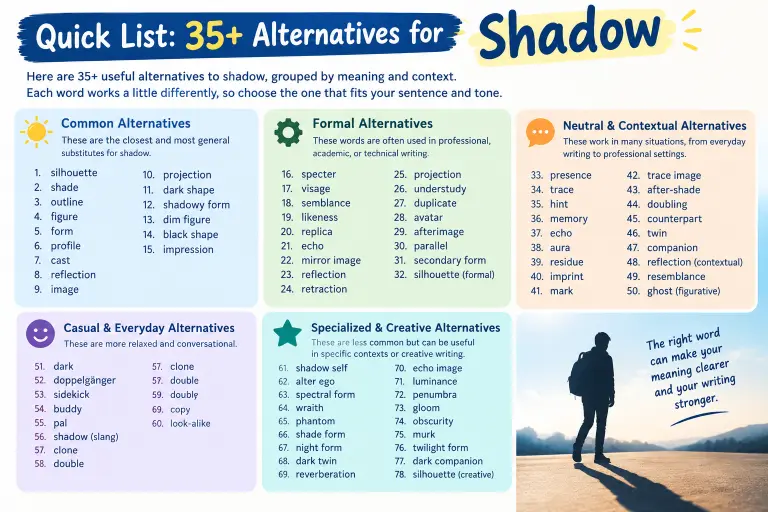
Closest or Physical Alternatives
- Shade
- Silhouette
- Darkness
- Gloom
- Dimness
- Obscurity
- Dark shape
- Outline
- Profile
- Umbra
Visual or Image-Related Alternatives
- Reflection
- Afterimage
- Image
- Impression
- Ghost image
- Blur
- Trace
Figurative Alternatives
- Presence
- Influence
- Effect
- Trace
- Remnant
- Echo
- Legacy
- Cloud
- Gloom
- Obscurity
- Stain
- Mark
Person-Related Alternatives
- Follower
- Observer
- Companion
- Attendant
- Pursuer
- Watcher
- Understudy
- Apprentice (in some professional contexts, not a true synonym)
Literary or Descriptive Alternatives
- Specter
- Ghost
- Phantom
- Wraith
- Darkness
- Veil
- Shroud
- Haze
Important: These 45 words are not interchangeable. For example, shade can replace shadow in some physical-light contexts, while specter is usually metaphorical or literary.
Formal Alternatives
1. Shade
Meaning: An area protected from direct light.
Explanation: Shade is one of the closest alternatives to shadow, but the two are not always identical. A shadow is usually formed when an object blocks light, while shade can simply mean an area away from direct sunlight.
Example:
“We sat in the shade of the large tree.”
Best Use: Everyday writing, descriptions of weather, architecture, and outdoor spaces.
Worst Use: Avoid using shade when you specifically mean the dark shape cast by an object.
Tone: Neutral and natural.
2. Silhouette
Meaning: A dark outline or shape of a person or object seen against a lighter background.
Explanation: Silhouette focuses on the recognizable outline rather than darkness itself. It is particularly useful for photography, art, fashion, and visual descriptions.
Example:
“The dancer’s silhouette appeared against the sunset.”
Best Use: Photography, art, design, literature, and visual descriptions.
Worst Use: It does not normally mean a general area of darkness.
Tone: Descriptive and slightly artistic.
3. Darkness
Meaning: The absence or lack of light.
Explanation: Darkness is broader than shadow. A shadow is a particular dark area; darkness can cover an entire room, landscape, or environment.
Example:
“The room disappeared into darkness.”
Best Use: Formal writing, descriptive prose, and abstract discussions.
Worst Use: Don’t use it if you specifically need to identify a shape cast by an object.
Tone: Neutral to formal.
4. Gloom
Meaning: Darkness or a feeling of sadness, dullness, or depression.
Explanation: Gloom can describe physical darkness, but it often adds an emotional meaning that shadow does not necessarily have.
Example:
“The abandoned building was filled with gloom.”
Best Use: Literature, emotional descriptions, atmospheric writing.
Worst Use: Avoid it for a simple physical shadow unless you want an emotional effect.
Tone: Literary and somber.
5. Dimness
Meaning: A low level of brightness or light.
Explanation: Dimness describes reduced visibility or weak light rather than a defined dark shape.
Example:
“The dimness of the hallway made it difficult to see.”
Best Use: Technical descriptions, formal writing, and visual observations.
Worst Use: It is not a good replacement for a sharply defined shadow.
Tone: Neutral and precise.
6. Obscurity
Meaning: A state of being hidden, unclear, or difficult to see.
Explanation: Obscurity is broader and more abstract than shadow. It can refer to something physically hidden or figuratively unknown.
Example:
“The building remained in obscurity beneath the heavy clouds.”
Best Use: Academic, literary, and formal writing.
Worst Use: It may sound too abstract when describing a simple shadow on the floor.
Tone: Formal.
7. Umbra
Meaning: The darkest central part of a shadow, especially in scientific contexts.
Explanation: Umbra is a technical term rather than a general synonym. In an eclipse, for example, the umbra is the region where the light source is completely blocked.
Example:
“The moon’s umbra moved across the Earth’s surface.”
Best Use: Astronomy, physics, science education, and technical writing.
Worst Use: Avoid it in ordinary conversation unless the technical distinction matters.
Tone: Technical and precise.
8. Outline
Meaning: The outer shape or boundary of something.
Explanation: An outline can resemble a shadow when a dark shape shows the form of an object, but it does not necessarily involve blocked light.
Example:
“We could see the outline of the mountain in the distance.”
Best Use: Art, design, photography, and visual descriptions.
Worst Use: Don’t use it when the key idea is darkness.
Tone: Neutral.
9. Profile
Meaning: The visible shape or side view of a person or object.
Explanation: Profile can describe a visible outline, particularly of a person’s face or an object’s side.
Example:
“Her profile appeared against the bright window.”
Best Use: Portraits, photography, art, and descriptive writing.
Worst Use: It does not mean a shadow generally.
Tone: Neutral and descriptive.
10. Shroud
Meaning: Something that covers, hides, or conceals.
Explanation: Shroud is a contextual alternative when a shadow creates a covering or concealing effect. It is more figurative and dramatic than shadow.
Example:
“Fog shrouded the valley.”
Best Use: Literary writing and atmospheric descriptions.
Worst Use: Avoid it for an ordinary shadow on a wall.
Tone: Dramatic and literary.
11. Veil
Meaning: Something that partly hides or covers.
Explanation: Veil works metaphorically when something conceals information, emotion, or a scene.
Example:
“A veil of darkness covered the village.”
Best Use: Creative writing, journalism, and descriptive prose.
Worst Use: It is not a direct substitute for a physical shadow.
Tone: Literary and elegant.
12. Trace
Meaning: A small remaining sign, mark, or indication of something.
Explanation: Trace can replace shadow in phrases such as “a trace of doubt” when shadow means a small remaining indication or influence.
Example:
“There was not a trace of fear in her voice.”
Best Use: Formal writing, analysis, and descriptive language.
Worst Use: Don’t use it for an actual dark shape.
Tone: Neutral to formal.
Semi-Formal and Neutral Alternatives
13. Reflection
Meaning: An image produced by light bouncing off a surface.
Explanation: A reflection is not technically a shadow. The two are often confused because both can appear as visual images.
Example:
“I saw my reflection in the glass.”
Best Use: Mirrors, water, windows, photography.
Worst Use: Never replace shadow with reflection when light is being blocked.
Tone: Neutral.
14. Afterimage
Meaning: A visual impression that remains after looking at an object or bright light.
Example:
“After staring at the bright screen, she noticed an afterimage.”
Best Use: Vision, photography, science, and visual descriptions.
Worst Use: Not appropriate for an ordinary cast shadow.
Tone: Technical and neutral.
15. Image
Meaning: A visual representation or picture.
Explanation: Image is much broader than shadow. It can work when the shadow is functioning as a visual representation.
Example:
“The image of the tree appeared on the wall.”
Best Use: General descriptions, websites, photography, and media.
Worst Use: Too broad if you need to specifically describe a dark shape.
Tone: Neutral.
16. Ghost Image
Meaning: A faint or secondary visual image.
Explanation: This can describe a faint duplicate image in photography, displays, or visual effects.
Example:
“The camera produced a faint ghost image.”
Best Use: Photography, screens, visual technology.
Worst Use: Avoid it for a normal shadow.
Tone: Technical or descriptive.
17. Blur
Meaning: An unclear or softened image.
Explanation: A blur can resemble a shadow visually, but it describes lack of sharpness rather than blocked light.
Example:
“The figure appeared as a blur in the distance.”
Best Use: Photography, motion, visual descriptions.
Worst Use: Not suitable for a clearly defined shadow.
Tone: Neutral.
18. Mark
Meaning: A visible sign, impression, or indication.
Explanation: Mark can replace shadow metaphorically when discussing the lasting effect something leaves.
Example:
“The experience left a lasting mark on her.”
Best Use: Personal writing, essays, and figurative language.
Worst Use: Avoid it when referring to a literal dark area.
Tone: Neutral.
19. Stain
Meaning: A lasting unwanted mark or negative association.
Explanation: Stain is a much stronger figurative alternative. It suggests something damaging or undesirable.
Example:
“The scandal left a stain on the company’s reputation.”
Best Use: Reputation, history, criticism, and strong figurative writing.
Worst Use: Don’t use it if you only mean a neutral influence.
Tone: Negative and strong.
20. Remnant
Meaning: Something that remains from an earlier situation.
Example:
“The old tradition is a remnant of the region’s past.”
Best Use: History, research, essays, and formal descriptions.
Worst Use: It cannot normally replace a physical shadow.
Tone: Formal and analytical.
21. Echo
Meaning: A repeated sound, idea, effect, or memory.
Explanation: Echo is a figurative alternative when shadow means a continuing influence or reminder.
Example:
“The policy’s effects remain an echo of the previous administration.”
Best Use: Essays, journalism, literature, and analysis.
Worst Use: Too figurative for a literal shadow.
Tone: Literary or analytical.
22. Presence
Meaning: The state or effect of something being present.
Explanation: Presence can replace shadow when the word suggests an unseen or continuing influence.
Example:
“His presence could still be felt throughout the organization.”
Best Use: Professional, literary, and emotional writing.
Worst Use: It loses the negative or mysterious quality that shadow can sometimes carry.
Tone: Neutral.
23. Influence
Meaning: The power to affect someone or something.
Explanation: This is a useful figurative alternative when shadow means an unseen effect on a person, decision, or organization.
Example:
“She remained under the influence of her former mentor.”
Best Use: Business, academic writing, history, and analysis.
Worst Use: Don’t use it for a physical shadow.
Tone: Formal to neutral.
24. Effect
Meaning: A change caused by an action, event, or condition.
Example:
“The decision had a lasting effect on the community.”
Best Use: Academic, business, and analytical writing.
Worst Use: It is too broad if the original sentence suggests mystery, darkness, or concealment.
Tone: Neutral and precise.
25. Cloud
Meaning: A source of worry, doubt, or uncertainty in figurative language.
Example:
“The controversy cast a cloud over the celebration.”
Best Use: Journalism, essays, and emotional writing.
Worst Use: It does not describe an actual shadow.
Tone: Figurative and slightly negative.
Informal and Casual Alternatives
There are relatively few true casual synonyms for shadow. Most informal alternatives depend on the meaning.
26. Tag Along
Meaning: To follow someone, usually casually.
Example:
“Can I tag along with you?”
When it sounds natural: Friends, family, casual conversation.
When to avoid it: Formal writing and professional reports.
Tone: Friendly and casual.
27. Follow
Meaning: To move behind or after someone.
Example:
“I’ll follow you to the station.”
When it sounds natural: Everyday conversation.
When to avoid it: When you need the stronger idea of secretly or closely observing someone.
Tone: Neutral and conversational.
28. Stick With
Meaning: To remain close to someone.
Example:
“Stay close and stick with me.”
When it sounds natural: Friendly speech and casual instructions.
When to avoid it: Academic or legal writing.
Tone: Casual and friendly.
Meaning: To follow behind someone.
29. Trail
Example:
“The children trailed behind their parents.”
When it sounds natural: Everyday storytelling and descriptive writing.
When to avoid it: It may imply distance rather than close observation.
Tone: Neutral and informal.
30. Lurk
Meaning: To remain nearby without being noticed or actively participating.
Example:
“He lurked in the background during the meeting.”
When it sounds natural: Casual or dramatic descriptions.
When to avoid it: Professional communication unless the negative implication is intended.
Tone: Informal and negative.
31. Tagalong
Meaning: A person who follows others without being a central member of the group.
Example:
“I was just the tagalong on their road trip.”
When it sounds natural: Casual conversation.
When to avoid it: Formal writing.
Tone: Informal, sometimes playful.
True Synonyms vs. Contextual Alternatives
The most important point is that shadow has several meanings. A word can be closely related without being interchangeable.
| Type | What It Means | Can It Replace “Shadow”? |
|---|---|---|
| True synonym | Nearly the same meaning in the same context | Sometimes |
| Near synonym | Similar meaning with a small difference | Often, depending on context |
| Contextual alternative | Works only for a particular sense | Yes, but only in that context |
| Broader expression | Covers a wider idea | Sometimes |
| Narrower expression | Describes one specific form of the idea | Only in specific contexts |
A useful example
Consider:
“The tree cast a shadow across the road.”
Shade may work in some contexts, but it changes the focus:
“The tree provided shade across the road.”
The first sentence emphasizes the dark shape created by blocked light. The second emphasizes protection from sunlight.
Now consider:
“She lived in the shadow of her famous sister.”
Here, shade does not work. Better alternatives include:
- influence
- presence
- comparison
- dominance
- reputation
The correct synonym is determined by meaning, not by the dictionary alone.
Industry-Specific Usage
Business Writing
Business writing often uses shadow figuratively to describe influence, uncertainty, or a person following another employee.
Useful alternatives include:
- influence
- impact
- effect
- presence
- oversight
- observation
- follow-up
Example
Instead of:
“The new manager worked in the shadow of the former director.”
You could write:
“The new manager worked under the influence of the former director.”
This is more precise if you mean the former director still affected decisions.
For employee observation, job shadowing is the established expression:
“The new employee will shadow the senior technician for two days.”
Here, shadow means observe and learn by following someone at work.
Corporate Communication
Corporate reports usually benefit from precise language.
Instead of:
“The company operates under the shadow of uncertainty.”
You might write:
“The company continues to face significant uncertainty.”
This is clearer and more direct.
For a negative reputation:
“The incident continues to affect the company’s reputation.”
is usually more precise than:
“The incident remains in the company’s shadow.”
Academic Writing
Academic writing often benefits from replacing figurative uses of shadow with precise terms such as:
- influence
- effect
- impact
- evidence
- indication
- legacy
- remnant
- consequence
Example
Less precise:
“The policy cast a shadow over later reforms.”
More academic:
“The policy had a lasting influence on subsequent reforms.”
The second version tells the reader exactly what kind of relationship you mean.
Customer Service
Customer service writing should usually avoid dramatic metaphors.
Instead of:
“We understand the shadow this delay has cast over your experience.”
Try:
“We understand the frustration this delay has caused.”
Or:
“We recognize the impact this delay has had on your experience.”
These versions are warmer and clearer.
Legal Writing
Legal writing requires especially careful word choice. Shadow can be metaphorical and ambiguous, while terms such as effect, influence, evidence, liability, restriction, consequence, or precedent may carry specific meanings.
For example:
“The agreement had a shadow over the transaction.”
is vague.
A legal document should identify the exact issue:
“The agreement created a restriction on the transaction.”
The correct replacement depends on the actual legal relationship. Casual alternatives such as darkness, gloom, or cloud should not be used when precision matters.
Email Communication
Professional emails usually favor impact, effect, influence, concern, uncertainty, observation, or follow-up over figurative uses of shadow.
Examples:
- “The issue may have an impact on the schedule.”
- “I would like to observe the process before taking responsibility for it.”
- “The previous decision continues to influence our approach.”
- “I would like to follow the team for one afternoon to understand the workflow.”
Email Examples
1. Client Communication — “Impact”
Subject: Update on the Project Timeline
Hi Jordan,
I wanted to let you know that the supplier delay may have an impact on the final delivery date.
We are reviewing the schedule now and will send you an updated timeline by Thursday.
Thank you for your patience.
Best,
Maya
2. Internal Workplace Email — “Observation”
Subject: Training Schedule
Hi Daniel,
Would it be possible for me to spend part of Thursday in the support team for observation?
I would like to understand how the team handles complex customer requests before I begin assisting with them.
Thanks,
Alex
3. Academic Email — “Influence”
Subject: Question About the Research Topic
Dear Professor Lee,
I am revising my paper and would like to discuss the influence of early economic policies on the later reforms I am studying.
Would it be possible to discuss this briefly after class?
Thank you,
Sarah
4. Customer Service — “Effect”
Subject: Your Service Request
Hello Mr. Patel,
We understand the effect the delay may have had on your plans.
We have reviewed your request and are working to resolve the issue as quickly as possible.
Thank you for your patience.
Kind regards,
Customer Support Team
5. Project Update — “Uncertainty”
Subject: Project Update
Hi Team,
The vendor has not yet confirmed the final delivery date, so there is still some uncertainty around the installation schedule.
I will share another update as soon as we receive confirmation.
Thanks,
Chris
6. Vendor Communication — “Follow”
Subject: Site Visit Request
Hi Maria,
Would it be possible for our new technician to follow your installation team during the morning session?
The goal is to help him understand the process before he begins working independently.
Best,
James
Short Dialogue Examples
Workplace
Person A: Why are you following the senior technician today?
Person B: I’m shadowing him so I can learn the repair process.
Classroom
Person A: What does “shadow” mean in this poem?
Person B: It seems to mean a lasting influence rather than an actual dark shape.
Customer Service
Person A: Can we say the delay “cast a shadow” over the customer’s experience?
Person B: We could, but “caused frustration” would be clearer.
Casual Conversation
Person A: Why is that kid following you everywhere?
Person B: He’s just tagging along.
Professional Discussion
Person A: Should we use “shadow” in the report?
Person B: I’d use “impact.” It’s more precise for a business audience.
How to Replace “35+ Synonyms for Shadow” in a Sentence
The keyword itself is a search phrase, not normally a phrase you would insert into a sentence. The examples below show how to replace shadow naturally according to its different meanings.
1. Physical darkness
Original:
“The tree cast a shadow over the path.”
Alternative:
“The tree provided shade over the path.”
Why it works:
Shade works when the emphasis is on protection from sunlight, although it is not identical to a cast shadow.
2. Dark shape
Original:
“I saw the shadow of a bird on the wall.”
Alternative:
“I saw the silhouette of a bird on the wall.”
Why it works:
Silhouette emphasizes the visible outline.
3. General darkness
Original:
“The house disappeared into shadow.”
Alternative:
“The house disappeared into darkness.”
Why it works:
Darkness is broader and describes the lack of light rather than a particular shadow.
4. Emotional influence
Original:
“She lived in the shadow of her older sister.”
Alternative:
“She lived under the influence of her older sister.”
Why it works:
The alternative makes the figurative meaning explicit.
5. Negative effect
Original:
“The scandal cast a shadow over the company.”
Alternative:
“The scandal had a negative impact on the company.”
Why it works:
Impact is clearer in business writing.
6. Continuing reminder
Original:
“The event remained in the shadow of the earlier crisis.”
Alternative:
“The event remained influenced by the earlier crisis.”
Why it works:
The alternative identifies the relationship more directly.
7. Following someone
Original:
“The intern shadowed the manager.”
Alternative:
“The intern observed the manager at work.”
Why it works:
Observed is clearer for formal communication.
8. Close following
Original:
“The reporter shadowed the politician.”
Alternative:
“The reporter followed the politician closely.”
Why it works:
This keeps the meaning while making the action explicit.
9. Historical influence
Original:
“The country remained in the shadow of its past.”
Alternative:
“The country remained influenced by its past.”
Why it works:
Influenced is more direct and appropriate for analytical writing.
Comparison Table
| Phrase | Tone | Meaning / Scope | Best Use | Example |
|---|---|---|---|---|
| Shadow | Neutral | Dark shape or figurative influence | General writing | “A shadow crossed the wall.” |
| Shade | Neutral | Protection from direct light | Outdoor descriptions | “We sat in the shade.” |
| Silhouette | Descriptive | Dark outline or profile | Photography/art | “Her silhouette appeared.” |
| Darkness | Neutral/formal | Absence of light | General description | “The room was dark.” |
| Gloom | Literary | Darkness with emotional weight | Creative writing | “The room felt gloomy.” |
| Influence | Formal | Power to affect something | Academic/business | “His influence remained.” |
| Impact | Formal/neutral | Effect of an event | Business/academic | “The change had an impact.” |
| Effect | Neutral/formal | Result caused by something | Analysis | “The effect was significant.” |
| Trace | Formal/neutral | Small remaining sign | Research/writing | “No trace remained.” |
| Remnant | Formal | Something left from the past | History | “A remnant of the old system.” |
| Follower | Neutral | Person who follows | People | “A loyal follower.” |
| Observer | Formal/neutral | Person watching | Work/research | “An independent observer.” |
| Tag along | Casual | Follow someone socially | Conversation | “Can I tag along?” |
| Specter | Literary | Frightening or haunting presence | Creative writing | “A specter of failure.” |
| Veil | Literary | Something that conceals | Figurative writing | “A veil of secrecy.” |
Which Alternative Should You Choose?
For formal writing
Choose influence, impact, effect, consequence, indication, remnant, or obscurity, depending on your exact meaning.
For business communication
Use impact, effect, influence, concern, uncertainty, or observation. These are generally clearer than dramatic metaphors.
For academic writing
Prefer influence, effect, impact, legacy, indication, evidence, or remnant.
For legal writing
Choose the exact legal concept rather than a metaphor. Words such as effect, consequence, restriction, evidence, or influence may work depending on the facts.
For professional email
Use simple words such as impact, effect, influence, observation, or follow.
For everyday conversation
Shadow, shade, darkness, follow, and tag along are natural choices.
For casual messages
Simple phrases such as follow me, stick with me, or tag along usually sound more natural than formal alternatives.
Grammar & Usage Guide
1. “Shadow” as a noun
The most common physical use is as a countable noun:
“I saw a shadow.”
You can also use the plural:
“The trees cast long shadows.”
2. “Shadow” as a verb
Shadow can also mean to follow or observe someone closely:
“The trainee shadowed the manager.”
This use is especially common in workplace training.
3. Common prepositions
Several natural combinations use specific prepositions:
- in the shadow of — “The village sits in the shadow of the mountain.”
- under the shadow of — often figurative or literary
- cast a shadow over — “The decision cast a shadow over the event.”
- follow someone — not normally “follow someone in the shadow” in ordinary English
- shadow someone — “She shadowed the technician.”
4. “Cast a shadow”
The fixed expression is:
“The building cast a shadow over the street.”
Not:
“The building threw a shadow”
Although throw a shadow can occur, cast a shadow is the more standard and polished expression.
5. “Shadow” versus “shade”
Remember:
Shadow = a dark area or shape caused by blocked light.
Shade = an area protected from direct light.
Example:
“The tree cast a shadow.”
versus:
“We sat in the shade.”
6. Figurative phrases
English commonly uses shadow metaphorically:
- cast a shadow over
- live in someone’s shadow
- in the shadow of
- shadow of doubt
- shadow of the past
These expressions often suggest influence, worry, comparison, or emotional weight.
Common Mistakes to Avoid
1. Treating every alternative as a true synonym
Reflection, influence, and silhouette are related to shadow but do not have the same meaning.
2. Confusing shadow with shade
A shadow is created when light is blocked. Shade is an area protected from direct sunlight.
3. Using “gloom” for every dark area
Gloom often carries an emotional or atmospheric meaning.
4. Using “specter” in ordinary writing
Specter is literary and often suggests something frightening or haunting.
5. Using “impact” for a physical shadow
“Impact” describes an effect, not a dark shape.
6. Using casual language in formal writing
“Tag along” works with friends but is usually unsuitable for an academic paper.
7. Removing the figurative meaning
“The scandal cast a shadow over the company” has emotional and reputational meaning. Replacing it with “the company became dark” destroys the intended idea.
8. Choosing a synonym only because it sounds sophisticated
A simple word is often better. Effect may be clearer than repercussion when the meaning is neutral.
When Not to Use the Original Word
You may want to replace shadow when:
- The audience needs technical precision. Use umbra in an astronomy context.
- You mean a person’s influence. Use influence or impact.
- You mean a person being observed. Use observer or trainee.
- The writing is highly technical. A precise scientific term may be better.
- The metaphor is too dramatic. Business emails usually benefit from direct wording.
- The word has become repetitive. A carefully selected alternative can improve style.
- You need to identify a visual outline. Use silhouette or profile.
- You mean general lack of light. Darkness may be more accurate.
When “shadow” is the better choice
Keep shadow when you mean a literal dark shape or when the metaphor is intentional and adds atmosphere:
“The old castle stood in the shadow of the mountain.”
Here, replacing shadow with a technical term would make the sentence less natural.
Advanced Writer Tips
Tone Control
Use shadow for vivid, flexible writing. Use darkness for a broader physical description, gloom for emotional atmosphere, and obscurity for a more formal or abstract style.
Professional Email Etiquette
In workplace emails, replace dramatic metaphors with precise language:
“The delay may have an impact on the schedule.”
This is usually clearer than:
“The delay has cast a shadow over the schedule.”
Politeness
A metaphor can sound stronger than a neutral alternative. Saying an action “cast a shadow” may sound more negative than saying it “affected” something.
Context Alignment
Ask yourself what shadow means in the sentence:
- A dark shape?
- Lack of light?
- A visual outline?
- A follower?
- An influence?
- A negative effect?
- A lingering memory?
Once you identify the meaning, choosing an alternative becomes much easier.
Precision
Do not choose silhouette simply because it sounds elegant. Use it when the outline is the important feature.
Likewise, use influence when the important idea is power to affect, not darkness.
Readability
If a sentence feels complicated, replace a figurative phrase with a direct one:
“The decision cast a shadow over the project.”
can become:
“The decision affected the project.”
The second sentence is less vivid but more direct.
Related Questions
What is another way to say “shadow”?
Depending on the meaning, you can say shade, silhouette, darkness, gloom, outline, influence, impact, effect, trace, follower, observer, or specter.
What is a professional alternative to “shadow”?
For a professional context, influence, impact, effect, observation, or follow may be better. The best choice depends on whether you mean influence or observing someone.
What is a formal alternative to “shadow”?
Obscurity, influence, effect, impact, remnant, indication, and umbra can work in specific formal contexts.
Is “shadow” a formal word?
Yes. Shadow is a standard neutral English word. It is suitable for formal, informal, academic, and creative writing. The context determines whether a more precise alternative is preferable.
Can “shade” replace “shadow”?
Sometimes, but not always. Shade describes protection from direct light, while shadow usually refers to a dark area or shape caused by blocked light.
What is the difference between “shadow” and “silhouette”?
A shadow is created by blocked light. A silhouette is the recognizable outline of an object or person against a contrasting background.
What is the difference between “shadow” and “influence”?
A shadow can metaphorically suggest an influence, especially a strong or negative one. Influence directly means the power to affect someone or something and is usually clearer in formal writing.
FAQs
What are the closest synonyms for shadow?
The closest choices depend on the sense. For a physical dark area, shade, darkness, silhouette, and umbra are useful. For figurative meanings, influence, effect, impact, trace, and presence may work better.
Is “darkness” the same as “shadow”?
No. Darkness means a lack or absence of light in general, while a shadow is usually a particular dark area created when an object blocks light.
Can “silhouette” be used instead of “shadow”?
Only in certain visual contexts. A silhouette emphasizes the outline of a person or object, while a shadow emphasizes the dark area produced by blocked light.
What is a synonym for “shadow” when referring to a person?
If shadow means someone who follows another person, possible alternatives include follower, observer, companion, attendant, or trainee. For workplace learning, trainee or observer is often clearer.
What is a synonym for “shadow” in academic writing?
Use a more precise term such as influence, impact, effect, legacy, indication, or remnant, depending on the intended meaning.
What is a poetic synonym for shadow?
Poetic alternatives include shade, silhouette, specter, phantom, veil, shroud, gloom, and echo. These create different moods, so they should not be treated as interchangeable.
What is the best synonym for shadow?
There is no single best synonym. Shade is often closest for light-related contexts, silhouette for visual outlines, darkness for lack of light, influence for figurative effects, and follower for a person who closely follows someone.
Key Takeaways
- Shadow has several meanings, so the best alternative depends on context.
- Use shade, darkness, silhouette, or umbra for different physical-light meanings.
- Use influence, impact, effect, trace, or legacy for figurative meanings.
- Use follower, observer, trainee, or tag along when the word refers to following a person.
- Choose precision over complexity: the simplest accurate alternative is usually the strongest choice.
Conclusion;
Finding the right synonym for shadow is less about memorizing a long list and more about identifying the meaning behind the word. A physical shadow may be described as shade, darkness, silhouette, or, in a scientific context, umbra.
A figurative shadow may represent influence, impact, effect, gloom, trace, or a lasting presence. When shadow describes a person who follows someone, words such as observer, follower, or trainee can be more precise.
Tone matters, too. Creative writing can benefit from expressive choices such as specter, veil, or shroud, while business and academic writing usually benefit from direct terms such as impact, effect, or influence.
The best replacement is therefore the word that preserves both the original meaning and the intended tone. Instead of replacing shadow automatically, first ask what the sentence is actually trying to communicate. That small step leads to clearer, more natural, and more effective English.
