
The phrase “ Synonyms for Strengthen” means to increase your ability to affect people, decisions, opinions, behavior, or outcomes. It can describe personal relationships, leadership, business strategy, political communication, marketing, academic work, or professional reputation. Because the phrase is broad, writers often search for alternatives that sound more precise, formal, persuasive, or natural.
Not every alternative to strengthen influence has exactly the same meaning. Words such as enhance, increase, expand, reinforce, amplify, establish, and build highlight different aspects of influence. This guide explains more than 37 useful alternatives, shows their differences, and provides examples for business, academic, professional, legal, and everyday writing.
Quick Answer
Useful synonyms and alternatives for strengthen influence include increase influence, enhance influence, expand influence, reinforce influence, amplify influence, build influence, develop influence, deepen influence, extend influence, boost influence, grow influence, increase impact, strengthen authority, establish credibility, build trust, gain leverage, expand reach, improve persuasion, and increase effectiveness. The best choice depends on your intended meaning and tone.
Quick List — 37+ Alternatives to “Strengthen Influence”
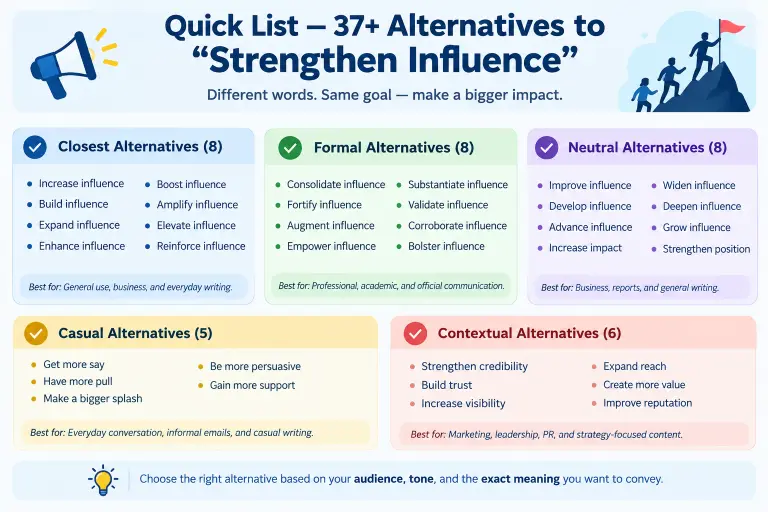
Closest alternatives
- Enhance influence
- Increase influence
- Expand influence
- Reinforce influence
- Amplify influence
- Boost influence
- Build influence
- Develop influence
- Grow influence
- Deepen influence
Formal alternatives
- Strengthen authority
- Increase persuasive power
- Enhance credibility
- Establish greater authority
- Expand strategic influence
- Reinforce one’s position
- Increase effectiveness
- Extend one’s reach
- Consolidate influence
- Broaden one’s impact
Neutral alternatives
- Build a stronger presence
- Increase impact
- Improve persuasion
- Expand reach
- Gain greater recognition
- Build trust
- Develop a stronger reputation
- Increase visibility
- Strengthen relationships
- Gain leverage
Contextual alternatives
- Shape opinions
- Sway decisions
- Drive engagement
- Lead change
- Encourage support
- Rally support
- Establish a stronger voice
- Make a greater impact
- Become more influential
- Strengthen one’s standing
- Broaden one’s voice
- Increase persuasive reach
These expressions should not all be treated as interchangeable. For example, build trust can contribute to influence but does not literally mean strengthen influence. Likewise, sway decisions describes a specific type of influence rather than influence in general.
Formal Alternatives

Formal Alternatives
1. Enhance Influence
Meaning: Make someone’s influence stronger or more effective.
Explanation: This is one of the closest formal alternatives to strengthen influence. It works well when the existing influence is already present and needs improvement.
Example:
“The organization introduced new communication strategies to enhance its influence among industry leaders.”
Best Use: Reports, business writing, strategy documents, professional articles.
Worst Use: Very casual conversations, where it may sound unnecessarily formal.
Tone: Professional and polished.
2. Increase Influence
Meaning: Make influence greater in amount or effect.
Explanation: This is a direct and clear alternative. Unlike some more specialized choices, it does not suggest how influence will increase.
Example:
“The company hopes to increase its influence in the international market.”
Best Use: Business, marketing, academic, and general writing.
Worst Use: Situations where you specifically mean credibility, authority, or reach rather than influence itself.
Tone: Neutral and precise.
3. Expand Influence
Meaning: Make influence extend to more people, groups, places, or areas.
Explanation: Expand emphasizes breadth. It is particularly useful when influence is spreading geographically or across a larger audience.
Example:
“The nonprofit plans to expand its influence through regional partnerships.”
Best Use: Organizations, campaigns, international work, leadership, and marketing.
Worst Use: When you only mean becoming more persuasive with the same audience.
Tone: Professional and strategic.
4. Reinforce Influence

Meaning: Make existing influence stronger or more secure.
Explanation: Reinforce suggests that influence already exists and needs additional support.
Example:
“Consistent communication helped reinforce the manager’s influence within the team.”
Best Use: Leadership, organizational communication, policy, and strategy.
Worst Use: When influence is being created from nothing.
Tone: Formal and analytical.
5. Amplify Influence
Meaning: Make influence more noticeable, powerful, or widespread.
Explanation: Amplify often suggests increasing the visibility or effect of an existing message, voice, or presence.
Example:
“Social media can amplify the influence of community organizations.”
Best Use: Marketing, media, public relations, digital communication.
Worst Use: Academic writing where a simpler term such as increase may be clearer.
Tone: Modern, strategic, energetic.
6. Boost Influence
Meaning: Increase influence noticeably.
Explanation: Boost is similar to increase, but it is more conversational and often suggests a relatively quick improvement.
Example:
“The campaign helped boost the brand’s influence among younger consumers.”
Best Use: Marketing, social media, casual business writing.
Worst Use: Highly formal legal or academic writing.
Tone: Neutral to informal.
7. Build Influence
Meaning: Develop influence gradually over time.
Explanation: This phrase emphasizes the process of creating influence rather than simply increasing influence that already exists.
Example:
“She built influence by consistently sharing useful industry insights.”
Best Use: Leadership, personal branding, networking, careers.
Worst Use: A situation involving a short-term increase in influence.
Tone: Natural and professional.
8. Develop Influence
Meaning: Gradually create or improve the ability to affect others.
Explanation: Develop emphasizes growth through learning, experience, relationships, or deliberate effort.
Example:
“Students can develop influence by becoming active members of their communities.”
Best Use: Education, leadership development, professional growth.
Worst Use: Very short-term situations.
Tone: Professional and educational.
9. Grow Influence
Meaning: Become increasingly influential.
Explanation: This is straightforward and natural, especially in digital marketing and personal-branding contexts.
Example:
“The creator continued to grow her influence by publishing helpful content.”
Best Use: Social media, personal branding, marketing.
Worst Use: Highly formal academic or legal writing.
Tone: Conversational and modern.
10. Deepen Influence
Meaning: Make influence stronger within an existing relationship or audience.
Explanation: Deepen emphasizes quality and strength rather than simply reaching more people.
Example:
“Regular engagement helped the organization deepen its influence among local residents.”
Best Use: Community relations, leadership, relationships.
Worst Use: When the main goal is reaching a larger audience.
Tone: Thoughtful and professional.
11. Strengthen Authority
Meaning: Increase recognized power, expertise, or legitimacy.
Explanation: Authority is related to influence but is not identical. Someone may influence others without holding formal authority.
Example:
“Publishing well-researched articles helped strengthen the researcher’s authority.”
Best Use: Academic, professional, leadership, and expert contexts.
Worst Use: When you mean popularity rather than authority.
Tone: Formal.
12. Increase Persuasive Power
Meaning: Become better able to convince people.
Explanation: This is narrower than strengthen influence. It focuses specifically on persuasion.
Example:
“Clear evidence can increase the persuasive power of the presentation.”
Best Use: Essays, speeches, marketing, presentations.
Worst Use: When influence happens through trust or reputation rather than persuasion.
Tone: Formal and analytical.
13. Enhance Credibility
Meaning: Increase the degree to which people consider someone trustworthy or believable.
Explanation: Credibility often contributes to influence, but it is not influence itself.
Example:
“Independent research can enhance the credibility of the organization.”
Best Use: Academic, business, professional, and media writing.
Worst Use: When the subject is influential for reasons unrelated to credibility.
Tone: Professional.
14. Establish Greater Authority
Meaning: Develop stronger recognized expertise or power.
Explanation: This is particularly appropriate when someone is moving toward a position of recognized expertise.
Example:
“The author established greater authority by publishing original research.”
Best Use: Academic and professional contexts.
Worst Use: Informal conversation.
Tone: Formal.
15. Expand Strategic Influence
Meaning: Increase influence in a deliberate, planned way.
Explanation: This phrase works especially well in organizational and business strategy.
Example:
“The company aims to expand its strategic influence across emerging markets.”
Best Use: Business plans, strategy reports, consulting documents.
Worst Use: Everyday communication.
Tone: Highly professional.
Semi-Formal & Neutral Alternatives
16. Broaden One’s Impact
Meaning: Affect more people, situations, or outcomes.
Explanation: Impact focuses on the result of influence rather than the power to influence.
Example:
“The nonprofit wants to broaden its impact through community partnerships.”
Best Use: Business, nonprofit, education.
Worst Use: When you specifically need to discuss persuasion.
Tone: Professional and neutral.
17. Increase Impact
Meaning: Make the effect of an action, message, or person stronger.
Example:
“The new campaign increased the impact of the organization’s message.”
Best Use: Marketing, presentations, reports.
Worst Use: When the focus is authority or social status.
Tone: Neutral.
18. Improve Persuasion
Meaning: Become more effective at convincing others.
Example:
“Adding evidence can improve persuasion in an argumentative essay.”
Best Use: Academic writing, speeches, sales.
Worst Use: When the desired influence is based on leadership rather than argument.
Tone: Neutral and practical.
19. Expand Reach
Meaning: Connect with a larger audience.
Explanation: Reach concerns the size or extent of an audience, not necessarily the level of influence.
Example:
“The campaign used video content to expand its reach.”
Best Use: Marketing, social media, websites.
Worst Use: When reaching more people does not mean influencing them.
Tone: Modern and professional.
20. Gain Greater Recognition
Meaning: Become more widely known or noticed.
Example:
“The artist gained greater recognition after the exhibition.”
Best Use: Careers, arts, professional profiles.
Worst Use: When recognition is already high but persuasive power is low.
Tone: Neutral.
21. Build Trust
Meaning: Increase people’s confidence in someone or something.
Explanation: Trust is often a foundation of influence, but it is not an exact synonym.
Example:
“Transparent communication helps businesses build trust with customers.”
Best Use: Customer service, leadership, business.
Worst Use: When the goal is simply increasing visibility.
Tone: Warm and professional.
22. Develop a Stronger Reputation
Meaning: Improve how people generally perceive someone or an organization.
Example:
“Consistent service helped the company develop a stronger reputation.”
Best Use: Business, personal branding, professional communication.
Worst Use: When influence is unrelated to reputation.
Tone: Professional.
23. Increase Visibility
Meaning: Make a person, brand, idea, or organization more noticeable.
Example:
“The campaign increased the nonprofit’s visibility online.”
Best Use: Marketing and public relations.
Worst Use: Visibility alone does not guarantee influence.
Tone: Neutral and strategic.
24. Gain Leverage
Meaning: Obtain a stronger position from which to influence an outcome.
Example:
“The team gained leverage by presenting strong evidence.”
Best Use: Negotiation, business, strategy.
Worst Use: Friendly or everyday situations where leverage may sound overly strategic.
Tone: Businesslike.
25. Shape Opinions
Meaning: Affect what people think about an issue.
Example:
“News coverage can shape public opinions.”
Best Use: Media, politics, education, public communication.
Worst Use: When the subject is influencing actions rather than opinions.
Tone: Neutral.
26. Sway Decisions
Meaning: Influence someone’s choice or judgment.
Example:
“Customer reviews can sway purchasing decisions.”
Best Use: Marketing, business, everyday writing.
Worst Use: When there is no decision involved.
Tone: Neutral.
27. Drive Engagement
Meaning: Encourage people to interact, respond, participate, or remain interested.
Example:
“The new content strategy helped drive engagement on the website.”
Best Use: Marketing, social media, websites.
Worst Use: General discussions of leadership influence.
Tone: Professional and digital-focused.
28. Lead Change
Meaning: Guide people or organizations toward a new direction.
Example:
“Strong leaders can lead change during difficult periods.”
Best Use: Business, management, education.
Worst Use: When there is no meaningful change involved.
Tone: Strong and professional.
29. Encourage Support
Meaning: Motivate people to support a person, idea, cause, or project.
Example:
“The campaign encouraged support for the community project.”
Best Use: Fundraising, nonprofit work, public communication.
Worst Use: When influence does not involve gaining support.
Tone: Positive and neutral.
30. Rally Support
Meaning: Bring people together in support of a cause or objective.
Example:
“The organizers rallied support for the neighborhood initiative.”
Best Use: Campaigns, community projects, causes.
Worst Use: Routine business communication where it may sound dramatic.
Tone: Energetic.
Informal and Casual Alternatives
Casual alternatives usually work by describing how someone becomes influential rather than replacing the phrase exactly.
31. Make a Bigger Splash
Meaning: Attract more attention or have a greater effect.
Example: “The new campaign really made a bigger splash online.”
Natural Use: Conversations and casual marketing language.
Avoid When: Writing legal or academic documents.
Tone: Casual and expressive.
32. Get More Say
Meaning: Gain greater ability to contribute to or affect decisions.
Example: “The employees want to get more say in how the schedule is organized.”
Natural Use: Workplace and everyday conversation.
Avoid When: Formal reports.
Tone: Conversational.
33. Have More Pull
Meaning: Have greater informal influence or connections.
Example: “She has more pull with the local organizers now.”
Natural Use: Informal conversation.
Avoid When: Professional or academic writing.
Tone: Casual.
34. Make Your Voice Heard
Meaning: Ensure your ideas or opinions receive attention.
Example: “Students should have opportunities to make their voices heard.”
Natural Use: Everyday, nonprofit, community, and advocacy writing.
Avoid When: You mean influence without public expression.
Tone: Conversational and empowering.
35. Get People on Board
Meaning: Gain agreement or support.
Example: “We need to get everyone on board before launching the project.”
Natural Use: Workplace conversation.
Avoid When: Highly formal documents.
Tone: Informal professional.
36. Make Waves
Meaning: Attract attention or cause noticeable change.
Example: “The young entrepreneur is making waves in the industry.”
Natural Use: Media, conversation, marketing.
Avoid When: You need precise academic wording.
Tone: Informal and energetic.
37. Get More Attention
Meaning: Become more noticeable.
Example: “The campaign needs to get more attention online.”
Natural Use: Casual communication.
Avoid When: You specifically mean persuasive power rather than visibility.
Tone: Simple and conversational.
True Synonyms vs. Contextual Alternatives
Not every phrase above can replace strengthen influence in every sentence.
| Type | What It Means | Can It Replace the Original? |
|---|---|---|
| True synonym | Makes existing influence stronger | Enhance influence usually can |
| Near synonym | Has a very similar idea but changes emphasis | Increase influence often can |
| Contextual alternative | Describes one route to greater influence | Build trust may work in some contexts |
| Broader expression | Describes a wider concept such as effect or success | Increase impact sometimes can |
| Narrower expression | Focuses on one kind of influence | Sway decisions works only for decisions |
| Formal equivalent | Uses more professional terminology | Strengthen authority works when authority is intended |
| Casual equivalent | Expresses influence conversationally | Have more pull works informally |
The key is to identify what “influence” actually means in your sentence: authority, persuasion, visibility, reach, reputation, trust, decision-making power, or impact.
Industry-Specific Usage
Business Writing
Business writing usually benefits from precise alternatives.
Instead of:
“The company wants to strengthen influence.”
Consider:
- “The company wants to expand its market influence.”
- “The company aims to increase its market impact.”
- “The brand plans to expand its reach.”
- “The organization seeks to strengthen its position in the industry.”
If you mean market visibility, use expand reach or increase visibility. If you mean decision-making power, gain leverage may be more accurate.
Corporate Communication
Corporate communication often needs language that sounds confident without exaggerating.
Example:
“The partnership will help strengthen the company’s position within the sector.”
Here, strengthen its position may be better than strengthen influence because it can include reputation, market standing, and competitive strength.
For internal communication:
“The new leadership program is designed to build trust and strengthen relationships across teams.”
That is more specific than simply saying the program will “strengthen influence.”
Academic Writing
Academic writing requires precision.
Useful choices include:
- increase impact
- shape public opinion
- affect behavior
- increase persuasive power
- strengthen authority
- establish credibility
- influence outcomes
- expand the scope of influence
Example:
“The study examines how social media can shape public opinion.”
This is better than:
“The study examines how social media can strengthen influence.”
The first sentence identifies exactly what is being influenced.
Customer Service
Customer service usually favors simple, positive language.
Instead of:
“We want to strengthen our influence with customers.”
Try:
“We want to build stronger relationships with our customers.”
Or:
“We want to build greater trust with our customers.”
Customer service writing should focus on trust, satisfaction, relationships, and support rather than sounding overly strategic.
Legal Writing
Legal writing requires particular care because influence, authority, control, power, and legal standing are not interchangeable concepts.
Depending on the context, a legal document might need a precise term such as:
- authority
- control
- legal power
- decision-making authority
- standing
- jurisdiction
- contractual rights
For example, strengthen influence should not automatically be replaced with increase legal authority. The latter can imply a formal legal power that the original phrase does not establish.
Email Communication
Professional emails usually sound better with specific wording.
Instead of:
“We hope to strengthen our influence with the client.”
Consider:
“We hope to build stronger trust with the client.”
Or:
“We hope to deepen our relationship with the client.”
The best choice depends on what you actually want to improve.
Email Examples
1. Client Communication
Subject: Building a Stronger Client Partnership
Hi Maria,
Thank you for the thoughtful feedback on the latest project.
We would like to deepen our relationship with your team by creating a clearer communication process and scheduling regular check-ins.
Best,
Daniel
2. Project Update
Subject: Expanding the Project’s Reach
Hi Team,
The first phase of the campaign has performed well. Our next step is to expand its reach through additional channels and community partnerships.
I’ll share the updated plan on Friday.
Best,
Alex
3. Internal Workplace Request
Subject: Employee Input on the New Schedule
Hi everyone,
We want team members to have more say in how the new schedule is developed. Please send your preferred working hours by Thursday.
Thanks,
Maya
4. Academic Communication
Subject: Improving the Argument in My Research Paper
Professor Lee,
I revised the paper to increase the persuasive power of the main argument. I also added two sources to support the conclusion.
Thank you for your guidance.
Best,
Jordan
5. Vendor Communication
Subject: Strengthening Our Partnership
Hello James,
We appreciate your continued support. We would like to strengthen our partnership by discussing delivery schedules and future planning.
Could we arrange a short call next week?
Best regards,
Nina
Short Dialogue Examples
Workplace
Person A: We need more people supporting the proposal.
Person B: Then we should focus on ways to encourage support rather than simply sending more emails.
Classroom
Person A: How can I make my argument stronger?
Person B: Add evidence that can increase its persuasive power.
Customer Service
Person A: How can we improve customer loyalty?
Person B: Start by building trust and responding consistently.
Casual Conversation
Person A: How did she become so influential?
Person B: She just made her voice heard and kept showing up.
Professional Discussion
Person A: Do we need more visibility?
Person B: Yes. We should expand our reach before trying to increase influence.
How to Replace “Strengthen Influence” in a Sentence
Example 1
Original:
“The campaign will strengthen influence among young customers.”
Alternative:
“The campaign will expand the brand’s reach among young customers.”
Why it works:
Reach focuses on audience size rather than persuasive power.
Example 2
Original:
“She strengthened her influence through research.”
Alternative:
“She enhanced her credibility through research.”
Why it works:
The new version explains the likely source of her growing influence.
Example 3
Original:
“The manager strengthened influence within the team.”
Alternative:
“The manager built trust within the team.”
Why it works:
Trust is a specific foundation for interpersonal influence.
Example 4
Original:
“The organization strengthened its influence in the community.”
Alternative:
“The organization deepened its community relationships.”
Why it works:
This emphasizes relationships rather than power.
Example 5
Original:
“The speaker strengthened influence with the audience.”
Alternative:
“The speaker increased persuasive power with the audience.”
Why it works:
This version specifically identifies persuasion.
Example 6
Original:
“The company strengthened influence over purchasing decisions.”
Alternative:
“The company increased its ability to shape purchasing decisions.”
Why it works:
The new wording clearly identifies the type of influence involved.
Example 7
Original:
“The nonprofit strengthened influence online.”
Alternative:
“The nonprofit increased its online visibility and reach.”
Why it works:
Online influence often involves both being seen and reaching people.
Example 8
Original:
“The leader strengthened influence among employees.”
Alternative:
“The leader strengthened authority and trust among employees.”
Why it works:
The revised sentence identifies two concrete sources of leadership influence.
Comparison Table
| Phrase | Tone | Meaning / Scope | Best Use | Example |
|---|---|---|---|---|
| Enhance influence | Formal | Make influence stronger | Reports | “We aim to enhance influence.” |
| Increase influence | Neutral | Make influence greater | General writing | “The campaign increased influence.” |
| Expand influence | Professional | Reach more areas or people | Strategy | “The brand expanded influence.” |
| Reinforce influence | Formal | Strengthen existing influence | Leadership | “The policy reinforced influence.” |
| Amplify influence | Modern | Increase visibility or effect | Marketing | “The campaign amplified influence.” |
| Build influence | Neutral | Develop influence over time | Careers | “She built influence online.” |
| Deepen influence | Professional | Strengthen existing relationships | Community work | “They deepened influence locally.” |
| Increase impact | Neutral | Produce a stronger effect | Academic/business | “The program increased impact.” |
| Expand reach | Professional | Reach a larger audience | Marketing | “The campaign expanded reach.” |
| Build trust | Neutral | Increase confidence | Customer service | “The company built trust.” |
| Gain leverage | Strategic | Improve negotiating position | Business | “The team gained leverage.” |
| Shape opinions | Neutral | Affect beliefs | Media | “The campaign shaped opinions.” |
| Sway decisions | Neutral | Affect choices | Sales | “Reviews sway decisions.” |
| Lead change | Professional | Guide transformation | Management | “She led change.” |
| Make waves | Casual | Attract attention or change | Conversation | “The launch made waves.” |
| Have more say | Casual | Gain decision-making input | Workplace | “Employees want more say.” |
Which Alternative Should You Choose?
For Formal Writing
Choose enhance influence, reinforce influence, strengthen authority, enhance credibility, or increase persuasive power, depending on the meaning.
For Business Communication
Use expand influence, increase impact, strengthen position, expand reach, or gain leverage.
For Academic Writing
Prefer precise expressions such as increase impact, shape opinions, affect outcomes, establish credibility, or increase persuasive power.
For Legal Writing
Do not casually substitute a word. Use the exact concept intended, such as authority, control, standing, rights, or jurisdiction, where applicable.
For Professional Email
Use natural phrases such as build trust, strengthen relationships, deepen the partnership, expand reach, or increase impact.
For Everyday Conversation
Use have more say, make your voice heard, make waves, get more attention, or have more pull.
For Casual Messages
Make a bigger splash and make waves are useful when you mean noticeable attention or impact.
Grammar & Usage Guide
“Strengthen” as a Verb
Strengthen is a transitive verb, so it normally takes an object.
Correct:
“The campaign strengthened its influence.”
You can also use it with a noun phrase:
“The campaign strengthened public influence.”
But if the meaning is personal:
“She strengthened her influence.”
“Influence” as a Noun
When influence is a noun, it often appears with possessives or modifiers:
- her influence
- political influence
- social influence
- professional influence
- public influence
- market influence
Example:
“The organization increased its political influence.”
“Influence” as a Verb
Influence can also be used as a verb:
“The campaign influenced public opinion.”
Here, you do not need strengthen.
Compare:
“The campaign strengthened its influence.”
with:
“The campaign influenced public opinion.”
The first describes increasing the power of influence. The second describes the act of influencing.
Common Prepositions
Common combinations include:
- influence over a decision
- influence on behavior
- influence among a group
- influence within an organization
- influence in a field or industry
Examples:
“She has considerable influence over the committee.”
“The campaign had a strong influence on public opinion.”
Adjective Forms
Related forms include:
- influential
- influentially, though rarely needed
- influential figure
- influential leader
- influential organization
Instead of:
“She has strong influence.”
You might write:
“She is highly influential.”
Common Mistakes to Avoid
1. Treating Every Alternative as an Exact Synonym
Build trust and strengthen influence are related but not identical.
Better: Choose the phrase that describes the actual goal.
2. Confusing Influence With Authority
A person can influence others without having formal authority.
Better: Use authority only when recognized power or expertise is intended.
3. Using “Reach” to Mean Influence
Reach describes audience size. It does not necessarily mean people are persuaded.
Better: Say expand reach when visibility or audience size is the focus.
4. Using Casual Expressions in Formal Writing
Phrases such as make waves or have more pull may sound too informal in academic or legal documents.
5. Using “Sway” Too Broadly
Sway usually involves influencing a decision, opinion, or choice.
It is not appropriate for every kind of influence.
6. Choosing “Impact” When You Mean Persuasion
Impact refers to an effect or result. It does not necessarily involve convincing people.
7. Repeating “Strengthen Influence”
Repeatedly using the same phrase can make writing dull.
Better: Vary the wording based on the precise meaning.
8. Using Overly Abstract Language
“Strengthen strategic influence capabilities” can sound vague.
Better: Say what actually changes: build trust with customers, expand reach, or increase persuasive power.
When Not to Use “Strengthen Influence”
The phrase is useful, but it is not always the clearest choice.
1. When You Mean Visibility
Use increase visibility or expand reach.
2. When You Mean Trust
Use build trust or strengthen relationships.
3. When You Mean Formal Power
Use strengthen authority or another precise term.
4. When You Mean Persuasion
Use increase persuasive power or improve persuasion.
5. When You Mean Decision-Making Power
Use gain leverage, gain more say, or increase decision-making authority, depending on context.
6. When You Mean Public Opinion
Use shape opinions or influence public opinion.
7. When You Mean Casual Attention
Use make waves, get more attention, or make a bigger splash.
When “Strengthen Influence” Is the Better Choice
Keep the original phrase when you genuinely mean making an existing ability to influence people or outcomes stronger and you do not need to specify the exact mechanism.
Example:
“The organization introduced several initiatives to strengthen its influence in the sector.”
That sentence is broad, but appropriately so when the specific mechanism is not the focus.
Advanced Writer Tips
Tone Control
Choose the verb based on the tone you want:
- Formal: enhance, reinforce, consolidate
- Professional: expand, develop, strengthen
- Neutral: increase, build, grow
- Casual: make waves, get more say, have more pull
Professional Email Etiquette
Avoid phrases that sound overly strategic when a simpler explanation is available.
Instead of:
“We intend to amplify our influence with your organization.”
Try:
“We hope to build a stronger working relationship with your team.”
The second version sounds more human and explains the goal more clearly.
Politeness
Influence-related language can sound aggressive if it suggests control.
Compare:
“We want to control customer decisions.”
with:
“We want to better understand and support customer decision-making.”
The second is more respectful and customer-focused.
Context Alignment
Ask yourself what is actually becoming stronger:
- Influence → enhance influence
- Trust → build trust
- Reputation → strengthen reputation
- Visibility → increase visibility
- Audience → expand reach
- Authority → strengthen authority
- Persuasion → improve persuasive power
- Relationships → deepen relationships
- Negotiating position → gain leverage
This simple distinction can make your writing much more precise.
Precision
Avoid using influence as a catch-all word.
Instead of:
“The company wants to strengthen influence.”
Consider:
“The company wants to increase brand visibility among small-business owners.”
The second sentence gives readers something concrete.
Readability
Shorter wording is often stronger.
Instead of:
“The organization implemented multiple initiatives designed to enhance its overall influence within the broader community.”
Try:
“The organization launched programs to deepen its influence in the community.”
The meaning is clearer and the sentence is easier to read.
Related Questions
What is another way to say “strengthen influence”?
You can say enhance influence, increase influence, expand influence, reinforce influence, amplify influence, build influence, deepen influence, or increase impact, depending on the context.
What is a professional alternative?
Enhance influence is a close professional alternative. Strengthen authority, expand reach, enhance credibility, and increase impact can be better when they describe the intended result more precisely.
What is a formal alternative?
Formal options include reinforce influence, consolidate influence, strengthen authority, enhance credibility, and increase persuasive power.
What can I use instead of “strengthen influence” in an email?
For professional emails, try build trust, deepen the relationship, strengthen the partnership, expand reach, or increase impact.
Is “strengthen influence” formal?
It is neutral-to-formal rather than highly formal. It works in professional and academic writing, but a more specific phrase may sound more natural.
Can “increase impact” replace “strengthen influence”?
Sometimes. Increase impact focuses on the effect produced, while strengthen influence focuses on the ability to affect people, decisions, or outcomes.
What is the difference between “strengthen influence” and “strengthen authority”?
Strengthen influence means becoming more capable of affecting people or outcomes. Strengthen authority suggests greater recognized power, expertise, legitimacy, or formal decision-making rights.
FAQs
1. What is the best synonym for “strengthen influence”?
Enhance influence is one of the closest direct alternatives. However, expand influence, build influence, or reinforce influence may be better depending on whether you mean greater reach, gradual development, or stronger existing influence.
2. What is a formal way to say “strengthen influence”?
Good formal choices include reinforce influence, enhance influence, strengthen authority, enhance credibility, consolidate influence, and increase persuasive power. The correct option depends on what kind of influence you mean.
3. What is a simple alternative to “strengthen influence”?
Increase influence is the simplest direct alternative. Other easy choices include build influence, grow influence, and expand influence.
4. Is “expand reach” the same as “strengthen influence”?
No. Expand reach means connecting with a larger audience. Strengthen influence means becoming more capable of affecting that audience. A person or brand can have a large reach without being highly influential.
5. Is “build trust” a synonym for “strengthen influence”?
Not exactly. Trust and influence are related, but trust is usually a foundation for influence. Use build trust when increasing confidence and reliability is the actual goal.
6. Which phrase is best for academic writing?
Use precise language such as increase impact, shape opinions, affect outcomes, enhance credibility, or increase persuasive power. Academic writing benefits from specifying exactly what is being influenced.
7. Which phrase is best for casual conversation?
For casual speech, make waves, have more pull, get more say, make your voice heard, or get more attention can sound more natural than strengthen influence, depending on the situation.
Key Takeaways
- Enhance influence is one of the closest direct alternatives to strengthen influence.
- Use expand reach when you mean reaching more people, not necessarily persuading them.
- Choose build trust when trust is the foundation of the influence you want to develop.
- Use strengthen authority only when recognized expertise, power, or legitimacy is involved.
- For stronger writing, name the specific result—such as visibility, credibility, persuasion, reach, or decision-making power.
Conclusion;
The best synonym for strengthen influence depends on what you actually want to communicate. If you simply mean making influence stronger, enhance influence, increase influence, reinforce influence, and build influence are reliable choices.
Tone matters, too. Formal writing may favor enhance credibility or strengthen authority, while everyday conversation may sound more natural with make waves, have more say, or make your voice heard.
In professional communication, specific wording is usually stronger than a broad phrase. Before replacing strengthen influence, ask what is becoming stronger: trust, authority, visibility, reach, reputation, persuasion, or impact.
Once you identify that element, choosing the right alternative becomes much easier.
