
Searching for 33+ synonyms for argument can be surprisingly tricky because argument has several meanings. It can describe a disagreement between people, a reason supporting an idea, a formal case in writing or law, or even a technical input in programming. The best replacement therefore depends on the sentence, audience, and tone.
For example, dispute, quarrel, and row describe conflict, while reason, evidence, and rationale describe support for an idea. In academic writing, claim, case, or contention may work better. This guide explains more than 33 useful alternatives, shows where each fits, and highlights words that look similar but should not be treated as exact synonyms.
Quick Answer
Useful synonyms for argument include dispute, disagreement, quarrel, debate, controversy, discussion, conflict, reasoning, rationale, justification, evidence, case, claim, assertion, contention, position, point, premise, grounds, basis, proof, explanation, defense, objection, counterargument, rebuttal, appeal, pleading, and parameter. The correct choice depends on whether argument means a disagreement, supporting reasoning, a formal case, or a technical input.
Alternatives for “Argument”
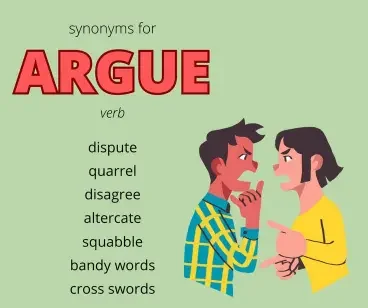
When “argument” means a disagreement
- Disagreement
- Dispute
- Quarrel
- Conflict
- Altercation
- Squabble
- Row
- Feud
- Clash
- Controversy
- Tiff
- Wrangle
“argument” means reasoning or support
- Reason
- Rationale
- Justification
- Basis
- Grounds
- Evidence
- Proof
- Case
- Explanation
- Reasoning
- Support
- Defense
- Point
- Premise
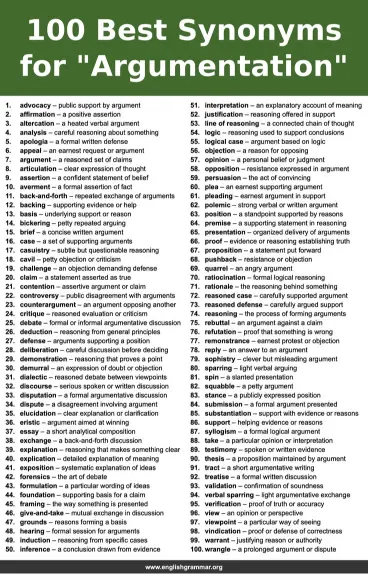
100 Best synonym for “argumention”
- Claim
- Assertion
- Contention
- Position
- View
- Standpoint
- Proposition
- Thesis
- Case
- Stance
When “argument” means a response or opposing point
- Objection
- Counterargument
- Rebuttal
- Response
- Challenge
- Critique
- Refutation
Technical meaning
- Parameter
- Input
- Operand
These groups are not interchangeable. The distinction matters more than simply having a long synonym list.
Formal Alternatives for “Argument”
1. Dispute
Meaning: A disagreement or conflict between people or groups.
Explanation: Dispute is a strong alternative when argument describes a serious disagreement. It often sounds more formal and less emotional than quarrel.
Example:
“The two companies became involved in a dispute over the contract.”
Best Use: Business, legal, professional, and formal writing.
Worst Use: A very minor disagreement, where difference of opinion may sound more natural.
Tone: Formal and neutral.
2. Controversy

Meaning: A subject that causes significant public disagreement.
Explanation: A controversy is usually broader than an argument between two individuals. It often involves public debate, media attention, or conflicting opinions.
Example:
“The new policy sparked controversy among community members.”
Best Use: News, journalism, public affairs, academic writing.
Worst Use: A private disagreement between two friends.
Tone: Formal and public-facing.
3. Debate

Meaning: A structured discussion in which opposing views are presented.
Explanation: Debate can replace argument when people exchange opposing ideas, especially in an organized or intellectual setting. Unlike quarrel, it does not necessarily imply anger.
Example:
“The students held a debate about renewable energy.”
Best Use: Education, politics, public speaking, academic writing.
Worst Use: An emotional family fight.
Tone: Neutral to formal.
4. Disagreement
Meaning: A difference in opinion or judgment.
Explanation: This is one of the safest alternatives when you want to describe an argument without suggesting hostility.
Example:
“We had a disagreement about how to manage the project.”
Best Use: Workplace, school, everyday conversation.
Worst Use: A highly aggressive confrontation.
Tone: Neutral and polite.
5. Reasoning
Meaning: The process of using logic to reach or support a conclusion.
Explanation: Reasoning refers to the thinking behind an argument rather than the disagreement itself.
Example:
“Her reasoning was clear and supported by evidence.”
Best Use: Academic, professional, analytical writing.
Worst Use: Describing a shouting match.
Tone: Formal and analytical.
6. Rationale
Meaning: The underlying reason or logic behind a decision.
Explanation: Rationale is particularly useful when explaining why someone made a choice or adopted a position.
Example:
“The report explains the rationale behind the proposed changes.”
Best Use: Business reports, policies, academic writing.
Worst Use: Casual conversations where reason sounds more natural.
Tone: Formal and professional.
7. Justification
Meaning: A reason or explanation showing why something is reasonable or appropriate.
Explanation: A justification supports an action, decision, or position. It can imply that someone needs to demonstrate that their choice is defensible.
Example:
“The manager provided a detailed justification for the expense.”
Best Use: Professional, academic, administrative, and formal contexts.
Worst Use: A simple personal opinion that does not require defense.
Tone: Formal.
8. Justification of a Position: Defense
Meaning: Support offered to protect or uphold an idea, person, or decision.
Explanation: Defense is useful when someone actively supports a position against criticism or attack.
Example:
“She presented a strong defense of the proposed policy.”
Best Use: Academic, legal, political, and formal discussions.
Worst Use: A neutral explanation where no opposition exists.
Tone: Formal and assertive.
9. Grounds
Meaning: The reasons or basis for a decision, action, or claim.
Explanation: Grounds is especially common in formal and legal English.
Example:
“The committee rejected the proposal on financial grounds.”
Best Use: Legal, administrative, professional writing.
Worst Use: Casual conversation.
Tone: Formal.
10. Basis
Meaning: The underlying reason, fact, or principle supporting something.
Explanation: Basis is broader and more neutral than argument. It identifies what something rests upon.
Example:
“There is little basis for the claim.”
Best Use: Academic, business, professional, and everyday writing.
Worst Use: A heated disagreement.
Tone: Neutral to formal.
11. Proposition
Meaning: A statement or idea put forward for consideration.
Explanation: A proposition can be the central idea being argued for or against. It does not necessarily mean a conflict.
Example:
“The paper examines the proposition that public transport should be expanded.”
Best Use: Academic, philosophical, political writing.
Worst Use: Casual disagreements.
Tone: Formal and intellectual.
12. Thesis
Meaning: The main claim or central position of a piece of academic writing.
Explanation: Thesis is narrower than argument. A thesis is the central idea; the argument may include the thesis plus reasons and evidence supporting it.
Example:
“The essay develops the thesis that early education improves long-term outcomes.”
Best Use: Academic writing.
Worst Use: General conversation.
Tone: Formal and academic.
Semi-Formal and Neutral Alternatives
13. Reason
Meaning: An explanation for why something is true, appropriate, or necessary.
Explanation: Reason is one of the most flexible alternatives. It can often replace argument when the word means a supporting point.
Example:
“She gave a good reason for changing the schedule.”
Best Use: Almost any context.
Worst Use: A serious dispute between people.
Tone: Neutral.
14. Evidence
Meaning: Information or facts used to support a conclusion.
Explanation: Evidence is not exactly the same as an argument. An argument may contain evidence, but evidence itself is the supporting material.
Example:
“The researchers presented evidence supporting their conclusion.”
Best Use: Academic, scientific, legal, professional writing.
Worst Use: Describing someone’s opinion without supporting facts.
Tone: Formal and objective.
15. Proof
Meaning: Evidence that establishes something as true or valid.
Explanation: Proof is stronger than evidence. In ordinary writing, it may suggest a high degree of certainty.
Example:
“The photographs provided proof that the equipment had been damaged.”
Best Use: Mathematics, formal reasoning, legal or factual contexts where strong evidence exists.
Worst Use: When the available information merely suggests something.
Tone: Strong and formal.
16. Case
Meaning: A set of reasons or evidence supporting a particular position.
Explanation: Case is an excellent alternative when someone is building a persuasive argument.
Example:
“The report makes a strong case for expanding the program.”
Best Use: Business, academic, political, persuasive writing.
Worst Use: When you mean a simple disagreement.
Tone: Professional and persuasive.
17. Claim
Meaning: A statement that someone says is true.
Explanation: A claim is the point being made, not necessarily the full argument supporting it.
Example:
“The article makes the claim that remote work can improve productivity.”
Best Use: Academic and analytical writing.
Worst Use: When you need to describe the evidence supporting the claim.
Tone: Neutral and analytical.
18. Assertion
Meaning: A confident statement presented as true.
Explanation: Assertion can sound stronger than claim. It sometimes suggests that the statement has been made without enough supporting evidence.
Example:
“His assertion was not supported by reliable data.”
Best Use: Critical analysis, academic writing.
Worst Use: Friendly everyday conversation.
Tone: Formal and sometimes skeptical.
19. Contention
Meaning: A position or point that someone strongly argues for.
Explanation: Contention is close to claim or argument, but it has a more formal and sometimes adversarial feel.
Example:
“The author’s central contention is that the policy is ineffective.”
Best Use: Academic, legal, analytical writing.
Worst Use: Casual messages.
Tone: Formal.
20. Position
Meaning: A person’s stated view on an issue.
Explanation: Position focuses on what someone believes or supports rather than how they defend it.
Example:
“The company clarified its position on the proposed regulation.”
Best Use: Business, politics, academic writing.
Worst Use: When you specifically need to describe evidence or reasoning.
Tone: Neutral and professional.
21. Standpoint
Meaning: A particular perspective or point of view.
Explanation: A standpoint describes where someone is coming from intellectually or personally. It is broader than argument.
Example:
“From a consumer standpoint, the change may be beneficial.”
Best Use: Essays, reports, discussions.
Worst Use: A direct disagreement.
Tone: Neutral and thoughtful.
22. Point
Meaning: A particular idea or reason made during a discussion.
Explanation: Point is much more conversational than argument and often refers to one part of an argument.
Example:
“That is a fair point.”
Best Use: Conversations, meetings, emails.
Worst Use: Highly technical analysis where precision is required.
Tone: Neutral and conversational.
23. Perspective
Meaning: A particular way of viewing or understanding an issue.
Explanation: Perspective emphasizes viewpoint rather than conflict or proof.
Example:
“I understand your perspective, even though I disagree with it.”
Best Use: Discussions, essays, workplace communication.
Worst Use: When you need to identify a specific piece of evidence.
Tone: Neutral and diplomatic.
24. Viewpoint
Meaning: An opinion or way of seeing an issue.
Explanation: Viewpoint is a useful alternative when argument means someone’s opinion or position.
Example:
“The article presents a different viewpoint on the issue.”
Best Use: Essays, discussions, articles.
Worst Use: A formal legal dispute where more precise terminology is needed.
Tone: Neutral.
25. Discussion
Meaning: An exchange of ideas or opinions.
Explanation: Discussion is broader and usually less confrontational than argument. It should not be used when conflict is central to the meaning.
Example:
“We had a productive discussion about the proposal.”
Best Use: Meetings, classrooms, professional communication.
Worst Use: A serious hostile dispute.
Tone: Neutral and cooperative.
26. Exchange
Meaning: A back-and-forth sharing of ideas, comments, or opinions.
Explanation: Exchange can describe a conversation, including a tense one, but it is less direct than argument.
Example:
“The two managers had a brief exchange about the deadline.”
Best Use: Professional writing and reporting.
Worst Use: When you need to clearly state that people were fighting.
Tone: Neutral.
27. Debate
Meaning: An organized exchange of opposing ideas.
Explanation: Debate is often constructive rather than hostile.
Example:
“The class held a debate about school uniforms.”
Best Use: School, university, politics, public speaking.
Worst Use: A personal quarrel.
Tone: Structured and formal.
Conflict-Focused Alternatives
These words are useful only when argument means a disagreement or fight.
28. Quarrel
A quarrel is an angry disagreement, often personal.
Example: “The siblings had a quarrel over the television.”
Best Use: Personal disagreements.
Worst Use: Academic disagreement or professional analysis.
Tone: Personal and somewhat informal.
29. Row
In American English, row is less common in this sense than in British English. It means a noisy or angry argument.
Example: “The neighbors had a row about the parking space.”
Best Use: Informal British English.
Worst Use: Formal American business writing.
Tone: Informal.
30. Squabble
A squabble is a petty or minor argument.
Example: “The children had a squabble over the game.”
Best Use: Minor disagreements.
Worst Use: Serious disputes involving legal or financial consequences.
Tone: Informal and slightly humorous.
31. Altercation
An altercation is a heated confrontation, often verbal and sometimes physical.
Example: “Security intervened after an altercation outside the venue.”
Best Use: Formal reporting.
Worst Use: A polite difference of opinion.
Tone: Formal and serious.
32. Clash
A clash describes a strong conflict between people, opinions, groups, or interests.
Example: “The two candidates clashed over economic policy.”
Best Use: Politics, business, public discussions.
Worst Use: A tiny disagreement.
Tone: Strong but versatile.
33. Feud
A feud is a prolonged conflict, usually between people or groups.
Example: “The two families have been involved in a feud for years.”
Best Use: Long-running conflicts.
Worst Use: A single disagreement.
Tone: Strong and often dramatic.
34. Conflict
Conflict describes serious opposition between people, groups, interests, or ideas.
Example: “The disagreement developed into a conflict between the departments.”
Best Use: Business, politics, psychology, international relations.
Worst Use: A harmless difference of opinion.
Tone: Formal to neutral.
35. Wrangle
A wrangle is a prolonged or difficult disagreement, often involving negotiation.
Example: “The partners spent weeks wrangling over the contract.”
Best Use: Business, politics, informal reporting.
Worst Use: Simple academic reasoning.
Tone: Informal to neutral.
Informal and Casual Alternatives
There are several casual alternatives, but they are mostly useful when argument means a disagreement.
36. Fight
Meaning: A strong disagreement or conflict.
Example: “They had a fight about money.”
Use: Everyday conversation.
Avoid: Formal reports unless the wording accurately reflects the situation.
Tone: Direct and informal.
37. Tiff
Meaning: A small, usually temporary disagreement.
Example: “They had a little tiff but made up later.”
Use: Light personal situations.
Avoid: Serious conflicts.
Tone: Casual and mild.
38. Blowup
Meaning: A sudden, intense argument.
Example: “The meeting ended in a major blowup.”
Use: Casual conversation and informal reporting.
Avoid: Academic or legal writing.
Tone: Informal and dramatic.
39. Spat
Meaning: A brief, relatively minor argument.
Example: “The two friends had a spat over where to eat.”
Use: Informal conversation and journalism.
Avoid: Serious disputes.
Tone: Casual and relatively mild.
40. Bicker
Meaning: To argue repeatedly about small things.
Example: “The children kept bickering over the remote.”
Use: Everyday conversation.
Avoid: Major professional or legal disputes.
Tone: Informal.
True Synonyms vs. Contextual Alternatives
The word argument is polysemous, meaning it has several related meanings. That is why a long synonym list can be misleading.
| Type | What It Means | Can It Replace “Argument”? |
|---|---|---|
| True/close synonym | A disagreement or dispute | Often, depending on context |
| Near synonym | A related disagreement or exchange | Sometimes |
| Contextual alternative | A reason, claim, viewpoint, or discussion | Only in the appropriate sense |
| Broader expression | A general exchange or conflict | Sometimes, but meaning becomes less precise |
| Narrower expression | A specific type of disagreement or reasoning | Only when that specific meaning is intended |
For example, “We had an argument” can become “We had a disagreement,” but changing it to “We had a discussion” makes the interaction sound more cooperative.
Likewise, “Her argument was supported by evidence” cannot normally be replaced with “Her quarrel was supported by evidence.” The two sentences use different meanings of argument.
Industry-Specific Usage
Business Writing
Business writing usually benefits from neutral words such as disagreement, position, rationale, case, concern, objection, or discussion.
Example:
Instead of: “The meeting became an argument about pricing.”
Use: “The meeting became a disagreement about pricing.”
For persuasive business writing:
“The proposal makes a strong case for reducing operating costs.”
That sounds more professional than repeatedly using argument.
Corporate Communication
In reports and internal announcements, choose words based on the level of conflict.
- Difference of opinion — diplomatic
- Concern — useful when someone raises a problem
- Position — useful for an official organizational view
- Rationale — explains why a decision was made
- Dispute — appropriate for a serious disagreement
- Discussion — useful when the conversation was constructive
Example:
“The leadership team discussed the concerns raised by employees.”
This is generally more neutral than saying:
“The leadership team had an argument with employees.”
Academic Writing
Academic writing uses argument frequently, but the word often means a structured position supported by reasons and evidence, not a fight.
Useful alternatives include:
- Claim
- Thesis
- Position
- Contention
- Case
- Reasoning
- Rationale
- Evidence
- Premise
- Proposition
Example:
“The author develops a strong argument for public investment.”
Possible alternative:
“The author develops a strong case for public investment.”
Do not automatically replace argument with claim. A claim is usually one assertion within a larger argument.
Customer Service
Customer service language should usually avoid emotionally loaded words such as fight or quarrel.
Prefer:
- Concern
- Disagreement
- Issue
- Complaint
- Dispute
- Difference of opinion
Example:
“We understand your concern and would like to resolve the issue.”
This is much more professional than:
“We understand your argument.”
Legal Writing
Legal contexts require extra precision. Depending on the situation, legal alternatives can include claim, contention, submission, pleading, objection, defense, position, case, or dispute.
However, these terms are not interchangeable.
For example:
- A claim is an assertion of a legal right or entitlement.
- An objection challenges something presented or proposed.
- A defense responds to an opposing claim.
- A pleading is a formal legal document in many legal systems.
- A case can refer to the overall legal matter or the reasoning supporting a position.
Avoid replacing argument with a legal term unless that specific meaning is intended.
Email Communication
For professional emails, these choices are especially useful:
| Situation | Better Alternative |
|---|---|
| Friendly disagreement | Difference of opinion |
| Serious disagreement | Dispute |
| Reason for a decision | Rationale |
| Supporting explanation | Reason |
| Persuasive proposal | Case |
| Opposing point | Objection |
| Collaborative conversation | Discussion |
Email Examples
1. Client Communication — “Concern”
Subject: Follow-Up on Your Project Concerns
Hi Jordan,
Thank you for sharing your concerns about the proposed timeline. I understand why the additional two weeks may affect your plans.
I’d be happy to review the schedule with you and discuss a few alternatives.
Best,
Maya
Why it works: Concern sounds professional and acknowledges the client’s issue without creating unnecessary conflict.
2. Internal Workplace Email — “Disagreement”
Subject: Follow-Up on Yesterday’s Meeting
Hi Team,
Thank you for the thoughtful discussion yesterday. Although there was some disagreement about the launch date, I think we now have a clearer understanding of the main priorities.
I’ll update the schedule based on the points we agreed on.
Best,
Daniel
Why it works: Disagreement is neutral and suitable for workplace communication.
3. Project Update — “Rationale”
Subject: Rationale for the Revised Timeline
Hi everyone,
I wanted to share the rationale behind the revised project timeline.
The additional week will give the testing team enough time to complete the final checks without rushing the release.
Please send me any questions by Thursday.
Thanks,
Priya
Why it works: Rationale specifically explains the reasoning behind a decision.
4. Academic Email — “Position”
Subject: Question About My Essay Position
Dear Professor Lee,
I am revising my essay and would like to clarify whether my position on public transportation is sufficiently supported by the sources I have selected.
I would appreciate any feedback you can provide.
Best regards,
Alex
Why it works: Position is appropriate for an academic viewpoint.
5. Vendor Communication — “Dispute”
Subject: Invoice Dispute — Account 1847
Hello Marcus,
We noticed a discrepancy between the agreed pricing and the amount shown on the latest invoice.
Could you please review the invoice and let us know how we can resolve this dispute?
Thank you,
Nina
Why it works: Dispute is appropriate for a specific business disagreement involving a financial matter.
6. Customer Service — “Issue”
Subject: Help With My Recent Order
Hello,
I’m contacting you about an issue with my recent order. One of the items arrived damaged, and I would like to know whether a replacement is available.
Thank you for your help.
Best,
Chris
Why it works: Issue is calmer and more solution-focused than argument or conflict.
Short Dialogue Examples
Workplace
Person A: I think we have a disagreement about the deadline.
Person B: Agreed. Let’s review the requirements and find a date that works for both teams.
Classroom
Person A: What’s your argument for school uniforms?
Person B: My main point is that uniforms can reduce pressure to wear expensive clothes.
Customer Service
Person A: I’d like to discuss a problem with my bill.
Person B: Of course. Let’s look at the issue together.
Casual Conversation
Person A: Did you two have a fight?
Person B: Just a little spat. We already worked it out.
Professional Discussion
Person A: What’s your position on the proposal?
Person B: I support it, but I think we need stronger evidence for the cost estimate.
How to Replace “33+ Synonyms for Argument” in a Sentence
The keyword itself is a search phrase, not something you would normally insert into a sentence. The examples below show how to replace argument according to its different meanings.
1. Disagreement
Original:
“We had an argument about the budget.”
Alternative:
“We had a disagreement about the budget.”
Why it works:
It preserves the conflict meaning while sounding more neutral.
2. Quarrel
Original:
“The children had an argument.”
Alternative:
“The children had a quarrel.”
Why it works:
Quarrel works for a personal disagreement, but sounds less professional.
3. Debate
Original:
“The students had an argument about climate policy.”
Alternative:
“The students held a debate about climate policy.”
Why it works:
It changes the meaning from possible conflict to structured discussion.
4. Reason
Original:
“She presented a strong argument for the proposal.”
Alternative:
“She presented a strong reason for the proposal.”
Why it works:
Reason works when referring to one supporting explanation, but it may weaken the sense of a complete persuasive case.
5. Case
Original:
“The report makes a strong argument for reform.”
Alternative:
“The report makes a strong case for reform.”
Why it works:
Case is a natural persuasive alternative in professional and academic writing.
6. Rationale
Original:
“The manager explained the argument behind the decision.”
Alternative:
“The manager explained the rationale behind the decision.”
Why it works:
Rationale specifically emphasizes the reasoning behind a decision.
7. Claim
Original:
“The author’s argument is that the policy is ineffective.”
Alternative:
“The author’s claim is that the policy is ineffective.”
Why it works:
Claim identifies the central assertion, but does not include all the supporting reasoning.
8. Position
Original:
“The company presented its argument on the issue.”
Alternative:
“The company presented its position on the issue.”
Why it works:
Position focuses on the organization’s official view rather than the supporting evidence.
Comparison Table
| Phrase | Tone | Meaning / Scope | Best Use | Example |
|---|---|---|---|---|
| Disagreement | Neutral | Different opinions | Work, everyday speech | “We had a disagreement.” |
| Dispute | Formal | Serious disagreement | Business, legal | “The companies settled the dispute.” |
| Quarrel | Informal | Personal angry disagreement | Family, friends | “They had a quarrel.” |
| Debate | Neutral/Formal | Structured opposing views | School, politics | “They held a debate.” |
| Reason | Neutral | Supporting explanation | General writing | “Give me one reason.” |
| Rationale | Formal | Reason behind a decision | Reports, policies | “The rationale is clear.” |
| Evidence | Formal | Facts supporting a conclusion | Academic, legal | “The evidence is strong.” |
| Case | Formal/Neutral | Set of reasons supporting a position | Persuasive writing | “She made a strong case.” |
| Claim | Neutral/Formal | Statement presented as true | Academic writing | “The claim needs support.” |
| Position | Neutral/Formal | Stated viewpoint | Business, politics | “Our position is clear.” |
| Objection | Formal | Expression of opposition | Meetings, legal | “She raised an objection.” |
| Counterargument | Formal | Argument opposing another | Academic writing | “The essay addresses a counterargument.” |
| Rebuttal | Formal | Response intended to challenge an argument | Debate, academic | “He offered a rebuttal.” |
| Fight | Informal | Strong personal disagreement | Everyday speech | “They had a fight.” |
| Squabble | Informal | Minor disagreement | Casual speech | “They had a squabble.” |
Which Alternative Should You Choose?
For formal writing
Choose dispute, contention, rationale, justification, grounds, case, or position, depending on the meaning.
For business communication
Use disagreement for a difference of opinion, dispute for a serious conflict, and rationale for the reasoning behind a decision.
For academic writing
Use argument when you mean a developed position supported by reasons and evidence. Use claim for a specific assertion, thesis for the central position, and case for a persuasive body of reasoning.
For legal writing
Choose the precise legal term required by the context, such as claim, defense, objection, pleading, submission, or contention. Do not substitute casual words such as fight or quarrel.
For professional email
Concern, disagreement, issue, position, rationale, and discussion are often safer and more diplomatic choices.
For everyday conversation
Use disagreement, fight, quarrel, spat, or argument, depending on the seriousness of the situation.
For casual messages
Short phrases such as fight, spat, squabble, or disagreement sound more natural than contention or rationale.
Grammar & Usage Guide
1. “Argument” as a countable noun
When referring to a specific disagreement, argument is countable.
- “We had an argument.”
- “They had three arguments last week.”
2. “Argument” as a reasoned case
It can also describe a developed line of reasoning.
- “The author presents a strong argument.”
- “Her argument is supported by evidence.”
3. Common prepositions
Several combinations are natural:
- argument about a topic
“They had an argument about money.” - argument over a disputed matter
“They had an argument over the contract.” - argument for a position
“She made an argument for reform.” - argument against a position
“He presented an argument against the proposal.” - argument with a person
“I had an argument with my brother.”
4. “Argument” vs. “argue”
Use argument as a noun:
“The argument was unnecessary.”
Use argue as a verb:
“They continued to argue.”
5. “Argue that” vs. “argument that”
Academic writing commonly uses:
“The author argues that the policy is ineffective.”
Or:
“The author’s argument is that the policy is ineffective.”
6. Capitalization
Argument is normally lowercase unless it begins a sentence or appears in a title using title-case conventions.
Common Mistakes to Avoid
1. Treating every synonym as interchangeable
Claim, evidence, quarrel, and rationale have different meanings.
2. Using “fight” in formal writing
“Fight” is conversational and can sound emotional. Use disagreement or dispute when appropriate.
3. Calling evidence an argument
Evidence supports an argument; it is not necessarily the entire argument.
4. Confusing a claim with a complete argument
A claim is an assertion. A full argument normally includes reasoning and support.
5. Using “debate” for every disagreement
A debate is generally more structured and intellectual than an ordinary argument.
6. Using “quarrel” for professional disputes
Quarrel often sounds personal or childish.
7. Using “contention” casually
“Contention” is formal and may sound unnatural in everyday conversation.
8. Using “proof” when the evidence is uncertain
Proof can imply that something has been established conclusively. Evidence may be safer when certainty is limited.
9. Ignoring the meaning of “argument”
Always determine whether the word means conflict, reasoning, claim, legal position, or technical input.
When Not to Use the Original Word “Argument”
You may want a different word when:
- You mean a peaceful exchange of ideas.
Use discussion instead. - You want a more diplomatic workplace tone.
Disagreement or difference of opinion may work better. - You mean the reason behind a decision.
Choose rationale or reason. - You mean one factual statement.
Use claim or assertion. - You mean supporting facts.
Use evidence. - You mean a structured academic exchange.
Use debate. - You mean a minor personal conflict.
Spat or squabble may be more precise. - You need a technical programming term.
Parameter or argument may be required depending on the programming context.
The original word is still the better choice when you mean a complete line of reasoning or a general disagreement and no more precise alternative is needed.
Advanced Writer Tips
Tone Control
Replace argument with disagreement to soften interpersonal conflict. Use dispute when the disagreement is serious. Use quarrel or fight only when a casual or emotional tone is appropriate.
For reasoning, choose reason for simple writing, case for persuasive writing, and rationale for formal explanations.
Professional Email Etiquette
Avoid unnecessarily emotional words. Compare:
“I disagree with your argument.”
with:
“I understand your position, although I see the issue differently.”
The second version is more diplomatic while preserving the disagreement.
Politeness
A small word change can change the emotional temperature of a sentence.
- “Argument” → neutral
- “Disagreement” → diplomatic
- “Dispute” → serious/formal
- “Fight” → emotional
- “Quarrel” → personal
Context Alignment
Ask what the sentence is actually doing:
- Describing conflict?
- Supporting an idea?
- Explaining a decision?
- Presenting a viewpoint?
- Responding to opposition?
The answer usually reveals the best replacement.
Precision
Don’t replace a word simply because you want variety. Choose the alternative that preserves the intended meaning.
Readability
In most everyday writing, reason, point, disagreement, case, and position are clearer than highly formal words such as contention or grounds.
Related Questions
What is another way to say “argument”?
It depends on the meaning. For a disagreement, try disagreement, dispute, quarrel, conflict, or debate. For reasoning, consider reason, case, rationale, justification, claim, or position.
What is a professional alternative to “argument”?
Disagreement is usually a good diplomatic choice. Dispute works for a serious conflict, while position or rationale may be better when discussing ideas rather than interpersonal conflict.
What is a formal alternative to “argument”?
Useful formal choices include dispute, contention, rationale, justification, grounds, case, proposition, and reasoning, depending on the intended meaning.
Can “discussion” replace “argument”?
Sometimes. Discussion suggests an exchange of ideas and does not necessarily involve conflict. If the original sentence describes an angry disagreement, discussion changes the meaning.
Can “claim” replace “argument”?
Only sometimes. A claim is a statement presented as true. An argument can include that claim plus the reasons and evidence supporting it.
Is “argument” a formal word?
Yes, but it is also completely normal in everyday English. Its formality depends heavily on context. “We had an argument” is ordinary conversation, while “the author’s argument” is common in academic writing.
What is the difference between an argument and a debate?
An argument can be an informal disagreement or a reasoned case. A debate usually involves an organized exchange of opposing views and tends to sound more structured.
FAQs
1. What is the closest synonym for “argument”?
For the conflict sense, disagreement is one of the closest neutral alternatives. For the reasoning sense, case or reasoning may be closer. There is no single best synonym for every sentence.
2. What is a softer word for “argument”?
Disagreement is usually softer and more diplomatic. Difference of opinion is even gentler when you want to emphasize that people simply see an issue differently.
3. What is a stronger word for “argument”?
For conflict, dispute, conflict, altercation, or feud can sound stronger, depending on the situation. For reasoning, case can emphasize persuasive strength.
4. What is a good academic synonym for “argument”?
Claim, thesis, contention, position, case, reasoning, and proposition can work in academic writing, but each has a different function. Argument itself is often the most accurate term for a developed line of reasoning.
5. What is a good synonym for “argument” in an essay?
Usually case, position, claim, reasoning, contention, or thesis can be useful. However, don’t replace argument automatically: academic argument often refers to the complete structure of claims, reasons, evidence, and conclusions.
6. What is a polite way to say “we had an argument”?
Try “We had a disagreement,” “We had a difference of opinion,” or “We discussed the issue but saw it differently.” These choices reduce the confrontational tone.
7. Can “discussion” and “argument” mean the same thing?
Not always. A discussion can be cooperative and calm, while an argument can involve conflict. In academic writing, however, an argument can also be a logical case rather than a disagreement.
Key Takeaways
- Argument has several meanings, so the best synonym depends on context.
- Use disagreement or dispute for conflict and case or reasoning for a persuasive position.
- Claim, evidence, rationale, thesis, and position are related terms but do not have identical meanings.
- Match the word to the audience: casual language works in conversation, while formal terms suit academic, business, and legal writing.
- Choose the most precise word rather than replacing argument simply to avoid repetition.
Conclusion;
The best synonym for argument depends on what you actually mean. If you’re describing a disagreement, disagreement, dispute, conflict, quarrel, and debate offer different levels of seriousness and structure. If you’re describing reasoning, alternatives such as reason, case, rationale, justification, claim, position, and reasoning can make your writing more precise.
The key is not to treat a synonym list as a collection of interchangeable words. Evidence supports an argument, a claim states an idea, a rationale explains a decision, and a debate describes a structured exchange. In professional and academic writing, those distinctions matter. For everyday conversation, simpler choices such as disagreement or fight may sound more natural. Choose the word that matches your meaning, audience, and tone, and your writing will become clearer without sounding repetitive.
